Lesson 04 — Changing a Song's Feeling
Learners sing or speak the same short song several ways — faster, slower, louder, softer, higher, lower — and describe how each change changes the song's feeling. They discover that the same words can be a lullaby or a march, and that tempo, dynamics, and pitch are the dials of feeling in music.
Objectives
Objectives
- D07.S2.03.02 Describe how changing tempo, dynamics, or pitch changes the feeling of a song.
Essential question
How does changing tempo, dynamics, or pitch change the feeling of a song?
Key vocabulary
Materials
Standard materials
- Voices and hands · everyone To sing or speak the same song or chant different ways
- A short familiar song or chant · 1 A simple lullaby, greeting song, or counting chant everyone knows
Low-tech / no-cost
- Voice and body alone The same words spoken fast, slow, loud, soft, high, and low — no tools needed
- A pot or drum to tap tempo · 1 per pair To tap the beat faster or slower
Enriched / lab & device
- A simple audio recording of one song in two moods · 1 device Optional, to hear the same melody slow and fast, or soft and loud
- A pitch pipe, keyboard, or app · 1 Optional, to hear high and low clearly
Works in different contexts
- large-group Sing one shared song, then change it together — "now slower... now softer... now higher" — and ask the group how the feeling changed each time
- multi-age Older learners lead a change (faster, softer, higher) and younger learners sing along and say how the feeling changed
- self-directed A learner sings or speaks one short phrase three ways — faster, softer, higher — and says how each change changes the feeling
- level-grouped Some learners change one thing (tempo); others change two or three (tempo, dynamics, pitch) and describe each change
- outdoor-only Sing or chant the same words near and far, fast and slow, under the sky, and feel how the open space changes the sound
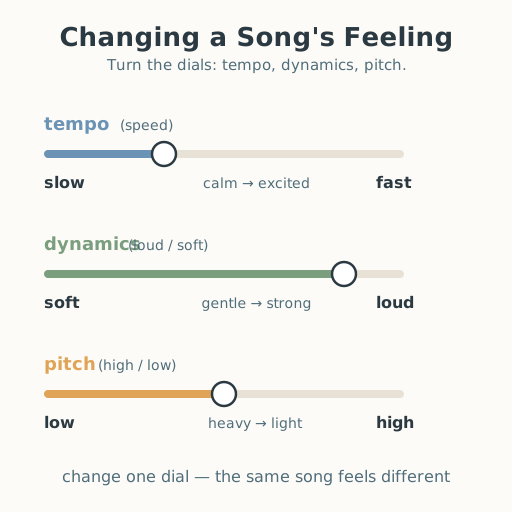
Lesson 4 — Changing a Song’s Feeling
Summary
Learners sing or speak the same short song several ways — faster, slower, louder, softer, higher, lower — and describe how each change changes the song’s feeling. They discover that the same words can be a lullaby or a march, and that tempo, dynamics, and pitch are the dials of feeling in music.
Objectives
- Describe how changing tempo, dynamics, or pitch changes the feeling of a song. (D07.S2.03.02)
Connection
Think of a lullaby and a celebration song. The lullaby is slow and soft; the celebration is fast and loud. The same words can feel completely different when you change how you sing them — how fast (tempo), how loud or soft (dynamics), and how high or low (pitch). Today you will sing one song several ways and watch its feeling change in your hands.
Materials
- Voices and hands
- A short familiar song or chant (a lullaby, greeting song, or counting chant)
Preparation
- Choose one short, familiar song or chant everyone can sing or speak.
- Be ready to lead the song at different speeds, volumes, and pitches.
Facilitator note
This lesson is written to the learner (“you”) so it works in a classroom and for a self-directed learner. Changing tempo, dynamics, and pitch and naming the feeling is a skill, so model each change one at a time — “watch: now I sing it slower… the feeling turns calm” — before learners take turns leading (Kirschner, Sweller & Clark, 2006). Use one song throughout so the only thing changing is tempo, dynamics, or pitch (this is the arts version of a fair test: change one thing, keep the rest the same). Define the three words simply: tempo is speed, dynamics is loud and soft, pitch is high and low. A learner who does not sing changes pitch by pointing high or low, dynamics by big or small movements, and tempo by tapping fast or slow — the feeling can be shown as well as sung. A learner who is Deaf or hard of hearing feels tempo as fast or slow vibration and sees dynamics as big or small gestures. Every feeling named is welcome; there is no wrong mood.
Procedure
- Gather (5 min). Sing or speak your song the usual way. How does it feel? Now get ready to change it.
- Change the tempo (10 min). Sing the song faster, then slower. Tempo is speed. How did the feeling change? Fast often feels excited or rushed; slow often feels calm or sad.
- Change the dynamics (10 min). Sing the song louder, then softer. Dynamics is loud and soft. How did the feeling change? Loud often feels strong or joyful; soft often feels gentle or secret.
- Change the pitch (10 min). Sing the song higher, then lower. Pitch is high and low. How did the feeling change? High often feels light or bright; low often feels heavy or deep.
- Share and close (5 min). Tell (or point to) one change you made and how it changed the feeling. Remember: the same song can be many songs — tempo, dynamics, and pitch are the dials of feeling, and you turn them.
Differentiation
- Support: Change one thing at a time and offer a choice (“did fast feel excited or calm?”), then change together.
- Support (non-singing): Show tempo by tapping fast or slow, dynamics by big or small arm movements, pitch by pointing high or low.
- Support (Deaf/HH): Feel tempo as fast or slow vibration and see dynamics as big or small gestures; a partner can describe the pitch.
- Extension: Invite learners to change two things at once (slow AND soft) and name the new feeling, or to lead a change for the group.
Assessment
- Formative (observation): Does the learner describe how changing tempo, dynamics, or pitch changes the feeling of the song?
- Performance: The learner sings or shows the song with one change and names the new feeling.
Resources
- No external resources required; the claims in this lesson are about the learner’s own singing and listening, which they practice directly.
Home connection
Sing a favorite song with a grown-up three ways — fast, soft, and high — and talk about how the feeling changes each time.