Lesson 05 — Levels, Speeds & Shapes
Learners make body shapes at high, middle, and low levels, move them at fast and slow speeds, and put them together into a short dance with a clear beginning, middle, and end. They discover that every body can dance, and that level, speed, and shape are a movement language.
Objectives
Objectives
- D07.S3.03.01 Perform a short dance or movement piece that uses high and low levels, speeds, and shapes.
Essential question
How do I perform a dance that uses high and low levels, speeds, and shapes?
Key vocabulary
Materials
Standard materials
- Open space to move · per group Enough room to stretch arms and move safely
- A simple beat or song (optional) · 1 A drum, clap, or recording to move to
Low-tech / no-cost
- The body alone Levels, speeds, and shapes need no equipment — only a moving body and some space
- A found object as a "sculpture" prompt A stone, leaf, or stick to copy into a body shape
Enriched / lab & device
- A scarf or ribbon per learner · 1 per learner Optional, to trace high and low lines and shapes in the air
- A recording of music with clear fast and slow parts · 1 device Optional, to move to music that changes speed
Works in different contexts
- large-group Move as one group first — everyone high, everyone low, everyone freeze — then let small groups or individuals take turns showing a level, speed, or shape
- multi-age Younger learners copy a level or shape; older learners lead a short sequence of three moves; pair them to create together
- self-directed A learner makes three shapes at three levels, moves them at two speeds, and puts them in order with a clear beginning and end
- level-grouped Some learners perform one level and one speed; others combine high, middle, and low with fast and slow; match the challenge
- outdoor-only Move like the world outside — tall as a tree (high), low as a stone (low), fast as rain, slow as a cloud — in an open space
Lesson 5 — Levels, Speeds & Shapes
Summary
Learners make body shapes at high, middle, and low levels, move them at fast and slow speeds, and put them together into a short dance with a clear beginning, middle, and end. They discover that every body can dance, and that level, speed, and shape are a movement language.
Objectives
- Perform a short dance or movement piece that uses high and low levels, speeds, and shapes. (D07.S3.03.01)
Connection
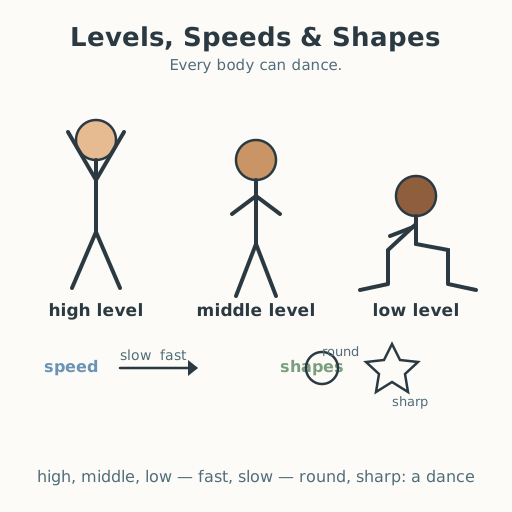
Your body can be tall as a tree (that is a high level), low as a stone (a low level), and everywhere in between. It can move fast as rain or slow as a cloud, and it can make round shapes and sharp shapes. Dancers everywhere use level, speed, and shape to speak without words. Today you will make your body speak in levels, speeds, and shapes.
Materials
- Open space to move
- A simple beat or song (optional)
Preparation
- Clear a safe space so every learner can move without bumping into anything or anyone.
- Have a simple beat ready (a drum, clapping, or a recording) if you want music.
Facilitator note
This lesson is written to the learner (“you”) so it works in a classroom and for a self-directed learner. This is movement, so the heart is safety and welcome, not perfection. Honor every body: a learner who uses a wheelchair, walker, or other aid dances with the parts that move — reaching high with arms or chin, sinking low by bending or tilting, making shapes with hands and shoulders. A seated learner dances fully. A learner with limited mobility can be the “director” who chooses the level, speed, and shape while a partner or the group moves it. There is no “best” movement; the only test is whether the body made the level, speed, or shape it meant to. Keep movements gentle and give everyone room to move at their own range. Celebrate each dancer’s choices.
Procedure
- Gather (5 min). Stand (or sit) where you have room. Reach up high — that is a high level. Sink down low — that is a low level. Stand in the middle — that is a middle level.
- Make shapes (10 min). Make a shape with your body — round like a ball, or sharp like a star. Try a shape at a high level, a middle level, and a low level. Freeze each one like a statue.
- Change speed (10 min). Move from your high shape to your low shape slowly, like honey. Now move fast, like a spark. Speed is how fast or slow you travel between shapes.
- Put it together (15 min). Make a short dance: a beginning shape (high and sharp), a middle move (slowly down to low and round), and an ending shape (low and still). Do it a few times so it feels like yours.
- Share and close (5 min). Show your dance to a friend or the group. Remember: your body speaks through level, speed, and shape — and every body’s dance belongs.
Differentiation
- Support: Offer one clear sequence (“high shape, slowly sink low, freeze”) and do it together first.
- Support (seated/adapted, wheelchair, limited mobility): Dance with the moving parts — arms high and low, chin up and down, hands and shoulders making shapes — or direct a partner who moves your chosen level, speed, and shape.
- Extension: Invite learners to make a dance with three levels and two speeds, and to teach their sequence to a partner.
Assessment
- Formative (observation): Does the learner perform a short movement piece using high and low levels, speeds, and shapes?
- Performance: The learner’s short dance, performed live.
Resources
- No external resources required; the claims in this lesson are about the learner’s own moving body, which they experience directly.
Home connection
With a grown-up, make a “level dance” at home — a high shape, a low shape, and a slow move between them — and teach it to each other.