Lesson 10 — The Gallery of Making
Learners bring the whole unit together in a gallery and celebration. They share a patterned artwork, a mood they found in a picture, a rhythm pattern, a movement retelling, or a designed build, and see that all of it is one thing — making — and that every piece has a story worth hearing.
Objectives
Objectives
- D07.S1.03.01 Use a simple pattern or repetition of shape, line, or color in an artwork.
- D07.S1.03.02 Describe the mood of an artwork and point to what in the picture creates it.
- D07.S2.03.01 Create a short rhythm pattern using long and short sounds and perform it.
- D07.S2.03.02 Describe how changing tempo, dynamics, or pitch changes the feeling of a song.
- D07.S3.03.01 Perform a short dance or movement piece that uses high and low levels, speeds, and shapes.
- D07.S3.03.02 Retell a story or feeling using only movement and gesture, and explain their choices.
- D07.S4.03.01 Follow a simple design process of imagine, plan, make, and improve to build something that meets a need.
- D07.S4.03.02 Explain how the materials available shape what can be made, using an example from their own making.
Essential question
How do pattern, sound, movement, and design all come together as making?
Key vocabulary
Materials
Standard materials
- Each learner's favorite piece from the unit · 1 per learner A patterned artwork, a mood picture, a rhythm pattern, a movement retelling, or a designed build
- A simple display space · 1 A table, wall, or cloth to lay work out like a gallery
Low-tech / no-cost
- The work itself and a circle to share in No special supplies; gather and share what was already made
- Voices, hands, and bodies Celebrate with a rhythm, a movement, and a shared song made by the body alone
Enriched / lab & device
- A camera or tablet · 1 per group Photograph the gallery and the sharing to revisit later
- A simple celebration treat · per learner A shared snack to close the unit together
Works in different contexts
- large-group Set up a whole-class gallery and take turns sharing one piece each, then close with a shared rhythm and movement that everyone joins
- multi-age Older learners act as the audience and ask one question about each piece; younger learners share and point; everyone shares something
- self-directed A learner gathers their favorite pieces, lays them out like a gallery, and tells a grown-up or recording the story of each one
- level-grouped Mix groups across levels so every learner both shares and asks a question; celebrate all four kinds of making equally
- outdoor-only Lay the unit's work — patterns, rhythm, movement, and builds — out on the ground and walk the gallery under the open sky
Lesson 10 — The Gallery of Making
Summary
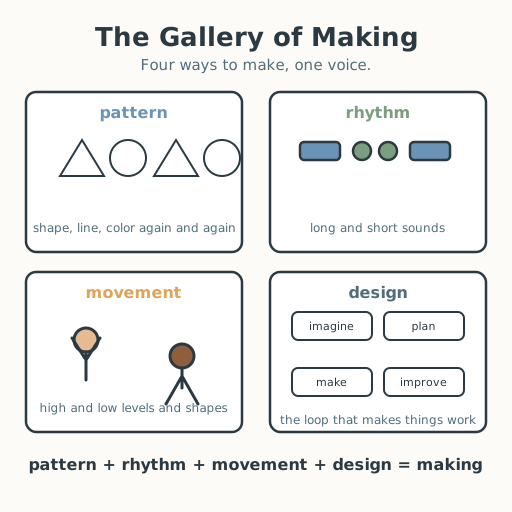
This capstone gathers everything the unit explored. Learners lay out their work like a gallery and share one thing they made — a patterned artwork, a mood they found in a picture, a rhythm pattern, a movement retelling, or a designed build. They see, all at once, that pattern, sound, movement, and design are all making — and that every piece has value and a story.
Objectives
- Use a simple pattern or repetition of shape, line, or color in an artwork. (D07.S1.03.01)
- Describe the mood of an artwork and point to what in the picture creates it. (D07.S1.03.02)
- Create a short rhythm pattern using long and short sounds and perform it. (D07.S2.03.01)
- Describe how changing tempo, dynamics, or pitch changes the feeling of a song. (D07.S2.03.02)
- Perform a short dance or movement piece that uses high and low levels, speeds, and shapes. (D07.S3.03.01)
- Retell a story or feeling using only movement and gesture, and explain their choices. (D07.S3.03.02)
- Follow a simple design process of imagine, plan, make, and improve to build something that meets a need. (D07.S4.03.01)
- Explain how the materials available shape what can be made, using an example from their own making. (D07.S4.03.02)
Connection
All through this unit, you have made things with your hands, your voice, your body, and your ideas — a pattern you drew, a mood you read in a picture, a rhythm of long and short sounds, a story told with movement, a thing you designed and improved. Today you get to look at it all together, the way a family or a village shows its work at a fair or a festival. Making is how you share who you are — and every piece you made has a story worth hearing.
Materials
- Each learner’s favorite piece from the unit
- A simple display space (table, wall, or cloth)
Preparation
- Help learners choose one favorite piece (a patterned artwork, a mood picture, a rhythm pattern, a movement retelling, or a designed build).
- Arrange a display space and a circle for sharing.
Facilitator note
This lesson is written to the learner (“you”) so it works in a classroom and for a self-directed learner. Make this a true celebration, not a contest. There are no “best” pieces — the point is that every learner shares and every learner is heard. Let learners share in whatever form suits them: talk, point, sing, move, or show. Sharing is a choice, never a duty — a learner may pass, and watching and clapping for others is full participation. Never single out a shy learner to share alone. Honor every culture’s arts as living heritage, and every learner’s work as belonging. Close by naming the unit’s big idea together: making is a voice, and every voice matters.
Procedure
- Gather (5 min). Bring your favorite thing from this unit. Look around at what everyone brought. It is a gallery of making.
- Set up the gallery (10 min). Lay out the pictures and builds. Remember the rhythm patterns and movement pieces are part of the gallery too — they live in your voice and body.
- Walk the gallery (10 min). Move quietly around and look. Find one thing that makes you curious. Ask its maker, “Tell me about this” — or point to it and smile.
- Share and celebrate (20 min). One at a time, share your piece if you want to — show your pattern, name a mood, play your rhythm, move your story, or explain your designed build and the improvement you made. You may also pass, or let a friend help you share. Everyone claps for everyone, because every piece has a story.
- Close (5 min). Remember: your hands, your voice, your body, and your ideas can all make something new. That is making, music, and movement — and it is yours forever.
Differentiation
- Support: Offer a gentle prompt to share (“show us your pattern,” or “play your rhythm for us”) and let the learner point or gesture rather than speak.
- Support (seated/adapted, non-speaking): Share from where the learner is — point, show, sign, move a hand, or have a friend help present the piece; that is full participation.
- Extension: Invite learners to name one thing they want to make next, and how they would improve it.
Assessment
- Summative (portfolio): The learner’s favorite piece, kept in the portfolio with a note of its story.
- Performance (observation): The learner shares one piece from the unit, in any form.
Resources
- No external resources required; this lesson gathers the learner’s own work from the unit.
Home connection
Make a tiny gallery at home: lay out a few things you made this unit and give a grown-up a “tour,” telling the story of each one.