Lesson 09 — Sound and Motion Together
Learners combine the rhythm pattern from earlier in the unit with a movement pattern of levels, speeds, and shapes, and perform them together as one piece. They discover that music and movement are two halves of one language, and that drummers and dancers everywhere move together.
Objectives
Objectives
- D07.S2.03.01 Create a short rhythm pattern using long and short sounds and perform it.
- D07.S3.03.01 Perform a short dance or movement piece that uses high and low levels, speeds, and shapes.
Essential question
How do I put a rhythm pattern and a movement pattern together into one piece?
Key vocabulary
Materials
Standard materials
- Voices, hands, and bodies · everyone To make rhythm and movement together
- A small set of sound makers · 1 set per pair A drum or pot, a shaker, a stick — to play the rhythm while moving
Low-tech / no-cost
- Body percussion and movement alone Clap the long-and-short pattern while moving high and low — no tools needed
- Found objects for sound Two stones or a hollow gourd to tap the rhythm while moving
Enriched / lab & device
- A drum or shaker per pair · 1 per pair To play the rhythm while one partner moves and the other sounds
- A recording device · 1 per group Optional, to record the piece and watch it back to notice how sound and motion match
Works in different contexts
- large-group Half the group plays the long-and-short rhythm while the other half moves high and low, then swap; keep the pattern short and shared
- multi-age Older learners hold the rhythm while younger learners move, then trade; everyone does both sound and motion at least once
- self-directed A learner makes a long-and-short rhythm and a high-low movement, then performs them together and checks that the sound matches the motion
- level-grouped Some learners pair one sound with one move; others pair a full rhythm pattern with a full movement sequence; match the challenge
- outdoor-only Tap a rhythm on a hollow log while moving high and low like the world outside — tall as a tree, low as a stone
Lesson 9 — Sound and Motion Together
Summary
Learners combine the rhythm pattern from earlier in the unit with a movement pattern of levels, speeds, and shapes, and perform them together as one piece. They discover that music and movement are two halves of one language, and that drummers and dancers everywhere move together.
Objectives
- Create a short rhythm pattern using long and short sounds and perform it. (D07.S2.03.01)
- Perform a short dance or movement piece that uses high and low levels, speeds, and shapes. (D07.S3.03.01)
Connection
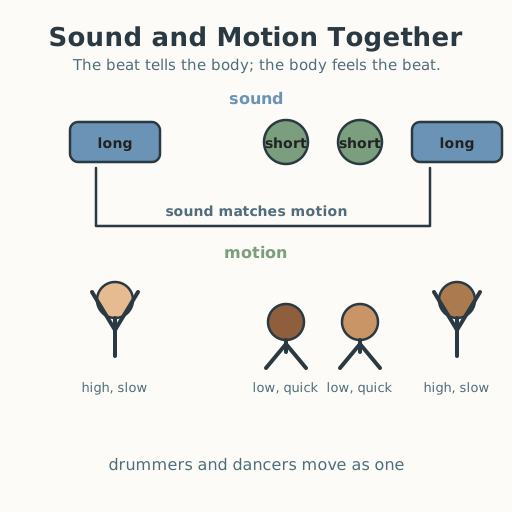
Think of a drummer and a dancer moving together — the drum’s long boom matches a slow, high reach; its short tap matches a quick, low step. Sound and motion are two halves of one language. The beat tells the body when to move, and the body tells the beat what it feels. Today you will put your long-and-short rhythm and your high-and-low movement together into one piece.
Materials
- Voices, hands, and bodies
- A small set of sound makers (a drum or pot, a shaker, a stick)
Preparation
- Have learners recall their rhythm pattern (long and short sounds) and their movement (high and low levels, speeds, shapes).
- Arrange the group so pairs have room to sound and move together.
Facilitator note
This lesson is written to the learner (“you”) so it works in a classroom and for a self-directed learner. Combining sound and motion is a skill, so model it once — “long boom, I reach high and slow; short tap, I drop low and quick” — before learners try (Kirschner, Sweller & Clark, 2006). Keep the pattern short (two to four sounds and two to four moves) so the match stays clear. Sound and motion can live in the same body (clap while moving) or split across partners (one sounds, one moves) — both are combining. A learner with limited mobility pairs sound with the movement they can make (a high hand, a low head) or directs a partner and matches the sound — directing and sounding is full participation. A learner who does not sing sounds with claps, taps, or a drum. A learner who is Deaf or hard of hearing matches movement to the feel of the beat’s vibration. Every piece belongs.
Procedure
- Gather (5 min). Warm up your rhythm: make a long sound (“ahhh” or a boom) and a short sound (“ta” or a tap). Then warm up your movement: reach high, sink low, move slow, move fast.
- Make a rhythm pattern (10 min). Put long and short sounds in a row — maybe long, short, short, long. Practice it until it comes back the same each time.
- Make a movement pattern (10 min). Put movements in a row to go with it — a slow high reach on the long, a quick low step on each short. Your movement matches your sound.
- Put them together (15 min). Perform them at the same time: sound the rhythm while you move the pattern, or let a partner sound while you move, then trade. Make the sound and the motion line up.
- Share and close (5 min). Show your piece. Remember: music and movement are two halves of one language — drummers and dancers everywhere move as one, and now you have too.
Differentiation
- Support: Pair one sound with one move (long boom = slow high reach) and do it together, then add a second pair if ready.
- Support (limited mobility, seated): Match sound with the movement you can make (a high hand, a low head), or direct a partner’s movement while you sound — directing and sounding is full participation.
- Support (non-singing): Sound with claps, taps, or a drum.
- Support (Deaf/HH): Match movement to the feel of the beat’s vibration; a partner can sound while you move.
- Extension: Invite learners to make a piece with three sound-motion pairs and to perform it with a partner, one sounding and one moving, then trading.
Assessment
- Formative (observation): Does the learner combine a long-and-short rhythm pattern with a movement pattern of levels and speeds, and perform them together?
- Performance: The learner’s sound-and-motion piece, performed live.
Resources
- No external resources required; the claims in this lesson are about the learner’s own sounding and moving, which they practice directly.
Home connection
Teach a grown-up your sound-and-motion piece — a long sound with a slow high reach, a short sound with a quick low step — and perform it together.