Lesson 01 — What My Body Needs
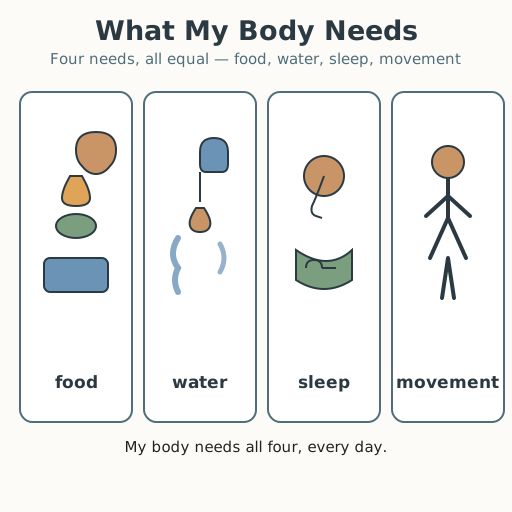
Learners open the unit by naming the four things every body needs to stay healthy — food, water, sleep, and movement — and begin to say why each matters. The four needs are shown as equals: none is a choice, and none ranks above the others. This frame will grow across the unit's later lessons.
Objectives
Objectives
- D03.S3.03.01 Describe what a body needs to stay healthy, such as food, water, sleep, and movement, and why each matters.
Essential question
What does my body need to stay healthy, and why does each need matter?
Key vocabulary
Materials
Standard materials
- Four body needs picture cards · 1 set Four cards — eating, drinking water, sleeping, moving/playing — from many places and kinds of bodies
- A large "my body needs" chart · 1 Four columns labeled food, water, sleep, and movement, to fill in across the unit
- Paper and crayons · per learner To draw one body need and why it matters
Low-tech / no-cost
- Voice and body Name the four needs aloud and act out each one; no cards or paper needed
- Four drawn circles Draw four circles on the ground and stand in the one that matches each need
Enriched / lab & device
- A "needs of living things" picture book · 1 A book showing that animals and plants also need food, water, rest, and movement
- Reusable chart paper or whiteboard · 1 For building the "my body needs" chart that the unit will keep adding to
Works in different contexts
- large-group Show each need card high, have the group act out the need together, then record ideas on the chart as a class
- self-directed A learner sorts the four cards, says why each matters, and draws their own body with its four needs
- outdoor-only Act out each need outdoors — a drink of water, running and resting — and name the need in each moment
- multi-age Older learners read the need cards and scribe on the chart while younger learners act out and match each need
- level-grouped Learners who can explain why each need matters teach it back; others match the need cards to their pictures
Lesson 1 — What My Body Needs
Summary
Learners open the unit by naming the four things every body needs to stay healthy: food, water, sleep, and movement. They begin to say why each one matters, and they start a “what my body needs” chart that the unit will keep filling in. The four needs are shown as equals — none is a choice, and none ranks above another.
Objectives
- Describe what a body needs to stay healthy, such as food, water, sleep, and movement, and why each matters. (D03.S3.03.01)
Connection
Every day, without thinking much about it, you eat food, drink water, sleep, and move. These are not extras and not treats — they are needs. A body that misses any one of them for long quickly feels bad. Today you will name your body’s four needs and why each one matters, so you can care for the body that carries you through every day.
Materials
- “Four body needs” picture cards (eating, drinking water, sleeping, moving)
- A large “my body needs” chart with four columns
- Paper and crayons
Preparation
- Prepare the four “body needs” picture cards and the four-column chart.
- Set a warm, non-judging tone: every body needs these four things, and every body is different in how and how much it needs them.
Facilitator note
This lesson is written to the learner (“you”). The four needs are equals. Do not rank them, and do not turn any of them into a rule about amounts, schedules, or body size. Food, water, sleep, and movement each matter, and different bodies need different amounts at different times — that range is normal and is never a measure of a person’s worth. This lesson retrieves Grade 2’s balanced-meal and water work (U.02.008) and opens the spiral for this unit’s deeper looks at food, water, sleep, movement, and safety. A learner who does not use a speaking voice acts out or points to each need; a learner who is blind or has low vision feels a cup, a blanket, and their own moving body to anchor each need; a learner who is deaf or hard of hearing follows the picture cards and demonstrations from the front, since every idea is shown, not only told. Some learners may not have steady access to food, water, or safe sleep at home — frame needs as what every body deserves, without making any learner feel singled out, and respond with care if a learner shares something hard. The health facts are from the World Health Organization: health is supported by adequate food, safe water, sleep, and regular physical activity.
Procedure
- Gather (5 min). Think about everything you did for your body today — you ate something, you drank something, you slept last night, and you moved. Those four things are your body’s needs.
- Meet the four needs (10 min). A need is something a body must have to stay well. Your body needs food for energy, water to work, sleep to rest and restore, and movement to stay strong. Point to each picture card as we name it.
- Why does each need matter? (15 min). Food gives your body energy to grow, play, and learn. Water keeps every part of your body working. Sleep lets your body rest, mend, and store what it learned. Movement keeps your heart, muscles, and bones strong and lifts your mood. Tell a partner one need and why it matters.
- Sort actions into needs (10 min). Which need is each action? Walking to school is movement. Eating lunch is food. Drinking water is water. Going to bed is sleep. Stand in the circle or point to the card that matches each action.
- Start your chart (5 min). On the big chart, add one thing under each need — one food you eat, one time you drink water, one bedtime habit, one way you move. We will keep adding to this chart all unit long.
- Close (5 min). Say it together: “My body needs food, water, sleep, and movement. I can give my body what it needs.”
Differentiation
- Support: Introduce one need at a time and act it out together; accept spoken, drawn, or gestured answers.
- Support (non-speaking): Point to the need cards and act out each need with the body.
- Support (blind/low-vision): Anchor each need by feel — a cup for water, a blanket for sleep, the body in motion for movement — and name the need aloud together.
- Extension: Name one more way your family meets each need at home, and add it to the chart.
Assessment
- Formative (observation): Can the learner name the four body needs and, in their own way, say why one of them matters?
- Self: The learner names the need they think about most and one way they meet it.
Home connection
With a grown-up, name the four things your body needs and point out one way your family meets each one today — food, water, sleep, and movement.
Resources
- World Health Organization, “Healthy diet” (what a body needs to stay well): https://www.who.int/news-room/fact-sheets/detail/healthy-diet
- World Health Organization, “Physical activity” (why movement matters): https://www.who.int/news-room/fact-sheets/detail/physical-activity