Lesson 02 — How Our Place Changed Over Time
Learners follow one place — a river, a market, or a school — across a long time and name what changed and what *caused* one of those changes, moving from simple then-and-now to cause-and-effect in the story of a place.
Objectives
Objectives
- D08.S1.03.02 Describe how a place or community changed over a long time, such as a river, market, or school, and what caused one of those changes.
Essential question
How did a place or community — a river, a market, or a school — change over a long time, and what caused one of those changes?
Key vocabulary
Materials
Standard materials
- "How a place changed" picture cards · 1 set Three sets of three cards each, showing a place at three times — a river (quiet crossing, a bridge, a busy port), a market (a few stalls, a growing market, a big market), a school (one room, a bigger school, a large school)
- A "then → now → why" chart · 1 per learner or pair Three columns for drawing the place long ago, the place now, and one cause of the change
- Pencils and crayons · per learner For drawing the three panels and the cause
Low-tech / no-cost
- A told and acted story The facilitator tells the story of a place changing; learners act the three times and the cause with their bodies
- Found objects A stone (before), a stick bridge (the cause), and a small crowd of pebbles (after) to show a place growing
Enriched / lab & device
- A photo set of one local place across time · 1 set Optional — real photographs of a local river, market, or school then and now
- A short video or time-lapse · 1 Optional — a gentle clip of a place growing and changing over the years
Works in different contexts
- large-group Build the three panels on a big chart together, the whole group calling out "then!", "now!", and "why!" as each card is placed
- self-directed The learner completes the then-now-why chart alone, then tells a grown-up or peer one change and its cause
- outdoor-only Visit a real local place — a river, a market, a school — and notice one thing that changed and one reason why, saying it aloud
- multi-age Older learners read the labels and scribe the cause, while younger learners place the cards and act the three times
- level-grouped Learners who grasp cause quickly coach peers by asking "what was it like before? what changed it?" rather than telling
Lesson 2 — How Our Place Changed Over Time
Summary
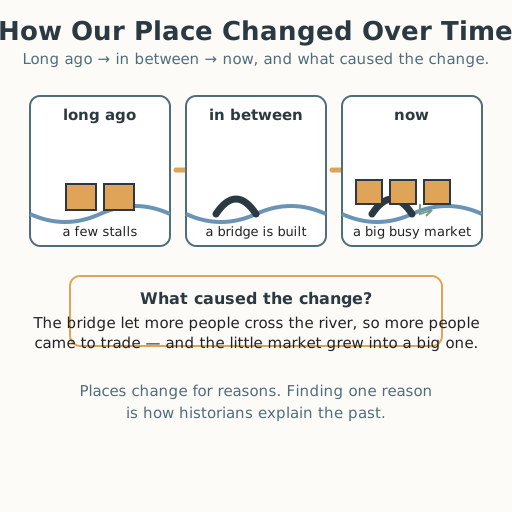
Learners follow one place — a river, a market, or a school — across a long time, and name both what changed and what caused one of those changes. Grade 2 noticed that things change and stay the same; Grade 3 asks the next, harder question: why? The answer is a cause — a bridge being built, a road arriving, more people coming to trade — and finding one cause is how historians explain the past.
Objectives
- Describe how a place or community changed over a long time, such as a river, market, or school, and what caused one of those changes. (D08.S1.03.02)
Connection
Think of a place you know well — a river, a market, a road, or your school. It was not always the way it is now. Once the river had no bridge; once the market was only a few stalls; once the school was one small room. Something made it change — a bridge was built, a road arrived, more people came. Noticing the change is the first step; finding the cause is the second. That is how the story of any place is told.
Materials
- “How a place changed” picture cards (river, market, school — three times each)
- A “then → now → why” chart
- Pencils and crayons
Preparation
- Prepare the three picture sets. River: a quiet crossing, a bridge being built, a busy port. Market: a few stalls, a growing market, a big market. School: one room, a bigger school, a large school.
- Prepare the “then → now → why” chart, and be ready to model the cause aloud: “The bridge was built, so more people could cross, so the little market grew.”
Facilitator note
This lesson is written to the learner (“you”). Cause-and-effect is a new and harder skill, so model it step-by-step before independent work (Kirschner, Sweller & Clark, 2006): hold up the three river cards, and think aloud — “Long ago, a quiet crossing. Then, a bridge was built. Now, a busy port. The cause of the change was the bridge: it let more people and goods cross, so the place grew.” Then guide the same move for the market or school before learners choose their own. Keep causes real, gentle, and non-judgmental: do not say the old way was worse. A quiet crossing, a few stalls, or a one-room school are not “backward” — they are earlier chapters of the same story, and many places still live in those chapters today. Many great cities and markets grew at river crossings and ports (see Resources); use this as a true, global pattern, not a story of one region. Honor every body: describe the cards in words for a learner who cannot see them; a learner who does not use a speaking voice points or acts the three times and the cause. A learner’s own place may be the best example of all — invite, never require, its telling.
Procedure
- Gather (5 min). Think of a place you know. What is one way it is different from how it was long ago? What do you think made it change?
- Meet “change” and “cause” (10 min). Change is the difference between then and now. A cause is the reason for the change. Look at the river: long ago, a quiet crossing; then, a bridge was built; now, a busy port. Say it together: “The cause was the bridge — it let more people cross, so the place grew.”
- Guided practice (10 min). Take the market cards. Together, place them in order, then name the change and the cause: “The market grew because a road brought more people to buy and sell.”
- Choose your own place (15 min). Pick a river, a market, or a school. On your chart, draw it then, draw it now, and write or tell one cause of the change.
- Share (5 min). Tell a partner: “Long ago it was… now it is… one cause was…” Point, act, draw, or sign.
- Close (5 min). Places change for reasons. Finding a cause — and telling it — is how we explain the past, not just remember it.
Differentiation
- Support: Use just one place (the river) and one change and cause, with heavy picture support.
- Support (blind/low-vision): Hear the three times described clearly and name the cause aloud; feel objects (a stone, a stick bridge, pebbles) to mark before, cause, and after.
- Support (non-speaking): Place the three cards in order and point to the “why” spot, or act the change and the cause.
- Support (Deaf/HH): The picture cards are visual — order them and sign “then,” “now,” and “cause” as you go.
- Support (motor-difference): Use larger cards and a stable chart; direct a partner to place each card while you point, sign, or eye-gaze.
- Extension: Name two causes for one change, and tell which one you think mattered more and why.
Assessment
- Formative (observation): Can the learner describe one place at two times and name at least one change?
- Formative (oral/performance): Does the learner name a cause — a reason the change happened — in their own words, without calling the old way worse?
Home connection
Ask someone at home how one place in your area has changed over the years, and what made it change. Tell them one change and one cause you found.
Resources
- Our World in Data, “Urbanization” — documents the long, global growth of towns and cities, many of which began and grew at river crossings, ports, and trade routes, supporting the idea that a crossing or port can cause a place to grow. https://ourworldindata.org/urbanization