Lesson 04 — Stories, Songs, and Art That Show What People Value
Learners meet a story, a song, and an art form from different cultures — kente cloth of the Akan, a Dreaming story and dot painting of Aboriginal Australia, and a song — and explain what each shows about what that culture values, honoring every culture's treasures as living and real.
Objectives
Objectives
- D08.S2.03.02 Describe a story, song, or art form from a culture and explain what it shows about what that culture values.
Essential question
What does a story, song, or art form from a culture show about what that culture values?
Key vocabulary
Materials
Standard materials
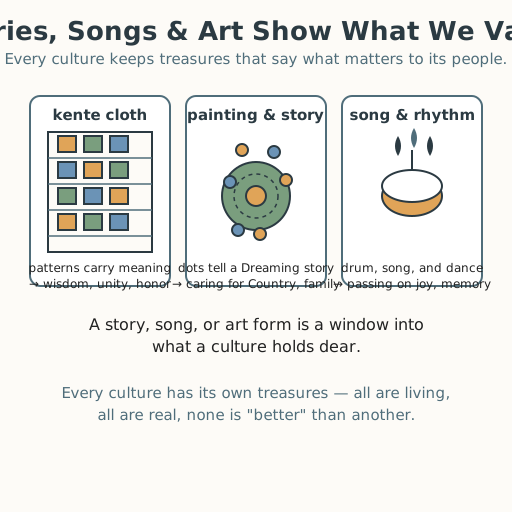
- Picture cards of three cultural treasures · 1 set Kente cloth with its patterns (wisdom, unity, honor), a dot painting that tells a Dreaming story (caring for Country and family), and a drum with song notes (joy and memory passed on)
- Paper and crayons · per learner For drawing one treasure and writing one sentence about what it shows the culture values
Low-tech / no-cost
- Told stories and acting The facilitator tells a short story or sings a short song; learners act the value it carries (caring, sharing, honoring elders)
- Body and voice Clap a rhythm and move to a beat, then name the value a song or dance carries
Enriched / lab & device
- A picture book or audio of stories, songs, and art from several cultures · 1 To meet more treasures — a kente weaving video, a Dreaming story, a lullaby or griot song
- A short music or art clip · 1 Optional — a gentle audio or video of a song or dance from another culture
Works in different contexts
- large-group Read one story aloud, show the art cards, and sing or clap one rhythm together; the group names the value each treasure carries
- self-directed The learner studies the cards, chooses one treasure, and writes or draws one sentence about the value it shows, then shares with a grown-up or peer
- outdoor-only Make a simple pattern with found objects (stones, leaves) and talk about how patterns and stories carry meaning for a people
- multi-age Older learners read the stories and scribe the "value" sentence, while younger learners draw the treasure and act the value
- level-grouped Learners who finish early coach peers by asking "what does this pattern or story say? what do the people care about?" rather than telling
Lesson 4 — Stories, Songs, and Art That Show What People Value
Summary
Learners meet a story, a song, and an art form from different cultures and explain what each shows about what that culture values. They meet kente cloth of the Akan peoples of Ghana, whose patterns carry meanings like wisdom and unity; a Dreaming story and dot painting of Aboriginal Australia, which carry the value of caring for Country and family; and a song — a treasure that passes on joy and memory. Every culture keeps treasures like these, and all are living and real.
Objectives
- Describe a story, song, or art form from a culture and explain what it shows about what that culture values. (D08.S2.03.02)
Connection
Think of something your family or people keeps — a song, a recipe, a way of making something. It is not just a thing; it carries a meaning, something your people care about. Every culture has such treasures: a woven cloth whose patterns mean wisdom, a painting whose dots tell a story of caring for the land, a song that passes joy from elder to child. Looking closely at a treasure — and naming what it says its people value — is how we come to know and respect one another.
Materials
- Picture cards of three cultural treasures (kente cloth, a dot painting, a drum and song notes)
- Paper and crayons
Preparation
- Prepare the cards and short tellings. Kente cloth (Akan peoples, Ghana): the colors and patterns each carry a meaning; kente is worn at important moments and is held as a treasure of wisdom, unity, and honor. Dreaming story and dot painting (Aboriginal Australia): art and story pass on the value of caring for Country and for family and kinship. A song: songs pass on joy, memory, and belonging. (See Resources.)
- Be ready to clap a simple rhythm or hum a short tune as the “song” example.
Facilitator note
This lesson is written to the learner (“you”). Honor every treasure as living, not “folk art” or “ancient.” Kente is woven today; Aboriginal artists paint today; songs are sung today. Never call any of it “simple” or “primitive” — each is deep, careful knowledge passed from one generation to the next. The skill is reading meaning: the lesson’s job is to move from “this is pretty” to “this shows what a people care about” — a pattern that means wisdom, a story that teaches caring for the land, a song that keeps memory alive. Model one full example first (Kirschner, Sweller & Clark, 2006): “Kente’s patterns are not random; each one has a name and a meaning, like wisdom or unity. So kente shows that its people value wisdom and togetherness.” Then guide the second treasure. Use accurate names and hedges (see Resources): say “the Akan peoples of Ghana,” “Aboriginal peoples of Australia,” and note that there are many Aboriginal nations, each with its own stories and art. Honor every body: describe the cards in words for a learner who cannot see them; a learner who does not use a speaking voice points or acts the value. A learner may also name a treasure from their own culture — every culture’s treasures belong in this lesson.
Procedure
- Gather (5 min). Think of a song, story, or thing your family keeps. What do you think it says about what your family cares about?
- Meet a treasure: kente cloth (15 min). Look at the woven cloth. Its patterns are not random — each one has a name and a meaning: wisdom, unity, honor. People wear kente at important times to carry those meanings with them. So kente shows that its people value wisdom and togetherness.
- Meet a second treasure: a Dreaming story and dot painting (10 min). The dots tell a story — of how the land was shaped and of the people’s duty to care for Country and for family. So the painting and story show that this culture values caring for the land and for one another.
- Meet a third treasure: a song (10 min). Listen or clap a rhythm. Songs pass on joy, memory, and belonging from elder to child. A song shows a culture values remembering and belonging together.
- Draw and tell (10 min). Choose one treasure. Draw it and write or tell one sentence: “This shows that the culture values…” You may choose a treasure from your own culture too.
- Close (5 min). A story, a song, an art form — each is a window into what a people hold dear. Every culture’s treasures are real, and all are worthy of respect.
Differentiation
- Support: Meet only kente, and finish one sentence together — “Kente shows its people value…” — with picture support.
- Support (blind/low-vision): Feel a woven sample or a raised dot pattern, hear the story and song clearly, and describe the value aloud.
- Support (non-speaking): Point to the treasure and to a “value” picture (a heart, a circle of people, a tree) instead of speaking.
- Support (Deaf/HH): The cards are visual — read the patterns with your eyes, and sign “value,” “story,” “song,” and “art” as you go.
- Support (motor-difference): Direct a partner to point to the treasure and the value while you sign or eye-gaze.
- Extension: Name a second treasure — from another culture or your own — and tell one value it shows, and who taught it to whom.
Assessment
- Formative (observation): Can the learner name one story, song, or art form and the culture it comes from?
- Formative (oral/performance): Does the learner explain, in a finished sentence, one value the treasure shows about its culture — without calling any culture’s treasure better or simpler?
Resources
- Smithsonian National Museum of African Art, “Kente cloth” — describes kente cloth of the Akan peoples of Ghana and Côte d’Ivoire, noting that its patterns and colors carry meanings and that it is worn on important occasions. https://africa.si.edu/
- AIATSIS (Australian Institute of Aboriginal and Torres Strait Islander Studies) — notes that Aboriginal and Torres Strait Islander art carries knowledge, law, and stories, including the value of caring for Country, and that there are many distinct nations, each with its own traditions. https://aiatsis.gov.au/
Home connection
Ask someone at home about a song, story, or thing your family keeps. What does it mean, and what does it show your family values? Who taught it to whom?