Lesson 05 — Why People Move
Learners name the reasons people move from one place to another — family, work, safety, and environment — and tell one story that shows a move and its reason, honoring every move as a real part of the human story, never a problem.
Objectives
Objectives
- D08.S3.03.01 Describe reasons people move from one place to another, such as family, work, safety, or environment, using a story or example.
Essential question
What reasons make people move from one place to another — family, work, safety, or environment — and what is one story that shows it?
Key vocabulary
Materials
Standard materials
- "Why people move" picture cards · 1 set Four reason cards (family, work, safety, environment) plus a short "a family's move" story in pictures (a dry season, packing, a journey, a new home)
- A "reasons to move" four-part chart · 1 per learner or pair Four spaces for family, work, safety, environment, with room to draw or write one example of each
- Pencils and crayons · per learner For drawing the reasons and the story
Low-tech / no-cost
- A told and acted story The facilitator tells the story of one family's move; learners act packing, walking, and arriving, and name the reason
- Body and voice Act out each reason — holding hands (family), carrying a tool (work), sheltering under an arm (safety), looking at the sky (environment)
Enriched / lab & device
- A short video or photo set of people moving · 1 Optional — a gentle clip or photos of a family moving for work, family, or a changing environment
- A map or globe · 1 To trace a move from one place to another
Works in different contexts
- large-group Sort the reason cards together on a big chart, the whole group calling out the reason for each story beat
- self-directed The learner sorts the reason cards and draws or writes one "why people move" story, then shares with a grown-up or peer
- outdoor-only Walk a short "journey" outside — from a dry spot to a place with shade and water — and name the reason people move (environment)
- multi-age Older learners read the story and scribe the reasons, while younger learners act the journey and place the cards
- level-grouped Learners who finish early coach peers by asking "why did they move? which reason is that?" rather than telling
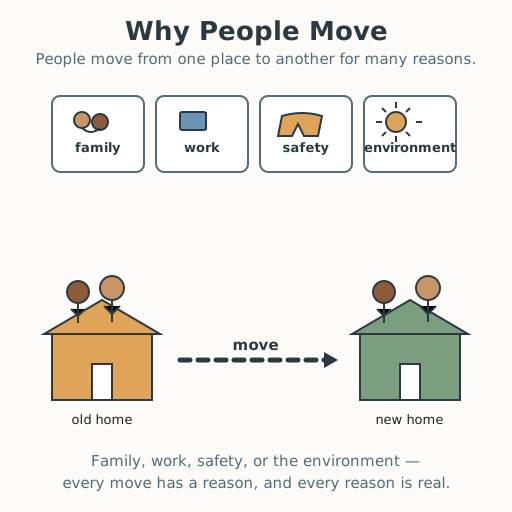
Lesson 5 — Why People Move
Summary
Learners name the reasons people move from one place to another — family, work, safety, and environment — and tell one story that shows a move and its reason. Grade 2 told a story of moving and drew a place; Grade 3 names the reasons behind the moving, holding every move as a real, worthy part of the long human story — people have always moved, and moving is never a failure.
Objectives
- Describe reasons people move from one place to another, such as family, work, safety, or environment, using a story or example. (D08.S3.03.01)
Connection
People have always moved. A family moves to be near relatives. A parent moves for a new job. A family moves to be safe from a flood or a fire. A herding family moves with the seasons, following grass and water. Each move has a reason, and each reason is real. Naming the reason — family, work, safety, or environment — is how we understand the human story of moving, from long ago to today.
Materials
- “Why people move” picture cards (four reason cards plus a “a family’s move” story)
- A “reasons to move” four-part chart
- Pencils and crayons
Preparation
- Prepare the four reason cards: family (joining relatives), work (a new job or seasonal work), safety (leaving a place that became unsafe), environment (drought, flood, or following pasture and water).
- Prepare a gentle story in pictures: a dry season arrives, a herding family packs, they journey, and they find a new home with grass and water — a move for environment, told warmly and blame-free.
- Prepare the four-part chart.
Facilitator note
This lesson is written to the learner (“you”). Hold every move with dignity, never pity. Moving is one of the oldest and most ordinary things people do — for family, work, safety, or the environment (see Resources). Many families in the room may have moved, or have relatives who moved; frame moving as a normal, strong thing people do, not as loss or lack. Keep the safety example gentle and age-appropriate: “a place became unsafe — a flood, a fire, a danger — so the family moved to be safe.” Do not dwell on frightening detail; the lesson’s power is in naming reasons and honoring journeys. Model one full example first (Kirschner, Sweller & Clark, 2006): tell the herding-family story and think aloud — “The grass dried up and the water shrank, so they moved to where the grass and water were. The reason was the environment.” Then guide the other three reasons. Distinguish evidence from values: that people move for these reasons is a factual, cross-cultural claim (see Resources); that moving is worthy of respect is a value we hold together. Honor every body: describe the cards in words for a learner who cannot see them; a learner who does not use a speaking voice points or acts. A learner may tell their own family’s move — invite, never require.
Procedure
- Gather (5 min). Think of a time you or someone you know moved, or imagine moving. What might make a family pack up and go to a new place?
- Meet the four reasons (10 min). Say them together:
- Family — to be near relatives.
- Work — a new job, or seasonal work.
- Safety — a place became unsafe, so the family moved to be safe.
- Environment — drought, flood, or following grass and water.
- Hear one story (10 min). Listen to the story of a herding family. The dry season came, the grass dried, and the water shrank. So they packed and journeyed to a place with grass and water, and made a new home there. Which reason is this? Environment.
- Sort the reasons (15 min). Take the reason cards. For each, tell a short example: “A family moved to live near a grandmother — that is family.” Draw or write one example of each reason on your chart.
- Tell your own story (10 min). Make up or retell a short “why people move” story — yours, a friend’s, or an imagined one. Name the reason. You may speak, act, draw, or sign.
- Close (5 min). Moving is one of the oldest things people do. Every move has a reason, and every reason is real.
Differentiation
- Support: Meet only two reasons (family and environment) with heavy picture support, and tell one short story together.
- Support (blind/low-vision): Hear the story told clearly and name the reason aloud; act out packing and arriving.
- Support (non-speaking): Sort the reason cards and point to the reason for each story beat instead of speaking.
- Support (Deaf/HH): The cards are visual — read them and sign “family,” “work,” “safety,” and “environment” as you place each one.
- Support (motor-difference): Use larger cards and a stable chart; direct a partner to place each card while you point, sign, or eye-gaze.
- Extension: Tell a story with two reasons for one move (work and family), and say which reason you think came first.
Assessment
- Formative (observation): Can the learner name at least three of the four reasons people move?
- Formative (portfolio/oral): Does the learner tell or draw one story of a move and name its reason, in their own words, with dignity and without pity?
Home connection
Ask someone at home if your family — or a family they know — ever moved, and why. Tell them which of the four reasons it was: family, work, safety, or environment.
Resources
- International Organization for Migration (IOM), “Who is a migrant?” — notes that people move for reasons including family, work, safety, and the environment, and that migration has been part of human life throughout history. https://www.iom.int/who-migrant-0