Lesson 04 — Left Out: Making It More Fair
Learners practice **noticing** when someone is left out or treated unequally and **changing** the situation to make it more fair — inviting them in, adding support, or changing a rule. Fairness is something we can *do*, not just notice.
Objectives
Objectives
- D09.S2.03.02 Identify a situation where someone was left out or treated unequally and describe how to make it more fair.
Essential question
When someone is left out or treated unequally, how can we make it more fair?
Key vocabulary
Materials
Standard materials
- Left out picture cards · 1 set Pictures of someone left out or treated unequally — a child not invited to a game, a sign in only one language, a table too high for a wheelchair, a child always going last
- Crayons and paper · per learner
Low-tech / no-cost
- Voice and body Act out each "left out" situation and its fix; no cards needed
- A drawn "notice then change" arrow Draw an arrow from a "left out" scene to a "more fair" scene on paper or the ground
Enriched / lab & device
- Laminated "left out" cards · 1 set per pair Durable cards for repeated matching of a "left out" situation to a "more fair" change
- A story or video showing someone being included after being left out · 1 Optional, for a group to watch and name the change that made it fair
Works in different contexts
- large-group Hold each card up large; the group names who is left out and why, then one learner proposes the change that makes it more fair
- self-directed The learner names who is left out in each card and tells or writes how to make it more fair
- outdoor-only Find a real "left out" spot outdoors (a game some cannot reach, a path some cannot use) and propose the change that makes it more fair
- multi-age Older learners model "notice who is left out, then change the situation"; younger learners try with their own example
- level-grouped Learners who need more support use two clear cards (not invited, always last); learners ready for more propose two different changes and compare which is fairer
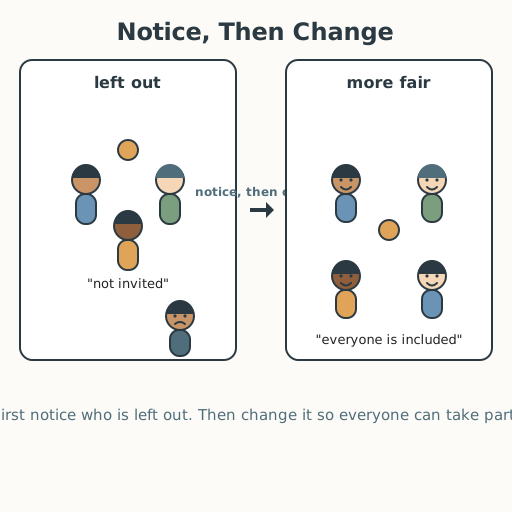
Lesson 4 — Left Out: Making It More Fair
Summary
Learners practice the two-step move at the heart of fairness: notice when someone is left out or treated unequally, then change the situation to make it more fair — invite them in, add a support, or change a rule. Fairness is something we can do, not only something we can name.
Objectives
- Identify a situation where someone was left out or treated unequally and describe how to make it more fair. (D09.S2.03.02)
Connection
Think of a game where three children play and a fourth stands at the edge, not invited — or a sign written in only one language that some families cannot read, or a table too high for a friend who uses a wheelchair. Someone is left out or treated unequally. The first step is to notice; the second is to change it: invite the fourth child in, write the sign in more than one language, lower the table or add a ramp. People everywhere do this — a village widens a path, a class adds a seat, a family teaches a game to the youngest. Today you will practice noticing and then making it more fair.
Materials
- “Left out” picture cards (a child not invited to a game, a sign in only one language, a table too high for a wheelchair, a child always going last)
- Crayons and paper
Preparation
- Prepare the “left out” picture cards.
- Arrange a circle for acting out and sharing.
Facilitator note
Written to the learner (“you”). This lesson teaches inclusion as an act: fairness is not only seeing inequality but doing something to change it. Keep examples gentle, everyday, and blame-free — the point is never to shame anyone but to notice systems and situations (“a sign in one language,” “a table too high”) as well as choices (“not invited”). Include ability naturally: a ramp, a lowered table, a translated sign are just ordinary ways everyone takes part, not “special” cases. This is an egalitarian, global claim: everywhere, people who are left out can be brought in by a change we can describe and make. Connect any gap to agency and hope (“we can change this”), not fear. A learner who does not speak aloud points to who is left out and to the change; a learner who is deaf or hard of hearing follows each card through sign and picture; a learner who is blind or low-vision hears each situation described and names the change aloud; a learner with a motor difference can direct a partner to act the change. A learner may always pass. The goal is the learner’s own description — “this person was left out because…, and it would be more fair if…” — not a memorized phrase.
Procedure
- Gather (5 min). Think of a time you saw someone left out — at a game, a meal, a task. Did anyone notice? Did anything change?
- Meet “notice, then change” (10 min). Being left out or treated unequally means someone does not get to take part the way others do. Making it more fair has two steps: notice who is left out and why, then change the situation so they can join.
- Notice and change (15 min). Pick a card. Name who is left out and why. Then name one change that makes it more fair (say, sign, point, or act it). Wonder together: could there be more than one fair change?
- Draw your own change (10 min). Draw or write a “left out” moment you have seen or imagined, then the change that made (or would make) it more fair. If drawing is not your way, act it out, build it with found objects, or have a partner scribe while you direct.
- Close (5 min). Fairness has two steps: notice who is left out, then change it so everyone can take part. You can do both.
Differentiation
- Support: Use two clear cards and model “this person was left out because…, and it would be fair if…”; a non-speaking learner points to the change; a learner with limited movement directs a partner.
- Extension: Invite learners to propose two different changes for the same “left out” situation and wonder which is fairer and why.
Assessment
- Formative (observation): Can the learner identify a situation where someone was left out or treated unequally and describe how to make it more fair?
- Artifact (portfolio): The learner’s “notice, then change” drawing (or a built, acted, or partner-scribed version).
Home connection
At home or in your neighborhood, notice one place where someone could be left out (a step, a game, a sign). Wonder with a grown-up: what one change would make it more fair?
Resources
- UNICEF, “Inclusive education” (removing barriers so every child can take part): https://www.unicef.org/education/inclusive-education
- The “notice, then change” move is the everyday form of what adults call equity; see the equality-vs-equity discussion in the United Nations materials on children’s rights.