Lesson 05 — Rules That Keep Us Safe and Fair
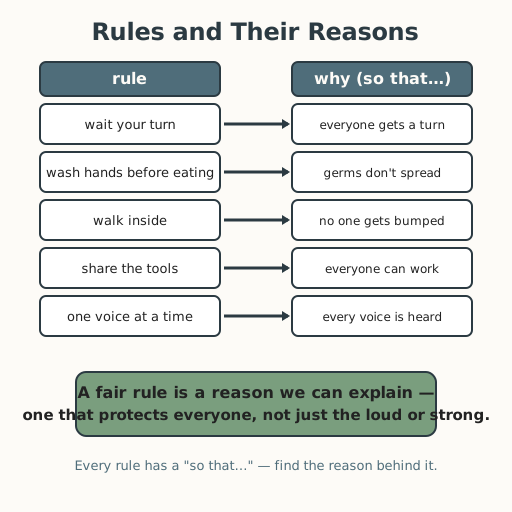
Learners explain how rules keep a group **safe** and **fair** — a rule is not just an order but a *reason in shared form*: wait your turn so everyone gets one, wash hands so germs don't spread, one voice at a time so everyone is heard. Rules protect everyone, not just the powerful.
Objectives
Objectives
- D09.S3.03.01 Explain how rules keep a group safe and fair and propose a rule for a shared space with a reason.
Essential question
How do rules keep a group safe and fair?
Key vocabulary
Materials
Standard materials
- Rule picture cards · 1 set Pictures of everyday rules — wait your turn, wash hands before eating, walk (not run) inside, share the tools, one voice at a time — each with its safety or fairness reason
- A "rule and its reason" chart · 1 A two-column sheet or poster to match each rule to the safety or fairness reason behind it
- Crayons and paper · per learner
Low-tech / no-cost
- Voice and body Act out each rule and the reason behind it; no cards or chart needed
- A drawn "rule → reason" arrow Draw an arrow from each rule to the safety or fairness reason it serves, on paper or the ground
Enriched / lab & device
- Laminated rule cards and a "safe / fair" sort board · 1 set per pair Durable cards for matching each rule to whether it keeps the group safe, fair, or both
- A visit or story about a shared space's rules (a library, a pool, a garden) · 1 Optional, to see real rules and their reasons in a working shared space
Works in different contexts
- large-group Hold each rule card up large; the group says what the rule is for — safety, fairness, or both — and acts it out
- self-directed The learner matches each rule to its reason and tells or writes how the rule keeps the group safe or fair
- outdoor-only Find a real shared space outdoors (a path, a water pump, a play area) and name a rule that keeps it safe or fair, with its reason
- multi-age Older learners ask "what would happen without this rule?" while younger learners act out each rule
- level-grouped Learners who need more support sort rules into "keeps us safe" or "keeps us fair"; learners ready for more also name the reason behind each rule
Lesson 5 — Rules That Keep Us Safe and Fair
Summary
Learners explain how rules keep a group safe and fair. A rule is not just an order to obey; it is a reason in shared form — wait your turn so everyone gets one, wash hands so germs don’t spread, walk inside so no one gets bumped, one voice at a time so everyone is heard. Rules protect everyone, not only the loud or the strong.
Objectives
- Explain how rules keep a group safe and fair and propose a rule for a shared space with a reason. (D09.S3.03.01) — this lesson focuses on explaining how rules keep a group safe and fair; Lesson 6 focuses on proposing a rule.
Connection
Think of a place where people share one thing — a water pump, a ball, a path, a classroom floor. Without rules, it becomes a scramble: the fastest gets the water, the loudest gets heard, someone gets bumped. A rule changes that: wait your turn, one voice at a time, walk inside. Every rule has a reason — a “so that…” — and that reason is what makes it fair instead of just bossy. People everywhere make rules this way: a fishing crew agrees who hauls when, a market sets where stalls may stand, a class agrees how to share the crayons. Today you will find the reason behind each rule.
Materials
- Rule picture cards (wait your turn, wash hands before eating, walk inside, share the tools, one voice at a time)
- A “rule and its reason” chart
- Crayons and paper
Preparation
- Prepare the rule cards, each with its reason on the back or a matching card.
- Prepare the “rule → reason” chart; arrange a circle.
Facilitator note
Written to the learner (“you”). This lesson reframes rules as shared reasons, not commands from above — a key egalitarian move. A rule is fair when it protects everyone and its reason can be explained to anyone. Do not present rules as obedience (“because I said so”); invite learners to find the “so that…” behind each one, and hold open the question of whether a rule that cannot give a reason is really fair. Keep examples safe, everyday, and global — rules appear in every community, and everywhere a good rule has a reason. A learner who does not speak aloud matches a rule to its reason by pointing or signing; a learner who is deaf or hard of hearing follows each rule through sign and picture; a learner who is blind or low-vision hears each rule and reason described and pairs them aloud; a learner with a motor difference can direct a partner to match the cards. A learner may always pass. The goal is the learner’s own explanation — “this rule keeps us safe/fair because…” — not a memorized list.
Procedure
- Gather (5 min). Think of a rule you follow every day — at home, in class, on a road. Why do you think it is there?
- Meet “a rule is a reason in shared form” (10 min). A rule tells everyone in a group what to do, so the group can be safe (no one is hurt) and fair (everyone gets a chance). Every good rule has a reason — a “so that…” we can explain.
- Match rule to reason (15 min). Pick a rule card. Say what it is for: safety, fairness, or both — and finish the reason: “…so that…” (say, sign, point, or act it). Wonder together: what would happen without this rule?
- Trace a rule’s reason (10 min). Draw or write one rule from your own life and an arrow to its reason. Tell a partner what the rule is for. If drawing is not your way, act out the rule and its reason, or have a partner scribe while you direct.
- Close (5 min). Rules are not just orders. They are reasons we share — so a group can be safe and fair for everyone.
Differentiation
- Support: Use two rules and model “this rule is so that…”; a non-speaking learner points to the reason; a learner with limited movement directs a partner.
- Extension: Invite learners to find a rule in the room whose reason is hard to explain and wonder: is it still a fair rule? Why or why not?
Assessment
- Formative (observation): Can the learner explain how a rule keeps a group safe and fair, with a reason?
- Performance: The learner’s “rule → reason” match and explanation, shared aloud.
Home connection
At home, ask a grown-up the reason behind one family rule. Wonder together whether the reason keeps everyone safe and fair — and whether any rule could be improved.
Resources
- CASEL SEL Framework (responsible decision-making and relationship skills): https://casel.org/fundamentals-of-sel/
- The idea that fair rules are those whose reasons can be explained to everyone is a plain-language form of the “public reason” idea in civic thought, adapted for children.