Lesson 08 — Calm Down and Talk It Through
Learners practice a simple step-by-step way to calm down and talk through a conflict without hurting anyone: stop and breathe, name the feeling, say what you need, listen to the other, and find a fair solve. This is the unit's core peace skill, taught as guided practice.
Objectives
Objectives
- D09.S4.03.01 Use a simple step-by-step way to calm down and talk through a conflict without hurting anyone.
Essential question
How do I calm down and talk through a conflict, step by step, without hurting anyone?
Key vocabulary
Materials
Standard materials
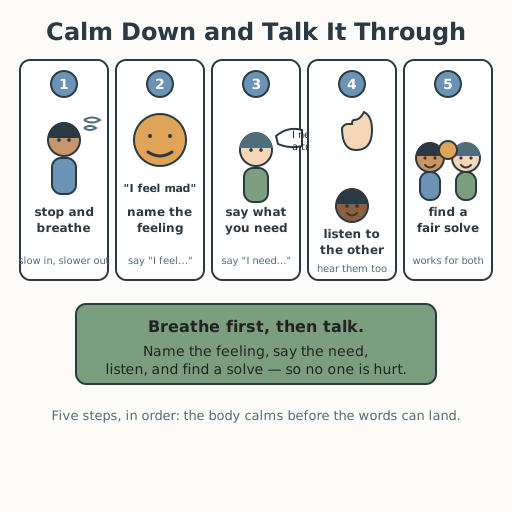
- A "calm down and talk" step strip · 1 Steps — stop and breathe, name the feeling, say what you need, listen to the other, find a fair solve — each with a simple icon
- Two puppets or soft toys · 2 For acting out the step-by-step path through a small conflict
- Crayons and paper · per learner
Low-tech / no-cost
- Voice and body Act out each step with breath and words; no strip or toys needed
- A drawn step strip Draw the steps on paper or the ground and walk through them with a partner
- Found objects A stone or leaf to hold while breathing, as a calm anchor
Enriched / lab & device
- Laminated "calm down and talk" cards · 1 set per pair Durable reminder cards for the classroom peace corner
- A short audio of a guided calm-down breath · 1 Optional, for a learner to practice the calm step alone
Works in different contexts
- large-group Model the full step-by-step path with two volunteers while the group names each step, then rehearse in pairs
- self-directed The learner works through the steps alone with the strip, breathing and talking through a small acted conflict
- outdoor-only Use a real small conflict outdoors (a shared swing or spot) and walk the steps right there, using the air and ground to calm down
- multi-age Older learners model the calm-down breath and the "I feel… I need…" words; younger learners try one step at a time
- level-grouped Learners who need more support practice just the first two steps (stop and breathe, name the feeling); learners ready for more walk all five steps
Lesson 8 — Calm Down and Talk It Through
Summary
Learners practice a simple step-by-step way to calm down and talk through a conflict without hurting anyone: stop and breathe, name the feeling, say what you need, listen to the other, and find a fair solve. This is the unit’s core peace skill, taught as guided practice — the learner has seen each piece, and now walks the whole path.
Objectives
- Use a simple step-by-step way to calm down and talk through a conflict without hurting anyone. (D09.S4.03.01)
Connection
Think of a time your body got hot and your voice got loud in a conflict — you wanted to grab, yell, or cry. In that moment, words alone don’t work; the body has to calm down first. There is a simple path that works everywhere: stop and breathe, name the feeling, say what you need, listen to the other person, and find a fair solve. People everywhere do some form of this — a deep breath before answering, two neighbors talking it out instead of shouting, friends saying “I felt… I need…” until they find a way. Today you will practice the whole path, step by step.
Materials
- A “calm down and talk” step strip (stop and breathe, name the feeling, say what you need, listen to the other, find a fair solve)
- Two puppets or soft toys
- Crayons and paper
Preparation
- Prepare the five-step strip, each step with a simple icon.
- Set up a small space for acting out; have the calm anchor (a stone or leaf) ready.
Facilitator note
Written to the learner (“you”). This lesson teaches self-regulation + conflict talk as one skill, not two. The order matters and is the point: the body must calm before the words can land, so Step 1 is always stop and breathe — never “just calm down” as a scolding, but a real, practiced breath (slow in through the nose, slower out through the mouth). Breathing is one way, not the only way: any slow calm that works counts — pressing feet to the floor, holding the calm anchor, or counting slowly — so a learner with breathing, sensory, or trauma-related difficulty never has to force a breath. Model the full five steps as a worked example, then let learners rehearse in pairs with a small, invented, blame-free conflict. The “I feel… I need…” words carry the blame-free move from Grade 2 forward — no one is “bad”; each side names a feeling and a need, and the pair finds a solve that works for both. A learner who does not speak aloud points to each step on the strip or signs; a learner who is deaf or hard of hearing follows the steps through sign and the strip; a learner who is blind or low-vision hears each step described and names what comes next; a learner with a motor difference can direct a partner or hold the calm anchor. A learner may always pass. The aim is that every learner can say, in their own way, “I can calm down and talk it through.”
Procedure
- Gather (5 min). Think of a conflict where your body got hot first. What did you do — and what could you have done instead?
- Meet the five steps (10 min). Learn the path: (1) stop and breathe — slow in, slower out; (2) name the feeling — “I feel…”; (3) say what you need — “I need…”; (4) listen to the other — hear their feeling and need; (5) find a fair solve — a way that works for both.
- Watch it modeled (10 min). Watch (or act) one whole path: two puppets want the same ball. They breathe, name feelings, say needs, listen, and find a fair solve (take turns). Name each step as it happens.
- Rehearse it (15 min). In a pair, choose a small acted conflict and walk the five steps. Take turns being each side. A learner who does not speak aloud points to the steps or directs a partner.
- Close (5 min). You can calm your body and talk it through — step by step — so no one gets hurt and both sides are heard.
Differentiation
- Support: Practice just the first two steps (stop and breathe, name the feeling) with the calm anchor; a non-speaking learner points to each step as the pair does it; a learner with limited movement directs a partner.
- Extension: Invite learners to try a second conflict where the first fair solve does not work and the pair must loop back to listening to find a new one — and wonder why listening is the step that unlocks the solve.
Assessment
- Formative (observation): Can the learner use the step-by-step way to calm down and talk through a conflict without hurting anyone?
- Performance (portfolio): The role-played path through the five steps, with the steps noted (or drawn or photographed), kept as a portfolio artifact.
Home connection
At home, teach someone the five steps: breathe, name the feeling, say the need, listen, find a fair solve. Try them the next time a small conflict comes up.
Resources
- CASEL SEL Framework (self-management and relationship skills): https://casel.org/fundamentals-of-sel/
- Slow-breathing as a calm-down tool is widely supported; see the “box breathing” and related practices taught in many schools and clinics, simplified here for children.