Lesson 07 — Having a Voice in the Group
Learners explain what it means to have a **voice** in a group — to share an idea and be listened to — and what happens when a voice is not heard: good ideas are lost and someone feels left out. They practice hearing quieter voices with a turn marker and a wonder box.
Objectives
Objectives
- D09.S3.03.02 Explain what it means to have a voice in a group and what can happen when someone's voice is not heard.
Essential question
What does it mean to have a voice in a group, and what happens when someone's voice is not heard?
Key vocabulary
Materials
Standard materials
- A "voice" picture set · 1 set Pictures of a voice being heard (a child speaking in a circle, a turn marker passed) and a voice not being heard (a child talked over, a quieter child ignored, a decision made before everyone spoke)
- A soft object as a turn marker · 1 A cloth, stone, or ball passed so each person's voice is heard in turn
- A "wonder box" and small slips of paper · 1 box, slips per learner For writing or drawing a question or idea anonymously, so quieter voices are heard
- Crayons and paper · per learner
Low-tech / no-cost
- Voice and body Act out a voice being heard and not heard; no cards or box needed
- A drawn "voice" circle Draw a circle with an ear in the middle and name who is heard and who is not
Enriched / lab & device
- Laminated "voice" cards · 1 set per pair Durable cards for sorting "voice heard" from "voice not heard" situations
- A recording or story about a group that listened to a quiet voice and it changed the decision · 1 Optional, showing why quieter voices matter
Works in different contexts
- large-group Pass the turn marker around the whole group so every voice is heard once; the group names what happened when a voice was skipped
- self-directed The learner sorts "heard" and "not heard" situations and tells or writes what it means to have a voice and what happens when a voice is missed
- outdoor-only Use a real group moment outdoors (deciding which way to walk, who speaks first) and practice passing a marker so every voice is heard
- multi-age Older learners practice listening to a younger, quieter voice and repeating it back; younger learners share one idea with the marker
- level-grouped Learners who need more support name one situation where a voice was missed; learners ready for more explain what changed once the voice was heard
Lesson 7 — Having a Voice in the Group
Summary
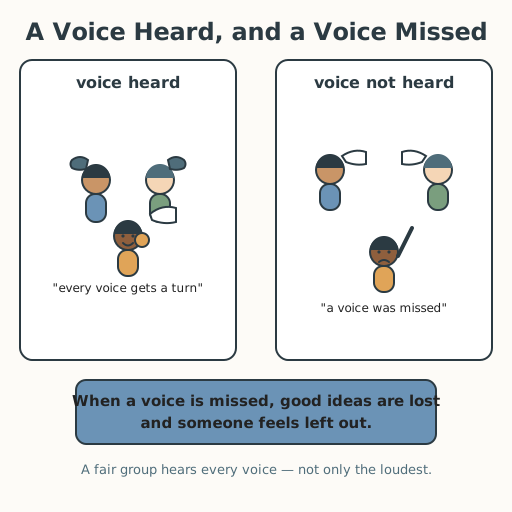
Learners explain what it means to have a voice in a group — to share an idea and be listened to — and what happens when a voice is not heard: good ideas are lost, and someone feels left out. They practice hearing quieter voices with a turn marker and a wonder box, because a fair group hears everyone, not only the loudest.
Objectives
- Explain what it means to have a voice in a group and what can happen when someone’s voice is not heard. (D09.S3.03.02)
Connection
Think of a time you had an idea but no one listened — you were talked over, or the decision was made before you spoke. Having a voice in a group means you get to share your idea and others listen. When a voice is not heard, two things are lost: the group loses a good idea it never heard, and the person feels left out and small. People everywhere know this — a council passes a talking stick so each voice is heard, a family asks the youngest what they think, a class uses a box for written questions so quiet voices count too. Today you will practice hearing every voice.
Materials
- A “voice” picture set (a child speaking in a circle, a turn marker passed; a child talked over, a quieter child ignored, a decision made before everyone spoke)
- A soft object as a turn marker
- A “wonder box” and small slips of paper
- Crayons and paper
Preparation
- Prepare the “voice” picture set and the wonder box with slips.
- Set the turn marker in the middle of the circle; arrange a circle for sharing.
Facilitator note
Written to the learner (“you”). This lesson teaches voice and inclusion — a
centerpiece of fair deciding. Having a voice means being able to share an idea and
be listened to; being heard is the point, not merely speaking. Keep it blame-free: no
one is “bad” for talking; the lesson is about making room for quieter voices, not
scolding louder ones. Use the turn marker (an ancient, global practice — a talking
stick, a shell, a stone) and the wonder box (written or drawn, so a learner can
share without speaking up) as concrete tools. Where questioning adults is not safe,
frame everything as wondering together (see docs/contexts.md). A learner who does
not speak aloud writes or draws a slip for the wonder box, or points to the picture
set; a learner who is deaf or hard of hearing shares by sign, writing, or the marker;
a learner who is blind or low-vision hears the situations described and shares aloud
or by touch; a learner with a motor difference can direct a partner to place their
slip. A learner may always pass. The goal is the learner’s own explanation — “a voice
means being heard, and when it is not heard…” — not a memorized phrase.
Procedure
- Gather (5 min). Think of a time you were heard and a time you were not. How did each feel?
- Meet “voice” (10 min). Having a voice means you can share your idea and be listened to. Look at the pictures: a voice being heard (a turn marker passed, a child speaking while others listen) and a voice not heard (talked over, ignored, decided around).
- Notice what is lost (10 min). For each “not heard” picture, name what the group lost and how the person felt. Wonder together: could a quiet idea ever be the best idea?
- Practice hearing every voice (15 min). Pass the turn marker around the circle; when you hold it, share one idea (or pass it on, or put a written slip in the wonder box). Listen when others hold it. Notice how it feels to have your turn held for you. If writing or drawing is your way, put an idea in the wonder box and have it read aloud later.
- Close (5 min). A fair group hears every voice — not only the loudest. When a voice is missed, the group loses an idea and a person feels left out. You can make room.
Differentiation
- Support: Use one “heard” and one “not heard” picture and model “when a voice is missed, the group loses… and the person feels…”; a non-speaking learner points to the picture or puts a slip in the box; a learner with limited movement directs a partner.
- Extension: Invite learners to wonder why some voices are quieter (shyness, a different language, being new) and propose one more way to hear them.
Assessment
- Formative (observation): Can the learner explain what it means to have a voice in a group and what happens when a voice is not heard?
- Performance: The learner’s part in the turn-marker circle and wonder box, with their own explanation of why every voice matters.
Home connection
At home, try a “turn marker” at one family talk: whoever holds it speaks, everyone else listens. Notice whose voice you heard that you usually don’t.
Resources
- CASEL SEL Framework (social awareness and relationship skills): https://casel.org/fundamentals-of-sel/
- The talking stick / talking circle is a widespread Indigenous and community practice for ensuring each voice is heard; see teaching resources on “talking circles” from multiple Nations, used here respectfully as a shared human practice.