Lesson 02 — One Job, Then and Now
Learners compare how one job was done long ago and how it is done today — water carried by hand and by tap, grain ground by hand and by mill, clothes washed by hand and by machine — and say what changed: the tool or machine, the speed, and often the need for electricity or running water. They learn that a new tool changes the way a job is done, but that the old way still works in places without power — new is not better, just different.
Objectives
Objectives
- D10.S1.03.02 Describe how one tool or machine changed the way a job was done long ago compared with today.
Essential question
How did one tool or machine change the way a job was done long ago compared with today?
Key vocabulary
Materials
Standard materials
- Then-and-now picture cards · 1 set Pairs showing one job done long ago and today — water carried by hand and by tap, grain ground by hand and by mill, clothes washed by hand and by machine, grain cut by hand and by machine
- Paper and crayons · per learner For drawing one job, then and now, with a "what changed" sentence
Low-tech / no-cost
- Spoken stories of a job, then and now Tell a job done long ago and today (carrying water, grinding grain, washing clothes); no printed cards needed
- Voice and body Act out carrying water by hand (slow) and turning a tap (fast); name what changed — speed, and the need for pipes and power
Enriched / lab & device
- A short video or photo pair of one job done then and now · 1 Optional — one clip or photo pair showing the same job done the old way and the new way
- A real old tool and a real new tool for the same job · 1 pair To feel what changed — speed, power, or ease (e.g., a hand grinder and an electric one)
Works in different contexts
- large-group Show each pair big; the whole group names the job, then says what changed (faster, easier, needs electricity) before a few learners sort then and now
- self-directed A learner sorts the pairs into then and now and writes or says what changed for one job
- outdoor-only Compare two ways to move water or grain outside — a jug carried by hand and a pipe or pump, or grinding by hand and by machine — and name what changed
- multi-age Older learners read the pair labels and write the "what changed" sentence; younger learners act the old way and the new way
- level-grouped Learners who finish early explain why the old way still matters (it works without electricity); others match one pair
Lesson 2 — One Job, Then and Now
Summary
Learners compare how one job was done long ago and how it is done today and name what changed. The job of getting water was once done by carrying a jug by hand and is now often done by turning a tap; the job of grinding grain was once done with a hand stone and is now often done by a mill. They notice that what changed is the tool or machine, the speed, and often the need for electricity or running water — and that the old way still works in places without power. New is not better; it is just different.
Objectives
- Describe how one tool or machine changed the way a job was done long ago compared with today. (D10.S1.03.02)
Connection
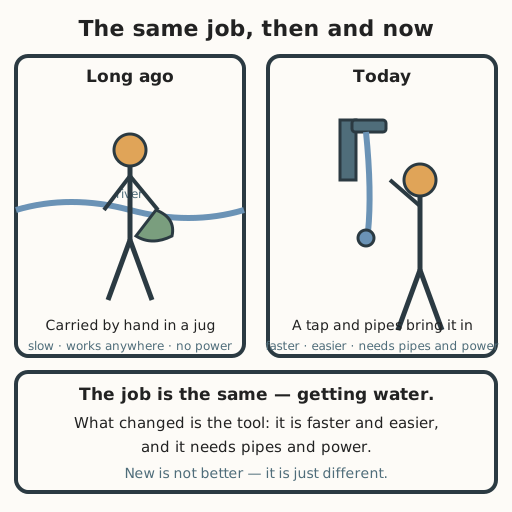
How did your family get water today — from a tap, a well, a pump, or a river? Long ago, almost everyone carried water by hand in a jug or a bucket. The job is the same — getting water — but the tool changed the way it is done: a tap and pipes bring water right to the house, so the job is faster and easier. That is what it means to compare a job then and now.
Materials
- Then-and-now picture cards (pairs for the same job)
- Paper and crayons
Preparation
- Prepare or draw then-and-now pairs for one job each: water carried by hand → a tap; grain ground by hand → a mill; clothes washed by hand → a washing machine; grain cut by hand → a cutting machine.
- Prepare to say, for each pair, the shared job and what changed.
- Clear space to act out a job the old way and the new way.
Facilitator note
This lesson is written to the learner (“you”). Hold the unit’s stance carefully: teach technology with neither worship nor fear. A new machine is not “better” just because it is new — it often makes a job faster or easier, and it often needs electricity, running water, or fuel that not everyone has. An old tool is not “worse” just because it is old — it works anywhere and never runs out of power. Both are real tools made by people to solve a problem (retrieval: link back to Lesson 1’s simple machines). Use examples from many places so no one home is the default: a hand pump in a village, a water jug carried from a river, a washing machine in a city flat. Distinguish evidence from values gently: “the machine is faster” is a fact; “the machine is better” is a value judgment — and at this age we hold them apart. Honor every body: a learner who is blind or has low vision can feel the old tool and hear the new one described; a non-speaking learner can point to “then” or “now” and to a picture for “faster” or “needs electricity.” Keep the change concrete, not scary — a job made easier, not a world lost.
Procedure
- Gather (5 min). Remember Lesson 1: tools make jobs easier. Sometimes there is an old way and a new way to do the same job.
- Meet then and now (15 min). For each pair, name the shared job first: “Both the jug and the tap bring water.” Then say what changed: “The tap is faster and easier, and it needs pipes and power. The jug works by hand, anywhere.”
- Sort then and now (10 min). With the cards, put each picture in the “long ago” pile or the “today” pile. For one pair, say the job and what changed.
- Say it in a sentence (5 min). Finish the frame together: “Long ago people ___. Today people ___. What changed is ___.”
- Draw one job, then and now (8 min). Draw one job done the old way and the new way, and write or say what changed.
- Close (2 min). A new tool changes the way a job is done — often faster and easier, often needing power. New is not better and old is not worse. Both ways matter.
Differentiation
- Support: Compare one pair only, saying the job and one change together aloud with the frame.
- Blind/low vision: Feel the old tool and hear the new one described; tell what changed (faster, needs electricity) by voice.
- Deaf/hard of hearing / non-speaking: Sort cards by pointing, and signal “faster,” “easier,” or “needs electricity” with a sign or picture to say what changed.
- Motor differences: Direct a partner’s hands to sort and draw while the learner says or points to the job and the change; use big, light cards.
- Extension: Tell why the old way still matters where there is no electricity, and name one job your family does by hand that machines could also do.
Assessment
- Formative (observation): Can the learner describe how one tool or machine changed the way a job was done long ago compared with today, and name what changed?
- Artifact (portfolio): The “then and now” drawing with the “what changed” sentence.
Home connection
At home, ask a grown-up how one job was done long ago — getting water, cooking, washing, traveling — and how it is done now. Tell them what changed and which way your family uses.
Resources
- Encyclopaedia Britannica, “Sewing Machine” — the sewing machine (patented in the 1800s) let people sew much faster than by hand, a real example of a tool changing the way a job was done. https://www.britannica.com/technology/sewing-machine