Lesson 04 — Every Message Has a Purpose and an Audience
Learners discover that every message has a purpose and an audience, and they name both for simple messages. A purpose is what the message is for — to inform, persuade, entertain, or warn. An audience is who it is for — students, walkers, children, families. They sort and label messages, then make one of their own with a clear purpose and audience.
Objectives
Objectives
- D10.S2.03.02 Explain that a message has a purpose and an audience, and name both for a simple message.
Essential question
What is a message's purpose and audience, and how do I name both for a simple message?
Key vocabulary
Materials
Standard materials
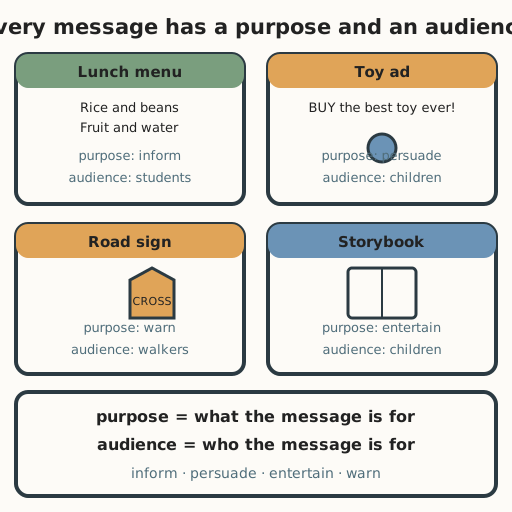
- Message cards with a purpose and an audience · 1 set Simple messages — a school lunch menu (to inform, for students), a toy ad (to persuade, for children), a "cross carefully" sign (to warn, for walkers), a storybook (to entertain, for children)
- A "purpose words" and "audience words" chart · 1 Purpose words — inform, persuade, entertain, warn; audience words — who it is for
- Paper and crayons · per learner For drawing one message and labeling its purpose and audience
Low-tech / no-cost
- Spoken messages and a listening ear Say a message aloud and name its purpose and audience together; no printed cards needed
- Voice and body Act out a message (warn someone to cross carefully, show a toy to sell) and let a partner guess the purpose and audience
Enriched / lab & device
- Real messages to examine · 2–3 A real sign, a menu, a book cover, or a poster — name each one's purpose and audience
- A device to show one real message and its audience · 1 per group Optional — look at a real message online and name its purpose and audience
Works in different contexts
- large-group Hold each message up big; the whole group names the purpose and the audience together before a few learners place each on a chart
- self-directed A learner reads or looks at each message and writes or says its purpose and audience alone
- outdoor-only Find a message outside — a sign, a notice, a poster — and name its purpose and audience
- multi-age Older learners read the messages aloud and coach younger ones in naming the purpose and the audience
- level-grouped Learners who finish early make up a new message and name both its purpose and audience; others name both for one given message
Lesson 4 — Every Message Has a Purpose and an Audience
Summary
Learners discover that every message has a purpose and an audience, and they name both for simple messages. A purpose is what the message is for — to inform, persuade, entertain, or warn. An audience is who it is for — students, walkers, children, families. They sort and label messages, then make one of their own with a clear purpose and audience.
Objectives
- Explain that a message has a purpose and an audience, and name both for a simple message. (D10.S2.03.02)
Connection
Think of a message you saw today — a lunch menu, a sign, a book cover, a poster. Every one of them was made by a person with two questions in mind: what is this message for? and who is it for? The menu informs hungry students; the “cross carefully” sign warns walkers near the road; the storybook entertains children at bedtime. That is a message’s purpose (what it is for) and its audience (who it is for). When you can name both, you can read any message with clear eyes.
Materials
- Message cards with a purpose and an audience (a menu, a toy ad, a “cross carefully” sign, a storybook)
- A “purpose words” and “audience words” chart
- Paper and crayons
Preparation
- Prepare the message cards: a lunch menu (inform, students), a toy ad (persuade, children), a “cross carefully” sign (warn, walkers), a storybook cover (entertain, children).
- Prepare the chart: purpose words (inform, persuade, entertain, warn) and audience words (who it is for).
- Set out paper and crayons.
Facilitator note
This lesson is written to the learner (“you”). This is the Grade 3 upgrade of Grade 2’s “who made it and who is it for”: now learners name the purpose (inform, persuade, entertain, warn) and the audience of a message. Model the two questions — what is it for? who is it for? — on one message, then guide practice on a second before learners work independently (Kirschner, Sweller & Clark, 2006). Keep the media stance warm: reading a message’s purpose and audience is not suspicion; it is understanding — the maker of a menu wants to help you eat, and the maker of a toy ad wants you to want the toy. Both are honest once you can see them. Use messages from many places and lives — a market notice, a road sign, a menu, a story told aloud — so no one home is the default; a spoken story or song is a real message with a purpose and audience too. Honor every body: read each message aloud for a learner who is blind or has low vision and let them name purpose and audience by voice; a non-speaking learner points to “inform,” “persuade,” “entertain,” or “warn” and to the audience picture; acting out each message works for learners who learn best by moving.
Procedure
- Gather (5 min). Every message was made for a reason and for someone. Today you learn to name both.
- Meet purpose and audience (10 min). A purpose is what a message is for: to inform, persuade, entertain, or warn. An audience is who it is for. Look at the lunch menu: its purpose is to inform, and its audience is students.
- Name them together (10 min). For each card, ask the two questions — what is it for? who is it for? — and say both: “The toy ad’s purpose is to persuade, and its audience is children.” “The sign’s purpose is to warn, and its audience is walkers.”
- Make your own message (12 min). Make a simple message of your own — a poster, a notice, a story title, a sign. Label its purpose (inform, persuade, entertain, or warn) and its audience (who it is for).
- Share and guess (5 min). Show your message to a partner. Can they guess its purpose and audience? Tell them if they are right.
- Close (3 min). When you can name a message’s purpose and audience, you can read it with clear eyes — no message tricks you, and no message is wasted on the wrong person.
Differentiation
- Support: Name the purpose and audience of one message together aloud, using the chart and the frame “Its purpose is to ___, and its audience is ___.”
- Blind/low vision: Hear each message described and name its purpose and audience by voice; a partner scribes the learner’s own message.
- Deaf/hard of hearing / non-speaking: Read or see each message and point to the purpose word and the audience picture to answer; the learner’s own message may be drawn and labeled with pictures.
- Motor differences: Direct a partner’s hands to draw and label while the learner says or points to the purpose and audience.
- Extension: Make a second message with a different purpose for the same audience, or explain how changing the audience would change the message (a “cross carefully” sign for drivers instead of walkers).
Assessment
- Formative (observation): Can the learner name both the purpose and the audience of a simple message?
- Artifact (portfolio): The learner’s own message, labeled with its purpose and audience.
Home connection
At home, find one message — a sign, a label, a notice, a song. Tell a grown-up its purpose (inform, persuade, entertain, or warn) and its audience (who it is for). Ask them who they think made it and why.
Resources
- Common Sense Education, “News & Media Literacy” — understanding that every message has a purpose and an audience, and learning to name both. https://www.commonsense.org/education/digital-citizenship/topic/news-and-media-literacy