Lesson 05 — A Food Chain — Where Energy Moves
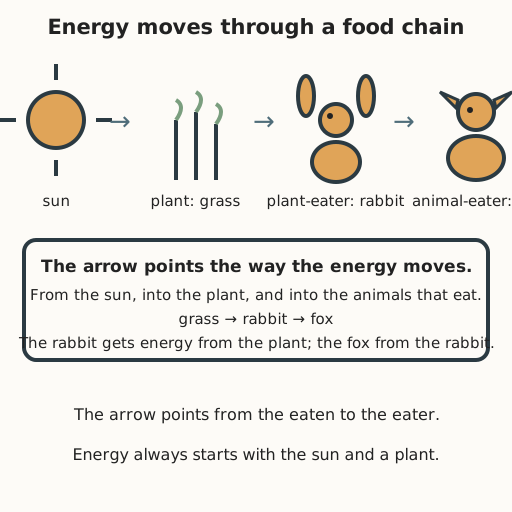
Learners build or draw a simple food chain with a plant and an animal and show the direction energy moves with arrows: the sun gives the grass its start, the rabbit gets energy from eating the grass, and the fox gets energy from eating the rabbit. They learn that the arrows point the way energy travels — always from the sun to the plant, and from the plant to the animals that eat it.
Objectives
Objectives
- D10.S3.03.01 Build or draw a simple food chain with a plant and an animal and show the direction energy moves.
Essential question
How do I build or draw a simple food chain with a plant and an animal, and show the direction energy moves?
Key vocabulary
Materials
Standard materials
- Food-chain picture cards · 1 set Sun, grass, a rabbit, a fox — to lay out in order, with arrow cards showing the direction energy moves
- Paper and crayons · per learner For drawing a food chain with arrows showing the direction energy moves
Low-tech / no-cost
- Real things and spoken examples A real leaf or grass blade, and spoken examples of who eats whom; no printed cards needed
- Voice and body Act out a food chain — the sun shines, the plant grows, the rabbit eats, the fox eats — and point the way the energy moves
Enriched / lab & device
- A food-chain building mat per pair · 1 per pair A mat with sun, plant, plant-eater, and animal-eater spaces to place cards in order with arrows
- A short video or picture set of plant-eaters and animal-eaters · 1 Optional — a cow eating grass, an owl catching a mouse, a fish eating a smaller fish
Works in different contexts
- large-group Lay the chain out big and the whole group moves along it, pointing the arrows and saying where each part gets energy; a few learners place the arrow cards
- self-directed A learner builds or draws the food chain alone and writes or says the direction energy moves
- outdoor-only Find a plant and a plant-eater outside (grass and an insect or bird eating it), and draw the chain in the dirt with arrows showing the direction energy moves
- multi-age Older learners read the chain labels and write the "gets energy from" sentences; younger learners act each part and point the arrows
- level-grouped Learners who finish early build a second chain of their own choosing and add a second animal-eater; others order the given chain
Lesson 5 — A Food Chain: Where Energy Moves
Summary
Learners build or draw a simple food chain with a plant and an animal and show the direction energy moves with arrows. The sun gives the grass its start, the rabbit gets energy from eating the grass, and the fox gets energy from eating the rabbit. They learn that the arrows point the way energy travels — always from the sun to the plant, and from the plant to the animals that eat it.
Objectives
- Build or draw a simple food chain with a plant and an animal and show the direction energy moves. (D10.S3.03.01)
Connection
Where does your energy come from? From the food you eat. And where does that food get its energy? Trace it back: the bread came from wheat, a plant; the wheat grew using sunlight. Every meal is the end of a food chain — a path of energy that starts with the sun, moves into a plant, and then into the animals (and people) that eat. When you draw a food chain, the arrows show which way the energy is moving.
Materials
- Food-chain picture cards (sun, grass, a rabbit, a fox)
- Paper and crayons
Preparation
- Prepare the food-chain cards: sun → grass → rabbit → fox, plus arrow cards showing the direction energy moves.
- Prepare examples of plant-eaters (a cow, a rabbit, an elephant) and animal-eaters (a lion, an owl, a shark).
- Set out paper and crayons.
Facilitator note
This lesson is written to the learner (“you”). This is the Grade 3 upgrade of Grade 2’s “energy from eating”: now learners build or draw the chain themselves and are explicit about the direction the energy moves, shown by the arrow. The arrow is the key new idea and the place beginners make mistakes — it points from the eaten to the eater (from grass to rabbit, from rabbit to fox), the direction the energy travels. Model the arrow once, then guide practice before learners build their own (Kirschner, Sweller & Clark, 2006). Keep it concrete and gentle: energy is what lets a body move, grow, and live; a food chain is a story of energy moving, not a scary story of eating — say “the fox gets energy from the rabbit,” not gory detail. Offer chains from many biomes — grass → rabbit → fox; sea plants → fish → shark; grass → zebra → lion — so no single place is the default. A light ethical thread: every living thing takes energy to live, and all of it belongs to one connected living world (this returns in Lessons 6 and 9). Honor every body: describe each card in words for a learner who is blind or has low vision; a non-speaking learner places the cards in order and points the arrow to show the direction energy moves; acting out each part works for learners who learn best by moving.
Procedure
- Gather (5 min). What gives you energy to run and play? (Food.) Every animal gets energy the same way — by eating. Today you follow that energy along a chain.
- Meet the chain (10 min). Lay out the cards. The sun gives the grass its start. The rabbit eats the grass and gets energy from the plant. The fox eats the rabbit and gets energy from the animal.
- Point the arrows (8 min). The arrow shows the direction energy moves. Place the arrows so they point from the eaten to the eater: grass → rabbit → fox. Say it: “The arrow points from the plant to the animal that eats it.”
- Build your own chain (12 min). Build or draw a food chain of your own — sun, a plant, a plant-eater, an animal-eater — and draw the arrows showing which way the energy moves. Label each part.
- Check the direction (5 min). Trade with a partner. Do their arrows point the way the energy moves — from the plant to the animal that eats it? Give one kind word.
- Close (5 min). A food chain is a path of energy, and the arrow shows its direction: from the sun, into the plant, and into the animals that eat. All of it is one connected, living world.
Differentiation
- Support: Order the given chain (sun → grass → rabbit → fox) and point the arrows together, saying “the arrow points from the grass to the rabbit.”
- Blind/low vision: Order the chain by feel (raised cards or named objects) and say each part and which way the energy moves.
- Deaf/hard of hearing / non-speaking: Place the cards in order and sign or point the arrow to show the direction energy moves; a partner says the sentence.
- Motor differences: Direct a partner’s hands to lay out the chain, place the arrows, and draw, while the learner says or points to the direction energy moves.
- Extension: Build a second chain of your own choosing and add a second animal-eater, pointing the arrows the whole way.
Assessment
- Formative (observation): Can the learner build or draw a simple food chain with a plant and an animal, and show the direction energy moves with arrows?
- Artifact (portfolio): The drawn or built food chain with labeled parts and arrows showing the direction of energy.
Home connection
At home, name one food you ate today and trace it back along a food chain: did it come from a plant, or from an animal that ate a plant? Draw the chain with arrows showing which way the energy moved.
Resources
- BBC Bitesize (KS2), “What is a food chain?” — a food chain shows how energy moves from the sun to plants and then to animals, supporting the lesson’s core idea and the direction of the arrows. https://www.bbc.co.uk/bitesize/topics/zcyycdm/articles/zww9r2p