Lesson 10 — Our Earth Home: Tools, Media, Living Things, and Care
This capstone brings the whole unit together. Learners build a four-part "Earth home" picture: a simple machine and the job it makes easier (with a then-and-now change), a message with a purpose and audience (advertisement or information), a food chain with the direction energy moves (and plants making their own food), and a resource with where it comes from and one way to use less. They celebrate that tools, media, living things, and care all belong to one shared home.
Objectives
Objectives
- D10.S1.03.01 Name a simple machine, such as a lever, wheel, or ramp, and tell how it makes a job easier.
- D10.S1.03.02 Describe how one tool or machine changed the way a job was done long ago compared with today.
- D10.S2.03.01 Tell the difference between an advertisement and information, and give one clue that something is an ad.
- D10.S2.03.02 Explain that a message has a purpose and an audience, and name both for a simple message.
- D10.S3.03.01 Build or draw a simple food chain with a plant and an animal and show the direction energy moves.
- D10.S3.03.02 Explain that green plants make their own food using sunlight, and that all living things depend on plants or on animals that eat them.
- D10.S4.03.01 Tell the difference between a natural resource that can run out and one that comes back, such as sunlight, with an example of each.
- D10.S4.03.02 Name one resource people use every day, where it comes from, and one way to use less of it.
Essential question
How do tools, media, living things, and care all belong to our one Earth home?
Key vocabulary
Materials
Standard materials
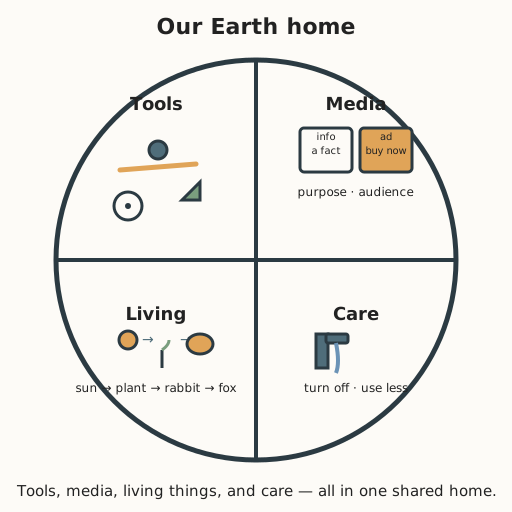
- Large paper for a class "Earth home" picture · 1 A big circle (the Earth) divided into four parts — Tools, Media, Living, Care — one for each strand of the unit
- Paper, crayons, glue, and found natural materials · per learner To add a drawing or mark to each of the four parts
Low-tech / no-cost
- A drawn or arranged circle on the ground Use sticks, stones, or chalk to mark a big Earth circle with four sections; add a found object to each
- Voice and body Act out the four ideas — a simple machine and its job, a message with a purpose and audience, a food chain with the direction energy moves, and a resource with a way to use less — and name each aloud
Enriched / lab & device
- A class "Earth home" book or poster kit · 1 To bind the four parts into a keepable class book or poster
- A recording device · 1 per group To capture each learner telling one thing from each part of the unit
Works in different contexts
- large-group Build one big "Earth home" circle together; every learner adds a mark to each of the four parts and tells one thing they learned from each strand
- self-directed A learner makes their own four-part "Earth home" drawing — a simple machine and its job, a message with a purpose and audience, a food chain with the direction energy moves, and a resource with a way to use less — and shares it with a grown-up
- outdoor-only Mark a big Earth circle on the ground and place one found object in each part — a stick over a stone for tools, a leaf for media, a plant and a creature for living, and a stone for care — then tell what each means
- multi-age Older learners help younger ones label their four parts and run the closing celebration
- level-grouped Learners who finish early add a "new way I want to help" to the Care part; others complete one mark in each of the four parts
Lesson 10 — Our Earth Home: Tools, Media, Living Things, and Care
Summary
This capstone brings the whole unit together. Learners build a four-part “Earth home” picture: a simple machine and the job it makes easier, with a then-and-now change; a message with a purpose and audience, told as advertisement or information; a food chain with the direction energy moves, and plants making their own food; and a resource with where it comes from and one way to use less. They celebrate that tools, media, living things, and care all belong to one shared home.
Objectives
- Name a simple machine, such as a lever, wheel, or ramp, and tell how it makes a job easier. (D10.S1.03.01)
- Describe how one tool or machine changed the way a job was done long ago compared with today. (D10.S1.03.02)
- Tell the difference between an advertisement and information, and give one clue that something is an ad. (D10.S2.03.01)
- Explain that a message has a purpose and an audience, and name both for a simple message. (D10.S2.03.02)
- Build or draw a simple food chain with a plant and an animal and show the direction energy moves. (D10.S3.03.01)
- Explain that green plants make their own food using sunlight, and that all living things depend on plants or on animals that eat them. (D10.S3.03.02)
- Tell the difference between a natural resource that can run out and one that comes back, such as sunlight, with an example of each. (D10.S4.03.01)
- Name one resource people use every day, where it comes from, and one way to use less of it. (D10.S4.03.02)
Connection
You have spent this unit learning four big things: tools are simple machines that make jobs easier and change over time; media carries advertisements or information, and every message has a purpose and an audience; living things are linked in food chains, with plants making their own food from sunlight; and we can care by knowing what runs out, what comes back, and using less. Today we put them all together, because they all live in the same home — the Earth we share.
Materials
- Large paper for a class “Earth home” picture (a big circle divided into four parts)
- Paper, crayons, glue, and found natural materials
Preparation
- Draw or mark a big circle — the Earth — divided into four parts, labeled: Tools, Media, Living, Care.
- Gather paper, crayons, glue, and found natural materials for adding to each part.
- Prepare to recall one thing from each strand with each learner.
Facilitator note
This lesson is written to the learner (“you”). This is a celebration, not a test. Help each learner recall one thing from each of the four strands and add it to the shared Earth home picture. Keep the tone joyful, hopeful, and inclusive — every machine, every message, every living thing, and every act of care is welcome, and none is ranked. Hold the unit’s whole stance gently: technology met with neither worship nor fear, media met with judgment not suspicion, the Earth met as home not storehouse, and learners met as helpers not saviors. Let retrieval do its quiet work: each learner naming one thing from each strand is spaced practice of the whole unit. Honor every body: a learner who is blind or has low vision may add a found object by feel to each part while a partner describes the part; a non-speaking learner adds marks and points while a partner names them; a learner with motor differences directs a partner’s hands. Every body is honored, and every body’s contribution counts.
Procedure
- Gather (5 min). Look at the big Earth circle. This is our shared home. Today we fill it with everything we learned.
- Part one — Tools (10 min). Name one simple machine — a lever, a wheel, or a ramp — and the job it makes easier; then say one way a tool changed a job long ago compared with today. Draw or place a mark in the “Tools” part.
- Part two — Media (10 min). Name one message, its purpose and audience, and say how you know it is an advertisement or information (give one clue). Draw a mark in the “Media” part.
- Part three — Living (10 min). Draw a food chain with a plant and an animal and arrows showing the direction energy moves; then say how a green plant makes its own food from sunlight, and who depends on it. Draw them in the “Living” part.
- Part four — Care (10 min). Name one resource that runs out and one that comes back, then name one everyday resource, where it comes from, and one way to use less of it. Add a mark to the “Care” part.
- Celebrate (5 min). Step back and look at the full Earth home. Tools, media, living things, and care — all together, in one home, cared for by many hands.
Differentiation
- Support: Work on one part of the Earth at a time, or let the learner add just one mark to a shared class picture with a partner’s help.
- Motor differences: Direct a partner’s hands to add each mark while the learner says what it stands for; the choosing and the saying are the contribution.
- Blind/low vision: Add found objects by feel to each part while a partner describes the part and names what the learner chose.
- Deaf/hard of hearing / non-speaking: Share each part with sign, pictures, and acting; the learner signs or points to the mark they add and to the part it belongs to.
- Extension: Make a small four-page “Earth home” book, one page for each part, and add a fifth page about a new way the learner wants to help.
Assessment
- Portfolio: The four-part “Earth home” picture or book becomes a portfolio artifact capturing the whole unit.
- Observation (formative): Can the learner recall one thing from each of the four strands — a simple machine and its job (with a then-and-now change), a message with a purpose and audience (ad vs information), a food chain with the direction energy moves (and plants making food), and a resource with where it comes from and one way to use less?
Home connection
Show your “Earth home” picture to a grown-up and tell them the four things you learned: a simple machine and its job, a message with a purpose and audience, a food chain with the direction energy moves, and one resource with a way to use less. Ask them what small act of care they like to do for the Earth.
Resources
- Unit sources are gathered across Lessons 1–9: Britannica Kids (tools), Britannica (sewing machine), Common Sense Education (media literacy), BBC Bitesize (food chains and plants), NASA Space Place (the Sun), WHO (drinking water), and UNESCO (education for sustainable development). No new factual claims are introduced in this capstone.