Lesson 09 — Our Care Message — Purpose, Audience, and Help
Learners bring the media skills and the stewardship skills together by making a "care message": a message that names one resource, where it comes from, and one way to use less of it — with a clear purpose (persuade) and a real audience to share it with. Making the message teaches the message, and sharing it makes care real.
Objectives
Objectives
- D10.S2.03.02 Explain that a message has a purpose and an audience, and name both for a simple message.
- D10.S4.03.02 Name one resource people use every day, where it comes from, and one way to use less of it.
Essential question
How do I make a message with a clear purpose and audience that helps people care for a resource?
Key vocabulary
Materials
Standard materials
- Care-message template · per learner A card with space for one resource, where it comes from, one way to use less, the purpose (persuade), and the audience (who it is for)
- Crayons and pencils · per learner For writing and decorating the care message
Low-tech / no-cost
- Paper and a pencil Fold any paper into a card and write one resource, where it comes from, and one way to use less, with its audience; no printed template needed
- Voice and body Say the care message aloud and act it out (turning off a tap, switching off a light) so it can be shared without writing
Enriched / lab & device
- A device to show a made care message to the class or family · 1 per group Optional — photograph or show the care message so it can be shared as a real message with an audience
- A class "care message" display board or binder · 1 To gather every learner's care message into one class message of care
Works in different contexts
- large-group Model one care message together on big paper, then each learner makes their own; a few share their resource, its source, and their audience with the group
- self-directed A learner writes one care message — a resource, where it comes from, one way to use less, and its audience — and shares it with a grown-up
- outdoor-only Choose a resource you can see outside (water for the plants, a tree) and make the care message about that real place
- multi-age Older learners help younger ones write the resource and source and read the finished messages aloud in a small sharing circle
- level-grouped Learners who finish early add a second way to use less, or check a partner's message for a clear purpose and audience
Lesson 9 — Our Care Message: Purpose, Audience, and Help
Summary
Learners bring the unit’s two halves together by making a message that cares. Each writes a “care message” that names one resource, where it comes from, and one way to use less of it — with a clear purpose (to persuade people to help) and a real audience to share it with. Making a message teaches the message, and sharing it makes care real.
Objectives
- Explain that a message has a purpose and an audience, and name both for a simple message. (D10.S2.03.02)
- Name one resource people use every day, where it comes from, and one way to use less of it. (D10.S4.03.02)
Connection
You have learned two big things this unit: how to see a message’s purpose and audience, and how to care for a resource by knowing where it comes from and using less. Today you put them together. You will make a small message that helps people care — naming a resource, where it comes from, and one way to use less, made for a real audience. A message that cares tells the truth and asks people to help, not to buy.
Materials
- Care-message template (space for one resource, where it comes from, one way to use less, the purpose, and the audience)
- Crayons and pencils
Preparation
- Prepare or fold the care-message template, one per learner.
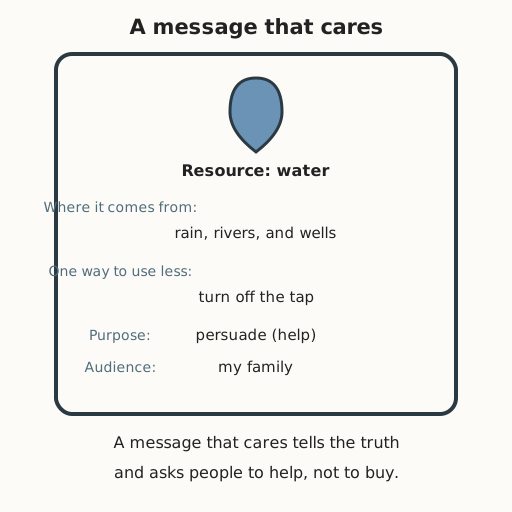
- Model one example aloud: “Water comes from rain, rivers, and wells. One way to use less is to turn off the tap. My purpose is to persuade, and my audience is my family.”
- Set out crayons and pencils.
Facilitator note
This lesson is written to the learner (“you”). This is a making and sharing day, not a test. The heart of it is that a message can care: it can name a resource, its source, and one way to use less, made for a real audience. Retrieval: learners recall Lesson 4 (purpose and audience), Lesson 7 (runs out vs comes back), and Lesson 8 (one resource, where it comes from, use less). Keep the media stance warm — making a truthful, helpful message is the joyful opposite of fear, and it puts technology to work caring rather than selling. Honor all resources and all homes equally: a message about a village well is as worthy as one about a city tap; a message told aloud and acted out counts just as much as a printed card. Distinguish evidence from values gently: “water comes from rain” is evidence; wanting to share the message is a value of care — both are welcome. No wealth assumption: any scrap of paper, or a message spoken and acted, is enough. Honor every body: a non-speaking learner can draw and point while a partner writes, or share in sign; a learner who is blind or has low vision can say the message aloud and have a partner scribe it, and feel the card’s shape; a learner with motor differences can direct a partner’s hands to write. Peer check: partners check each other’s message for a clear purpose (persuade) and a real audience.
Procedure
- Gather (5 min). You can name a message’s purpose and audience, and you can care for a resource. Today you make a message that does both at once.
- Model one care message (10 min). Watch or make one together: one resource (“water”), where it comes from (“rain, rivers, and wells”), one way to use less (“turn off the tap”), the purpose (“to persuade people to help”), and the audience (“my family”).
- Choose your resource (5 min). Pick one resource from Lesson 7 or 8 — water, wood, or electricity. Say where it comes from and one way to use less.
- Make your message (15 min). Write and draw your care message: the resource, where it comes from, one way to use less, the purpose (persuade), and your audience.
- Peer check (5 min). Trade messages with a partner. Does it name a resource, where it comes from, one way to use less, and an audience? Give one kind word.
- Share (8 min). Read or act your care message to someone — a partner, a small group, or the class. Tell them the resource, where it comes from, one way to use less, and who it is for.
- Close (2 min). A message that cares tells the truth, names its purpose, and helps real people. You are now a maker of caring messages.
Differentiation
- Support: Use the frame “___ comes from ___. One way to use less is ___. My purpose is to persuade, and my audience is ___,” with a partner’s help.
- Blind/low vision: Say the message aloud and have a partner scribe it; feel the card and share it by voice.
- Deaf/hard of hearing / non-speaking: Draw the message and share it in sign or by pointing while a partner reads the words aloud.
- Motor differences: Direct a partner’s hands to write and draw while the learner says or points to the resource, its source, the “use less” action, and the audience.
- Extension: Add a second way to use less, or check a partner’s message and explain why its purpose and audience are clear.
Assessment
- Formative (peer): Does the partner’s message name a resource, where it comes from, one way to use less, and an audience, with a clear purpose?
- Artifact (portfolio): The finished “care message” becomes a portfolio artifact, capturing the media and stewardship threads together.
Home connection
Show your care message to a grown-up and share the resource, where it comes from, and one way to use less. Ask the grown-up: what one message of care would they like to send about the Earth, and who would they send it to?
Resources
- Common Sense Education, “News & Media Literacy” — creating honest messages and knowing their purpose and audience, supporting the making-and-sharing work. https://www.commonsense.org/education/digital-citizenship/topic/news-and-media-literacy
- UNESCO, “Education for Sustainable Development” — caring for the Earth and for other people as one everyday practice, the value frame behind the care message. https://www.unesco.org/en/sustainable-development/education