Lesson 01 — Feelings That Change and Mix
Learners discover two new powers of feeling language: that a feeling can change over time (nervous becomes calm becomes proud across one day), and that two feelings can be true at once (happy *and* sad at a goodbye). This opens the year-end unit by gathering the year's emotional literacy at its new, grade-3 depth.
Objectives
Objectives
- D01.S1.03.01 Describe how a feeling can change over time and name when they feel more than one feeling at once.
Essential question
How does a feeling change over time, and when do I feel more than one feeling at once?
Key vocabulary
Materials
Standard materials
- A "feelings over time" chart · 1 set A morning–midday–evening path for tracking how one feeling changes across a day
- Crayons and paper · per learner For drawing a feeling changing and a mixed feeling
Low-tech / no-cost
- Voices, faces, and bodies Act out a feeling changing across a day and two feelings at once; no chart or paper needed
- Found objects A stone, leaf, or stick can stand for a feeling that "stays" or "shifts"
Enriched / lab & device
- The class "feelings wall" from earlier in the year Revisit the year's feeling-word bank and add the new words "mixed" and "change"
- Camera or tablet · 1 per group Record a short "feelings over time" sequence of three faces, then watch it back
Works in different contexts
- large-group Track one shared feeling (nervous before a performance, proud after) on the chart as a whole group, then let learners draw their own
- self-directed A learner draws or writes their own "feelings over time" path and one mixed feeling, then shares with a trusted person
- outdoor-only Watch the sky or a shadow change across the lesson as a model of "changing over time," then name a feeling that changed today and one that mixed
- multi-age Older learners model telling a feeling that changed and a mixed feeling, then younger learners retell their own
- level-grouped Learners ready to extend name a situation where a feeling changed *and* a second feeling appeared at the same time
Lesson 1 — Feelings That Change and Mix
Summary
Learners name two new truths about feelings that they are now old enough to hold: a single feeling can change over time, and two feelings can be true at once. They track one feeling across a day (nervous → calm → proud), and then find a “mixed” feeling — happy and sad, excited and scared — and give a real example from their own life. This opens the year-end unit by gathering the year’s emotional literacy at its new depth.
Objectives
- Describe how a feeling can change over time and name when they feel more than one feeling at once. (D01.S1.03.01)
Connection
Think of one ordinary day. In the morning you might feel nervous about a thing you have to do; by midday you feel calm, because it went fine; by evening you feel proud. One day, one you — and the feeling kept changing. Now think of a goodbye: a friend moves away, or a season ends, or you leave a place you love. You might feel sad to leave and excited for what is next — both at the very same time. Feelings are not stuck, and they are not always one at a time. Today you practice naming both of those true things.
Materials
- A “feelings over time” chart (morning–midday–evening path)
- Crayons and paper
- The class “feelings wall” (optional)
Preparation
- Draw or prepare the “feelings over time” path with three stops: morning, midday, evening.
- Have the year’s feeling-word bank ready to look back on.
- Arrange a circle for acting out and sharing.
Facilitator note
This lesson is written to the learner (“you”) so it works in a classroom and for a self-directed learner. It is the spiral-up from Grade 2, where learners told two alike feelings apart; now they hold that a feeling can move and mix. Two commitments carry it: no feeling is wrong, and two feelings can both be true — a child does not have to choose one. A learner may say a goodbye felt “only sad” or “only excited”; honor that too — mixed feelings are one truth about feelings, not a rule every moment must follow. Feeling words live differently in every language and culture; invite a learner to share a home-word for a mixed or changing feeling, and notice that some languages have a single word where others need two. For a learner who is blind or has low vision, describe the faces and the “body-sense” of each stop aloud (nervous = fluttery stomach; calm = loose shoulders; proud = lifted chest) so the change can be felt rather than seen. A learner who does not use a speaking voice can draw, point, sign, or show the change with face and body while a partner names it.
Procedure
- Gather (5 min). Think of one ordinary day this week. What did you feel when you woke up? At the middle of the day? At the end? Did the feeling stay the same, or did it change?
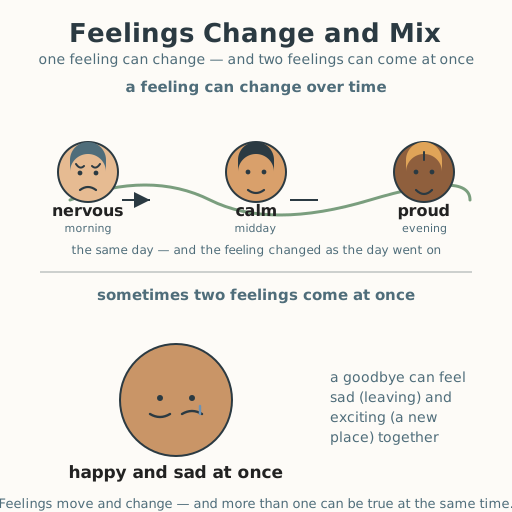
- Watch a feeling change (15 min). Look at the “feelings over time” path. Here is one day: nervous in the morning, calm at midday, proud by evening. Say each word and make each face. Then act out the change together — nervous flutter, calm breath, proud chest. A feeling can change as the day goes on.
- Meet a mixed feeling (10 min). Now look at the second picture: one face that is half-smiling and half-sad — happy and sad at once. That is called a mixed feeling. A goodbye can feel sad (leaving) and exciting (a new place) together. Both are true at the same time.
- Find your own (15 min). On your paper, draw or write one feeling that changed for you this year (from what, to what), and one time you felt two feelings at once (which two?). Share with a partner if you like.
- Close (5 min). Feelings move, and feelings can mix. Naming both — the change and the mix — helps you understand yourself, and helps a friend feel truly understood. That is a grown-up power you now have.
Differentiation
- Support: Offer a two-stop path (just “before” and “after”) and picture choices for feelings; scribe the words a learner says.
- Support (non-speaking): Point to faces or act out the change and the mix; a partner names them.
- Support (blind/low-vision): Describe each face and its body-sense aloud; build the path tactually with textured markers.
- Extension: Name a situation where a feeling changed and a second feeling appeared at the same time, and tell how you knew both were true.
Assessment
- Formative (self + observation): Can the learner describe one feeling that changed over time (from what to what), and name one time they felt more than one feeling at once?
Home connection
Tell someone at home about one feeling that changed for you today — or one time you felt two feelings at once — and ask them about a time a feeling of theirs changed or mixed.
Resources
- CASEL SEL Framework (self-awareness): https://casel.org/fundamentals-of-sel/