Lesson 04 — My Goal and My First Step
Learners turn a wish into a plan: they set one simple personal goal and name the very first step toward it — the one small thing they can do first. Each learner makes a "goal and first step" staircase page, carrying the year's self-regulation work into a next step they can actually take.
Objectives
Objectives
- D01.S3.03.01 Set a simple personal goal and name the first step toward it.
Essential question
How do I set a simple personal goal and name the very first step toward it?
Key vocabulary
Materials
Standard materials
- A "goal and first step" staircase page · 1 per learner A staircase with a goal at the top and a first step at the bottom, to fill in
- Crayons and pencils · per learner
Low-tech / no-cost
- Voices and bodies Say your goal aloud, then name and act out the very first step — no page needed
- Found objects A stick for the goal and a stone for the first step, placed a short distance apart on the ground
Enriched / lab & device
- A portfolio folder or binder · 1 per learner To keep the goal-and-first-step page for the celebration and beyond
- Camera or tablet · 1 per group Record each learner saying their goal and their first step, to watch again later
Works in different contexts
- large-group Set one shared class goal and its first step together on the board, then learners set their own
- self-directed A learner sets their own goal and first step alone, then shares it with a trusted person
- outdoor-only Mark a goal spot and a first-step spot on the ground, then walk the first step toward it
- multi-age Older learners model a goal and its first step, then coach younger learners to name theirs
- level-grouped Learners ready to extend add a *second* step after the first, and say when they will do it
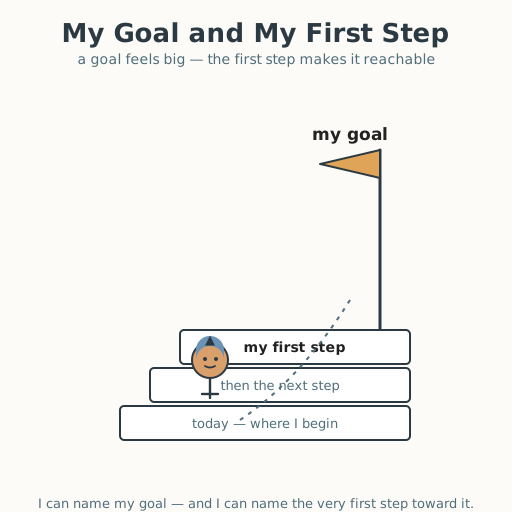
Lesson 4 — My Goal and My First Step
Summary
Learners turn a wish into a plan. They set one simple, personal goal — something real and reachable — and then name the very first step toward it, the one small thing they can do first. Each learner makes a “goal and first step” staircase page, which joins the year-end portfolio and carries the year’s self-regulation work forward.
Objectives
- Set a simple personal goal and name the first step toward it. (D01.S3.03.01)
Connection
Everyone, everywhere, has wanted something they did not yet have — to read a hard book, to ride without help, to learn a new game, to be a better friend. A wish becomes a goal when you decide to reach it, and a goal becomes reachable when you name the first step: not the whole climb, just the first small thing. A mountain is climbed one step at a time, and every step begins with the very first one. Today you set a goal of your own and name its first step.
Materials
- A “goal and first step” staircase page
- Crayons and pencils
Preparation
- Prepare the staircase page: a goal flag at the top, a “my first step” step near the bottom, and room to fill in.
- Have the year’s earlier goal and calm-tools work ready to look back on (optional).
- Arrange a circle for sharing goals and first steps.
Facilitator note
This lesson is written to the learner (“you”). It spirals up from Grade 2’s “choose a calm tool on my own,” now into choosing a direction and its first move. The commitments: a goal is the learner’s own, not the adult’s, and the first step is small enough to actually take — a goal too big or too adult-chosen fails the lesson. Coach learners from “I want to be the best” toward something concrete and near (read one new book; learn to tie one knot; practice ten kind greetings; hold a pencil the new way for one week). Honor every goal as equal in worth — a goal about kindness is as real as a goal about reading. Some learners live with scarcity or instability; keep goals free of things that cost money. For a learner who is blind or has low vision, describe the staircase aloud and build it tactually; the goal and step live in words, not pictures. For a learner who does not use a speaking voice, accept drawing, pointing, signing, or a partner voicing. The first step is the lesson: naming it is the power.
Procedure
- Gather (5 min). Think of one thing you want to be able to do or be better at — not a wish for later, but something you could begin soon. That is your goal.
- Set your goal (10 min). Write or draw your goal at the top of the staircase. Make it small and real: “read one new book,” “learn to tie my own knot,” “say one kind thing to a new person each day this week.” It should be your goal, not someone else’s.
- Name the first step (10 min). Now look at the bottom step. What is the very first small thing you would do? “Find a book.” “Ask for one piece of rope.” “Say hello to one new person tomorrow.” Write or draw that first step. Not the whole climb — just the first step.
- Check your plan (10 min). Ask yourself: Can I really do this first step soon? If it is still too big, make it smaller. A good first step is one you could do today or tomorrow.
- Share and promise (10 min). Tell a partner your goal and your first step, and listen to theirs. Then make a small promise to yourself: I will take my first step.
- Close (5 min). A goal feels big, but the first step is small enough for you. Naming it is a grown-up power. This year you learned to set a direction — next year you will climb.
Differentiation
- Support: Offer a menu of small, concrete goals and first steps to choose from; scribe the words a learner says.
- Support (non-speaking): Point to or act out the goal and the first step; a partner writes or voices them.
- Support (blind/low-vision): Set the goal and step by voice; build the staircase tactually so the “first step” can be felt.
- Extension: Add a second step after the first, and say when you will take it.
Assessment
- Formative (self + portfolio + observation): Can the learner state one simple, concrete goal and name a first step small enough to actually take?
Home connection
Tell someone at home your goal and your very first step — then take the first step and tell them how it went.
Resources
- CASEL SEL Framework (self-management): https://casel.org/fundamentals-of-sel/