Lesson 05 — Rules and Routines That Work for Everyone
Learners see a shared moment with and without a routine — a crowd pushing at one cup versus a line where everyone takes a turn — and explain *why* rules and routines make a community work fairly: they make sure no one is left out. They then test the class's own routines and name how each one serves everyone.
Objectives
Objectives
- D02.S3.03.02 Explain how rules and routines help a community work fairly for everyone.
Essential question
How do rules and routines help a community work fairly for everyone?
Key vocabulary
Materials
Standard materials
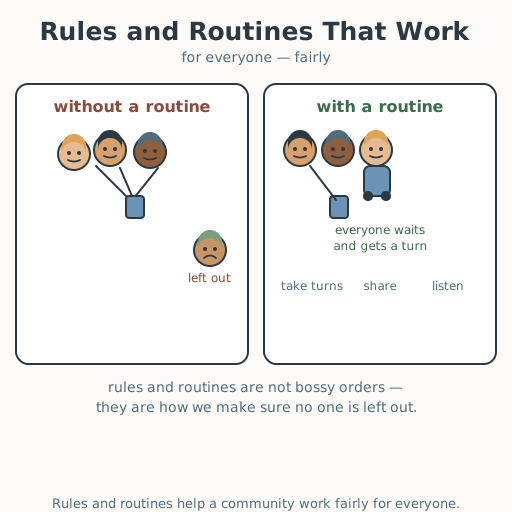
- A "before and after the routine" chart · 1 set Two scenes — a messy, unfair moment and the same moment with a fair routine
- Chart paper and markers · 1 set For a class list of "what our routines make fair"
Low-tech / no-cost
- Voices and bodies Act out a moment with and without a routine, so everyone can see and feel the difference
- Found objects One cup or one ball shared in a circle, taking turns, as a living routine
Enriched / lab & device
- The class's own routine chart from earlier in the year Revisit the routines the class already built and test whether each is fair for everyone
- Camera or tablet · 1 per group Record a routine working and a routine missing, then compare them
Works in different contexts
- large-group Build the "before and after" chart as a whole group, then test the class's own routines one by one
- self-directed A learner writes or draws one rule or routine and explains how it makes a shared moment fair for everyone
- outdoor-only Draw two scenes in the dirt — one without a routine, one with — and act out the fair one with a shared object
- multi-age Older learners explain *why* a routine is fair; younger learners act out following it
- level-grouped Learners ready to extend name a rule that is fair for most but not all, and how to fix it so everyone is included
Lesson 5 — Rules and Routines That Work for Everyone
Summary
Learners see the same shared moment two ways: without a routine, people crowd and someone is left out; with a routine, everyone takes a turn and no one is left out. They explain that rules and routines are not bossy orders — they are how a community makes things fair for everyone. Then they test the class’s own routines and name how each one serves the whole. This gathers the year’s community work at its grade-3 depth.
Objectives
- Explain how rules and routines help a community work fairly for everyone. (D02.S3.03.02)
Connection
In every community, people need shared things — water, food, a turn to speak, a place in line, a clean shared space. When there is no routine, the quick and the loud get there first and someone is left out. When there is a routine — take turns, share, listen, tidy up — everyone gets a turn, and the community works fairly for everyone. All over the world, markets, buses, water pumps, and kitchens run on such small routines so that everyone is treated fairly. Today you look at how your own class does this.
Materials
- A “before and after the routine” chart
- Chart paper and markers
- One shared object (a cup or a ball) to pass in turns
Preparation
- Prepare or draw the “before and after” chart: one scene of a crowded, unfair moment and the same moment with a fair routine.
- Set out chart paper for the class list “what our routines make fair.”
- Arrange space to act out a moment with and without a routine.
Facilitator note
This lesson is written to the learner (“you”). It spirals up from Grade 2’s “welcoming circle,” now into the why of fairness: a routine is fair when it serves everyone, not just the fast or the loud. The egalitarian commitment is firm: a fair routine includes the ones who are easy to miss — a learner who moves slowly, who uses a wheelchair, who is shy, who does not speak the room’s main language. Test each routine against that question: does this work for everyone, or only for some? Be tender: some learners have seen routines used unfairly against them (a rule that favors some over others). Honor that honestly and turn it into agency — “what would make it fair for everyone?” A rule is not sacred; a community can change a rule that is not fair. For a learner who is blind or has low vision, act the scenes out so the difference is felt — crowding bodies versus a patient line — and describe it aloud. For a learner who does not use a speaking voice, accept pointing, signing, drawing, or acting out a turn. The line between “order” and “fairness” is the lesson’s heart.
Procedure
- Gather (5 min). Here is one cup of water and six thirsty people. What happens with no routine? Some push, some get there first, and one person is left out.
- See the difference (10 min). Look at the “before and after” chart. Without a routine: a crowd, a push, a left-out person. With a routine: a line, a turn for each, and everyone drinks. Say what changed. The routine made it fair.
- Act it out (10 min). With one shared object, first try to share it with no routine — feel the crowding. Then form a circle and pass it, taking turns, so everyone gets it. Which felt fair? Why?
- Name the “why” (10 min). Together, finish this sentence: a rule or routine helps a community because it… (makes sure no one is left out; gives everyone a turn; keeps a shared space clean for all; lets everyone be heard).
- Test your own routines (10 min). Look at your class’s real routines — lining up, sharing materials, taking turns to speak. For each, ask: does this work fairly for everyone? If one does not, say how you could fix it so it does.
- Close (5 min). A fair community is not an accident. It is built of small routines that include everyone — and your class knows how to build them.
Differentiation
- Support: Act out one routine at a time; offer a sentence starter (“a routine helps because…”).
- Support (non-speaking): Point to or act out a fair and an unfair moment; a partner voices the “why.”
- Support (blind/low-vision): Feel the difference by acting the scenes out; describe the chart aloud.
- Extension: Name a rule that is fair for most but not all, and say how to change it so everyone is included.
Assessment
- Formative (performance + observation): Can the learner explain, in their own words or by acting it out, how a rule or routine makes a shared moment fair for everyone — and name one way the class’s own routine includes people?
Home connection
Find one routine at home (meals, water, chores) and ask: does it work fairly for everyone? Tell someone what you noticed, and one small change that would make it fairer.
Resources
- CASEL SEL Framework (social awareness, responsible decision-making): https://casel.org/fundamentals-of-sel/