Lesson 06 — Contributing Fairly to a Group Goal
Learners take on a real group goal and discover what *fair* cooperation means: not one person doing everything and not one person doing nothing, but each person giving a real part. They plan a fair share of the work, do it together, and check afterward that the load was shared. This gathers the year's teamwork for the celebration to come.
Objectives
Objectives
- D02.S4.03.01 Practice cooperation by contributing fairly to a group goal.
Essential question
How do I contribute fairly to a group goal, so that everyone gives a real part?
Key vocabulary
Materials
Standard materials
- A real group goal (a garden bed, a mural, a shared structure, a class book) · 1 Something the whole group builds or finishes together, where each person's part is needed
- Chart paper and markers · 1 set For a "who does what — a fair share" plan
Low-tech / no-cost
- Bodies and found materials Build or make one shared thing with stones, sticks, leaves, or drawn parts — each person adds a fair piece
- Voices Plan aloud who does what so the work is shared evenly, then do it; no props needed
Enriched / lab & device
- A class building set, large paper, or garden plot · 1 set A goal big enough that everyone's fair part is needed to finish it
- Camera or tablet · 1 per group Record the group planning and building, then watch it back to see each fair part
Works in different contexts
- large-group Split into small teams, each with its own group goal, then share how each team divided the work fairly
- self-directed A learner designs a group goal and writes or draws what each person's fair part would be, then shares it
- outdoor-only Build one shared thing from stones, sticks, or earth — a wall, a pattern, a shelter — each person adding a fair part
- multi-age Older learners model dividing a job fairly and guide younger learners to choose and do their own part
- level-grouped Learners ready to extend check afterward: was the work fair? name one part that was uneven and how to fix it
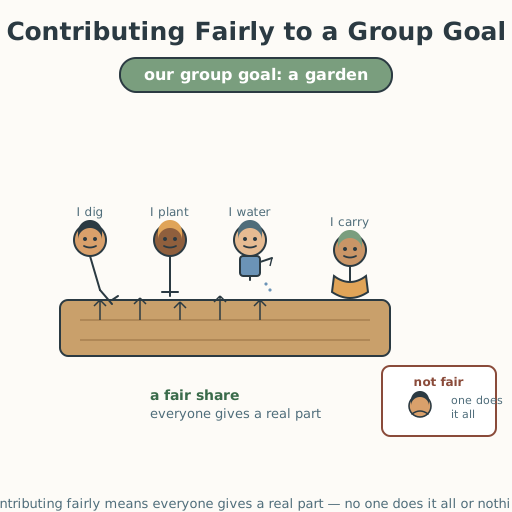
Lesson 6 — Contributing Fairly to a Group Goal
Summary
Learners take on a real group goal — a garden bed, a mural, a shared structure, a class book — and discover what fair cooperation means. It is not one person doing everything, and it is not one person doing nothing: it is each person giving a real part. They plan a fair share, do the job together, and check afterward that the load was shared. This gathers the year’s teamwork for the celebration to come.
Objectives
- Practice cooperation by contributing fairly to a group goal. (D02.S4.03.01)
Connection
Think of a job that many hands must do: planting a field, raising a wall, cooking a feast, carrying a harvest in from the fields. Such jobs fail two ways — if one person tries to do it all, or if one person does nothing while others carry them. Fair cooperation is the middle path: everyone gives a real part, sized to what they can do, so the whole job gets done and no one is drained or left idle. All over the world, communities work this way. Today your class tries it.
Materials
- A real group goal (a garden bed, a mural, a shared structure, or a class book)
- Chart paper and markers
Preparation
- Choose a group goal that genuinely needs every person’s part (plant a bed, paint a mural, build a tower, assemble a class book of pages).
- Set out chart paper for the “who does what — a fair share” plan.
- Arrange space to work together safely, with every learner able to reach their part.
Facilitator note
This lesson is written to the learner (“you”). It spirals up from Grade 2’s “many hands, one big job” (a job no one could do alone) into fairness within the job — the harder, more mature idea. Two commitments carry it: every part is real and needed (the person who clears the path is as needed as the one who plants), and a fair share is sized to the person, not identical for all — fairness is not “everyone does exactly the same,” but “everyone gives a real, reachable part and no one is drained or left out.” A learner who uses a wheelchair or has limited strength can direct, count, fetch, steady, or cheer — all real parts; name them as such. Watch for the two unfair patterns and name them kindly if they appear: one child grabbing all the work, or one child fading out of it. The check afterward is where the learning lands: was the work shared fairly, and would we change anything? For a learner who is blind or has low vision, give a hands-on part with a partner describing the shared goal. For a learner who does not use a speaking voice, accept pointing, signing, or a pictured plan.
Procedure
- Gather (5 min). Here is our group goal. It cannot be done well by one person alone — and it also cannot be done fairly if one person does it all. We need a fair share.
- Plan the fair share (10 min). Look at the goal and list every part it needs: digging, planting, watering, carrying — or drawing, cutting, pasting, arranging. Then decide together: who takes which part, so everyone gives a real one? Write or draw the plan. No one does everything; no one does nothing.
- Do the job (15 min). Work together, each at your part. If someone finishes early, they help a neighbor rather than sit idle. If someone is stuck, another lends a hand — that is cooperation, not competition.
- Check the fairness (10 min). Stop and look. Did everyone give a real part? Was any one person doing too much, or too little? Say each person’s part out loud. If a part was uneven, say how you would balance it next time.
- Close (10 min). Fair cooperation means everyone gives a real part, and everyone shares the finished work. At our celebration, we will gather the whole class’s work — and now you know exactly how to make that fair.
Differentiation
- Support: Give each learner one clear, reachable part and a partner; use a pictured plan.
- Support (mobility/strength): Offer non-physical parts — directing, counting, fetching, steadying, cheering — and name them as real parts.
- Support (non-speaking): Use pointing, signing, or a pictured plan to choose and show a part.
- Extension: After the job, name one part that was uneven and one change that would make the share fairer.
Assessment
- Formative (performance + peer + observation): Did the learner give a real part toward a group goal, and can they name their own part and how the work was shared fairly (or one way it could be fairer)?
Home connection
Do one shared job at home with a fair share — each person with a real part — and tell someone how sharing the work made it fair.
Resources
- CASEL SEL Framework (relationship skills): https://casel.org/fundamentals-of-sel/