Lesson 05 — My Interests, Abilities, and Experiences Make Me, Me
Learners build a "three-petal me" — interests, abilities, and experiences — and see how each part shapes their sense of self. They name what they love, what they can do, and what they have lived through, and begin to notice that these parts combine into a person who is still growing and unique.
Objectives
Objectives
- D01.S2.04.01 Explain how their interests, abilities, and experiences shape their sense of self.
Essential question
How do my interests, abilities, and experiences shape who I am?
Key vocabulary
Materials
Standard materials
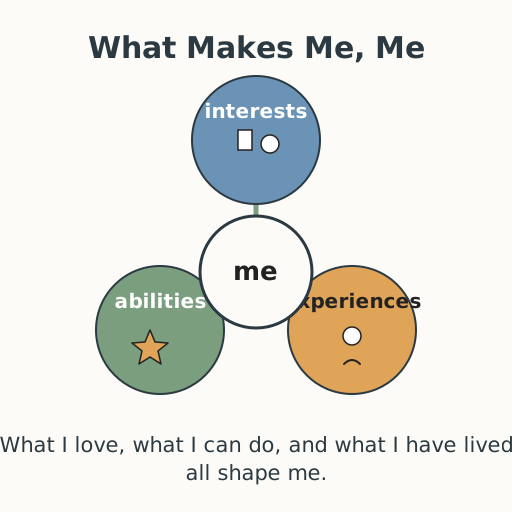
- Three-petal 'me' flower chart · 1 A flower with a center labeled "me" and three petals labeled interests, abilities, and experiences
- My three-petal flower page · 1 per learner A blank flower for the learner to fill with their own interests, abilities, and experiences
- Pencils and crayons · per learner
Low-tech / no-cost
- Three stones or leaves and a center marker Arrange three found objects as petals around a center and name one interest, ability, and experience for each
- Voice and body Say your three petals aloud to a partner; no page needed
Enriched / lab & device
- A digital 'about me' collage tool · 1 per pair A simple tool to combine pictures or drawings into a three-part self-portrait
- An interview sheet for a partner · 1 per pair Questions to ask a partner about their interests, abilities, and experiences, then record their answers
Works in different contexts
- large-group Build one big shared flower on the board first, then learners fill their own flowers in small groups and share one petal each
- multi-age Older learners interview a younger learner about their petals and help them record the answers
- self-directed A learner fills their own three petals alone and checks that each petal is truly theirs, not someone else's idea of them
- level-grouped Learners ready to extend add a fourth petal — such as "what I value" or "where I come from" — and explain how it shapes them too
- outdoor-only Gather three natural objects that stand for an interest, an ability, and an experience, and arrange them as your flower on the ground
Lesson 5 — My Interests, Abilities, and Experiences Make Me, Me
Summary
Learners build a “three-petal me” — interests, abilities, and experiences — and see how each part shapes their sense of self. They name what they love, what they can do, and what they have lived through, and begin to notice that these parts combine into a person who is still growing and unique.
Objectives
- Explain how their interests, abilities, and experiences shape their sense of self. (D01.S2.04.01)
Connection
Who are you? Part of the answer is what you love — your interests, like drawing, running, or caring for animals. Part is what you can do — your abilities, like reading aloud, making people laugh, or fixing things. And part is what you have lived through — your experiences, like moving to a new place, losing a tooth, or helping a neighbor. Together these three petals make the flower that is you. A child who herds goats on a mountainside, a child who swims in a warm sea, and a child who sells fruit in a market are each shaped by what they love, what they can do, and what they have lived — different petals, same three-part flower.
Materials
- Three-petal “me” flower chart
- My three-petal flower page
- Pencils and crayons
Preparation
- Print or draw the three-petal flower chart.
- Copy a blank flower page for each learner.
- Arrange space for sharing in pairs.
Facilitator note
This lesson is written to the learner (“you”). The goal is a positive, true sense of
self — not a boast and not a competition. Emphasize that every learner has all three
petals, and no petal is “better” than another: an ability to be a good friend is as real
as an ability to run fast. Model your own three petals first (worked example). Some
learners may have experiences that are heavy or private; let them choose what to share
and offer the option to keep a petal private. See docs/facilitation.md on holding
difficult topics safely.
Procedure
- Gather (5 min). You have been reading your feelings. Now you turn to a bigger question: what makes me, me? Today you build a flower with three petals.
- Meet the three-petal flower (10 min). Look at the chart. The center is me. The three petals are interests (what I love to do), abilities (what I can do well or am learning), and experiences (things I have lived through). Each petal shapes who you are. Together they make a person no one else is.
- Hear a worked example (10 min). “My interest is caring for animals. My ability is reading aloud. My experience is helping my grandmother at the market every summer.” See how the three petals combine into one whole self? Now think of your own.
- Build your flower (15 min). On your page, fill each petal with your own truth — draw or write one interest, one ability, and one experience. If a petal feels hard, ask a partner: “What do you see me love? What do you see me do well?”
- Close (5 min). You are not just one thing. You are your interests, your abilities, and your experiences — all growing together. And you are not finished: there is room for new petals as you grow.
Differentiation
- Support: Offer idea cards for each petal and scribe the learner’s answers; let a learner draw instead of write.
- Extension: Add a fourth petal — what you value — and explain how it shapes the rest of the flower.
Assessment
- Formative (observation): Can the learner name one interest, one ability, and one experience and say how each shapes who they are?
- Artifact (portfolio): The three-petal flower page, kept for the “my growing self” page later in the unit.
Home connection
Ask someone at home what they think one of your interests, abilities, and experiences is, and see if it matches what you wrote.
Resources
- CASEL SEL Framework (self-awareness competency): https://casel.org/fundamentals-of-sel/