Lesson 06 — The Map of My Growing Self
Learners draw a "self-map" that gathers their interests, abilities, and experiences into one picture of who they are — and who they are becoming. A special "not yet" branch reframes things they cannot do yet as growth in progress, turning the map into a portfolio artifact that grows with them across the year.
Objectives
Objectives
- D01.S2.04.01 Explain how their interests, abilities, and experiences shape their sense of self.
Essential question
How do I draw the map of who I am and where I am growing?
Key vocabulary
Materials
Standard materials
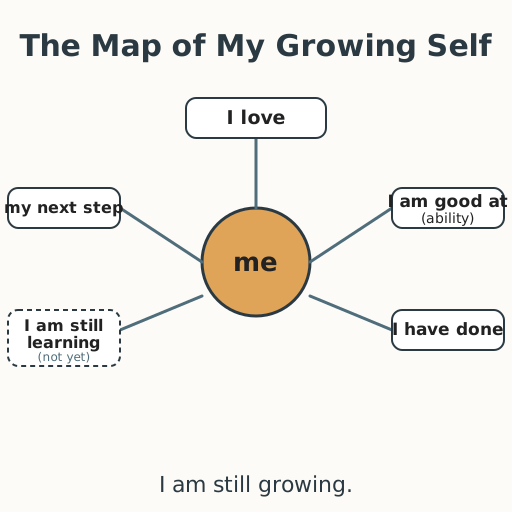
- Self-map example chart · 1 A mind-map with "me" in the center and branches: I love, I am good at, I have done, I am still learning, my next step
- My self-map page · 1 per learner A blank mind-map frame for the learner to fill, including a "not yet" branch for something they are still growing
- Pencils and crayons · per learner
Low-tech / no-cost
- A map drawn in the sand or on the ground Draw your self-map with sticks and stones, placing yourself in the center and branches around you
- Voice and body Stand in the center and point out in four directions, naming one branch of your self-map each
Enriched / lab & device
- A reusable 'growing self' portfolio page · 1 per learner A page learners update each week with a new strength or a new "not yet" that is becoming a "now I can"
- A partner map interview · 1 per pair Learners interview each other about each branch and add one true thing a partner noticed about them
Works in different contexts
- large-group Build one shared self-map on the board first, then learners draw their own in small groups and gallery-walk to see the variety
- multi-age Older learners help a younger learner find words for their "not yet" branch and celebrate a "now I can"
- self-directed A learner draws their own map alone and checks that each branch is honest and specific to them
- level-grouped Learners ready to extend add a "how I got here" branch and a "where I want to go" branch with a first step
- outdoor-only Draw a large self-map on the ground and walk from branch to branch, saying each part of yourself aloud at each stop
Lesson 6 — The Map of My Growing Self
Summary
Learners draw a self-map that gathers their interests, abilities, and experiences into one picture of who they are — and who they are becoming. A special “not yet” branch reframes things they cannot do yet as growth in progress, turning the map into a portfolio artifact that grows with them across the year.
Objectives
- Explain how their interests, abilities, and experiences shape their sense of self. (D01.S2.04.01)
Connection
A map shows you where you are and where you are headed. You can draw a map of yourself the same way. In the center is you. Around you are the roads you have traveled and the roads still ahead: what you love, what you are good at, what you have done, what you are still learning, and your next step. A child in a desert town maps the way to the well she can now find alone; a child in a port city maps the knot he cannot tie yet. Every person’s map is different, and every person’s map is unfinished — because you are still growing.
Materials
- Self-map example chart
- My self-map page
- Pencils and crayons
Preparation
- Print or draw the self-map example chart.
- Copy a blank self-map page for each learner.
- Arrange space for quiet drawing and a gallery walk.
Facilitator note
This lesson is written to the learner (“you”). The “not yet” branch is the heart of it: research on mindset (Dweck) and on mastery learning treats “not yet” as information, never a verdict — and that is the message to carry. Model your own self-map, including a real “not yet” of your own, so learners see that adults are still growing too. Keep the map honest, not performative; every branch is a real truth about the learner. This page is a portfolio artifact — have learners keep it and return to it later in the year.
Procedure
- Gather (5 min). Last time you built a flower with three petals: interests, abilities, and experiences. Today you draw the whole map of your growing self.
- Meet the self-map (10 min). Look at the chart. The center is me. The branches are I love, I am good at, I have done, I am still learning, and my next step. The “I am still learning” branch is special: we call it not yet. You are not “bad at” something — you are not yet able, and that is how every expert began.
- Hear a worked example (10 min). “I love to sing. I am good at listening to friends. I have moved to a new town. I am still learning to swim — not yet. My next step is one swimming lesson.” See how the map shows a whole person, including the part still growing?
- Draw your own map (15 min). Fill your page with your own truth for each branch. Be honest, and remember: “not yet” is a strong thing to write, not a weak one.
- Close (5 min). You are a whole person who is still becoming. Keep this map — later in the year you will look back and see how far you have grown.
Differentiation
- Support: Offer branch starter cards and scribe the learner’s answers; let a learner draw pictures for each branch instead of words.
- Extension: Add a “how I got here” branch (who helped you) and a “where I want to go” branch with a first step.
Assessment
- Formative (observation): Can the learner complete each branch of the map with something true, including a “not yet” that is stated as growth, not failure?
- Artifact (portfolio): The self-map page, kept as a “my growing self” artifact.
Home connection
Show your self-map to someone at home and tell them one thing on your “not yet” branch — and ask them what they are still learning too.
Resources
- CASEL SEL Framework (self-awareness competency): https://casel.org/fundamentals-of-sel/
- Dweck, C. S. (2006). Mindset: The New Psychology of Success. Random House. (Evidence for “not yet” framing; note that mindset effects are modest and work best with real feedback, not praise alone.)