Lesson 08 — My Tradition Connects Me to a Larger Community
Learners trace how their family or cultural tradition connects them outward — to the people they share it with, to their local community, and to a wider world where other people do similar things. They discover that the same human needs (to celebrate, to welcome, to remember) appear in traditions everywhere, turning one personal thread into a sense of shared belonging.
Objectives
Objectives
- D01.S2.04.02 Describe a family or cultural tradition and how it connects them to a larger community.
Essential question
How does my tradition connect me to a larger community?
Key vocabulary
Materials
Standard materials
- Concentric circles chart · 1 Circles radiating out — me, my family tradition, my local community, the wider world — with threads connecting them
- My connection web page · 1 per learner A page with four rings to fill: me, my tradition, who I share it with, and who else in the world does something like it
- Pencils and crayons · per learner
Low-tech / no-cost
- A rope or a circle drawn on the ground Stand in the center and step outward ring by ring, naming the people your tradition connects you to
- Voice and body Trace the connection with your finger in the air from yourself outward, saying each ring aloud
Enriched / lab & device
- A 'shared traditions' comparison set · 1 set per pair Cards showing the same kind of tradition (a meal, a greeting, a festival) across many cultures, to find the common thread
- A community map tool · 1 per pair A simple map where learners mark the places their tradition touches — home, neighborhood, town, and beyond
Works in different contexts
- large-group Draw one big set of circles on the floor and have learners stand in the ring that shows how far their tradition reaches, then share in small groups
- multi-age Older learners help a younger learner trace their tradition's thread outward and name one person in each ring
- self-directed A learner fills their own connection web alone and checks that each ring has a real person or group in it
- level-grouped Learners ready to extend find one tradition in another culture that is like theirs and name the shared human need behind both
- outdoor-only Walk outward from a central spot, stopping at each ring to name the people your tradition connects you to
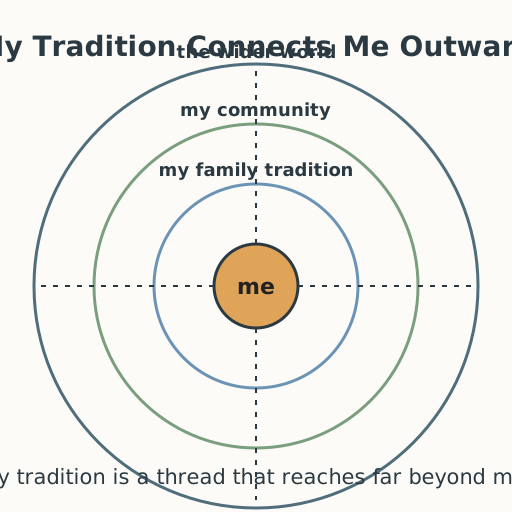
Lesson 8 — My Tradition Connects Me to a Larger Community
Summary
Learners trace how their family or cultural tradition connects them outward — to the people they share it with, to their local community, and to a wider world where other people do similar things. They discover that the same human needs — to celebrate, to welcome, to remember — appear in traditions everywhere, turning one personal thread into a sense of shared belonging.
Objectives
- Describe a family or cultural tradition and how it connects them to a larger community. (D01.S2.04.02)
Connection
A tradition is rarely yours alone. The meal you cook at harvest is cooked by other families on your street, in your town, and by families in other lands who also harvest. The way you greet an elder echoes the way greetings work in cultures far away. When you follow your one small tradition outward, you find threads — to the people who do it with you, to your community, and to a wider world full of people doing something like it. You are not a single dot; you are tied into a web. A fisher child’s blessing of the boats is one thread in a worldwide web of people who honor the sea.
Materials
- Concentric circles chart
- My connection web page
- Pencils and crayons
Preparation
- Print or draw the concentric circles chart.
- Copy a “my connection web” page for each learner.
- Arrange space for pair sharing and quiet writing.
Facilitator note
This lesson is written to the learner (“you”). The aim is belonging without ranking: no
tradition is “bigger” or “more connected” than another, and every thread is real. The
key discovery is that the same human needs appear across cultures — which is an
egalitarian and global point, not a competition. Model your own web first (worked
example). Be ready for learners whose tradition connects them to a community they have
left or lost; honor that thread gently as still real. See docs/facilitation.md on
cultural power dynamics and difficult topics.
Procedure
- Gather (5 min). Last time you named a tradition of yours. Today you follow it outward to see how it connects you to a much bigger community.
- Meet the concentric circles (10 min). Look at the chart. In the center is me. The next ring is my family tradition. The next is my community — the people nearby who share it. The outer ring is the wider world — people far away who do something like it. The dotted lines are threads tying you outward.
- Find the shared needs (10 min). People everywhere celebrate, welcome, remember, and give thanks. A festival of light, a harvest feast, a naming ceremony, a song for the sea — different forms, but the same human needs underneath. Find the need your tradition answers.
- Fill your own web (15 min). On your page, write or draw each ring: your tradition, who you share it with, your community, and who else in the world does something like it. Name at least one real person or group in each ring.
- Close (5 min). Your tradition is a thread, and it reaches far beyond you. Knowing that is belonging: you are one person, tied to many, in a world where everyone is tied to someone.
Differentiation
- Support: Offer a ring-by-ring word bank and scribe the learner’s answers; let them draw a person or place for each ring.
- Extension: Find one tradition in another culture that is like yours and name the shared human need behind both.
Assessment
- Formative (observation): Can the learner describe how their tradition connects them to a community beyond their family, naming at least one real person or group?
- Self-check: The learner checks that every ring of their web holds something real, not made up.
Home connection
Ask someone at home who else in the world shares a tradition like yours, and add what you learn to your outer ring.
Resources
- CASEL SEL Framework (social awareness competency): https://casel.org/fundamentals-of-sel/