Lesson 07 — Welcome Every Body
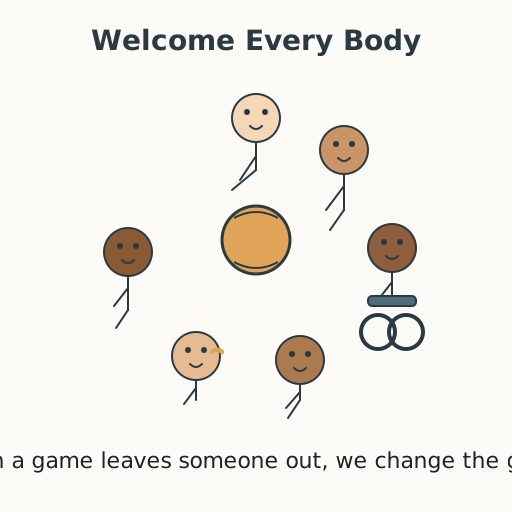
Learners turn respect into action by designing play that welcomes every body. They play a simple passing game, notice who might be left out, and add or change a rule — such as passing to the side so a seated player can reach, or using a signal everyone can see — so every kind of body can join and belong.
Objectives
Objectives
- D03.S1.04.02 Notice and respect differences in how bodies sense and move, including people who use aids or assistive tools.
- D03.S2.04.02 Apply movement skills such as balance, agility, and coordination to a variety of activities, including adapted or seated versions.
Essential question
How can we design play so every kind of body can join?
Key vocabulary
Materials
Standard materials
- A "welcome every body" design sheet · per learner A page with a circle of players and a space to add or change one rule so everyone can join
- A soft ball or rolled cloth · 1 per group For a passing game everyone can play standing, seated, or with wheels
- Pencils and crayons · per learner
Low-tech / no-cost
- A ball of rolled cloth or paper Any soft object to pass; no special ball needed
- Your voices and bodies Play a name-and-gesture passing game with only your body and voice — everyone joins in their own way
Enriched / lab & device
- A wheelchair-accessible game space · 1 A clear, flat, wide path so players who use wheels or chairs can move freely
- A video of inclusive sports · 1 A clip such as sitting volleyball or boccia to see adapted games in joyful, fair play
Works in different contexts
- large-group Make one big circle and pass the ball together, trying a new inclusive rule as a whole group before learners design in small groups
- self-directed A learner writes or draws one new rule that would let a friend who moves differently join, and explains why it is fair
- outdoor-only Draw a wide circle on the ground and pass a rolled cloth or stone; adapt the passing rule so someone seated can reach it too
- level-grouped Learners ready to extend redesign a familiar game with two new rules so more kinds of bodies can join
Lesson 7 — Welcome Every Body
Summary
Learners turn respect into action by designing play that welcomes every body. They play a simple passing game, notice who might be left out, and add or change a rule — such as passing to the side so a seated player can reach, or using a hand signal everyone can see — so every kind of body can join and belong.
Objectives
- Notice and respect differences in how bodies sense and move, and adapt activities so everyone can join. (D03.S1.04.02)
- Apply movement skills to a variety of activities, including adapted or seated versions. (D03.S2.04.02)
Connection
A game is only truly fun when everyone can play. If a rule leaves someone out — a game only for the fastest runners, or only for people who can stand — then the rule can be changed, not the person. Around the world, people have invented ways to include every body: sitting volleyball, boccia for wheelchair players, goalball for players who cannot see. Welcoming every body is not just kind; it makes the game better for everyone.
Materials
- A “welcome every body” design sheet
- A soft ball or rolled cloth
- Pencils and crayons
Preparation
- Print or draw the design sheet.
- Clear a wide, flat space so players who use wheels or chairs can move freely.
- Have a soft ball or rolled cloth ready for the passing game.
Facilitator note
This lesson is written to the learner (“you”). The key move is adapting the game, not the child: a rule that leaves someone out is the problem, not the body. Model one worked example aloud — “if we only pass over our heads, someone seated can’t reach, so let’s pass to the side” — then let learners design. Keep it joyful and concrete. If a learner uses an aid, honor their expertise: they know best what works for them, and their ideas lead. Never single anyone out as “the example.” This lesson carries forward Lesson 6’s respect for diverse bodies and sets up the next two lessons on rules and fair play.
Procedure
- Gather (5 min). Yesterday you met many ways bodies sense and move. Today you ask: how do we make a game everyone can play?
- Play the passing game (10 min). Stand or sit in a circle. Pass the soft ball around the circle in any way your body can — toss, roll, or hand it to the next person. Notice: did everyone get a turn? Was anyone left out?
- Notice who might be left out (10 min). Talk with a partner: if a friend could not stand, or could not see the ball, or could not hear a “go!” shout, could they still play? What would stop them?
- Change one rule (15 min). On your design sheet, add or change one rule so more bodies can join. For example: pass to the side so a seated player can reach; roll the ball instead of throwing it; use a hand signal instead of only a shout. Write or draw your new rule and why it is fair.
- Try the new rule (10 min). Play the passing game again with your new rule. Did more bodies join? Did it feel more welcoming?
- Close (5 min). Say it together: “when a game leaves someone out, we change the game, not the person.” A welcoming game is a fairer game for everyone.
Differentiation
- Support: Change the rule together aloud and model it once before playing; use a single simple adaptation.
- Extension: Redesign a familiar game with two new rules so still more kinds of bodies can join, and explain each change.
Assessment
- Formative (observation/peer): Can the learner name who might be left out of a game and propose one rule change that lets them join?
Resources
- United Nations — Convention on the Rights of Persons with Disabilities (Article 30, participation in play and sport): https://www.un.org/development/desa/disabilities/convention-on-the-rights-of-persons-with-disabilities.html
- World Health Organization — physical activity fact sheet: https://www.who.int/news-room/fact-sheets/detail/physical-activity
Home connection
Think of a game your family plays. Tell someone at home one rule you could change so a neighbor, a younger child, or someone who moves differently could join too.