Lesson 08 — Rules of the Game
Learners learn and follow the rules of a simple cooperative game. They read three rules, put them in order, and play — discovering that rules are not walls but agreements that make a game fair and fun for everyone, and that a cooperative game is won together, not against each other.
Objectives
Objectives
- D03.S2.04.01 Learn and follow the rules of simple cooperative games and sports while playing fairly.
Essential question
Why do games have rules, and how do I learn and follow them fairly?
Key vocabulary
Materials
Standard materials
- A simple cooperative game card · 1 set One or two easy cooperative games with three clear rules each (for example, "keep it up together" or "pass the hoop around")
- A soft ball, hoop, or rolled cloth · 1 per group The game object for the group to move together
- Paper and pencils · per learner To write the game's rules in order
Low-tech / no-cost
- A ball of rolled cloth or paper Any soft object to move together; no special equipment needed
- Your bodies and voices Play a rule-following game with only steps and claps; no object needed
Enriched / lab & device
- A class set of cooperative game cards · 1 set Durable cards with several cooperative games and their rules, for a game-choice corner
- A stopwatch · 1 per group To time how long a team can keep the object moving together — a shared goal, not a competition against others
Works in different contexts
- large-group Teach one game to the whole group first with its three rules read aloud, then split into smaller groups to play
- self-directed A learner reads a game's rules, writes them in order, and plays a solo version (such as keeping a cloth aloft) following the rules
- outdoor-only Use a stone or rolled cloth and a drawn circle; play the passing game with three rules agreed aloud first
- multi-age Older learners read the rules and younger learners act them out, then they play together
Lesson 8 — Rules of the Game
Summary
Learners learn and follow the rules of a simple cooperative game. They read three rules, put them in order, and play — discovering that rules are not walls but agreements that make a game fair and fun for everyone, and that a cooperative game is won together, not against each other.
Objectives
- Learn and follow the rules of simple cooperative games and sports while playing fairly. (D03.S2.04.01)
Connection
Every game you love has rules — how to pass, where to stand, when it is your turn. Without rules, a game falls apart: nobody knows what to do, and someone always gets left out or hurt. Rules are not there to spoil fun; they are the agreement that makes fun possible for everyone. The same is true everywhere: ball games in a Brazilian favela, a running game in a Kenyan schoolyard, a board game on a family mat — all of them work because everyone agrees to the rules.
Materials
- A simple cooperative game card (three clear rules)
- A soft ball, hoop, or rolled cloth
- Paper and pencils
Preparation
- Choose or write one or two simple cooperative games with three clear rules each.
- Clear a safe space and gather the game object.
- Plan how to split the group into small teams.
Facilitator note
This lesson is written to the learner (“you”). Teach the rules with explicit instruction — read the three rules aloud, model them, then play — because rules are foundational knowledge a novice needs spelled out (Kirschner, Sweller & Clark, 2006). Choose cooperative games (a shared goal — “keep the cloth aloft together,” “pass the hoop around the circle without dropping it”), not elimination games, so there are no losers to rank. If a learner breaks a rule, treat it as information, not a verdict: gently restate the rule and invite them to try again. This lesson opens the unit’s third strand — cooperative games and fair play — and leads into Lesson 9 on playing fairly.
Procedure
- Gather (5 min). You have learned to welcome every body. Today you learn how a game works: through its rules. Why do you think games have rules?
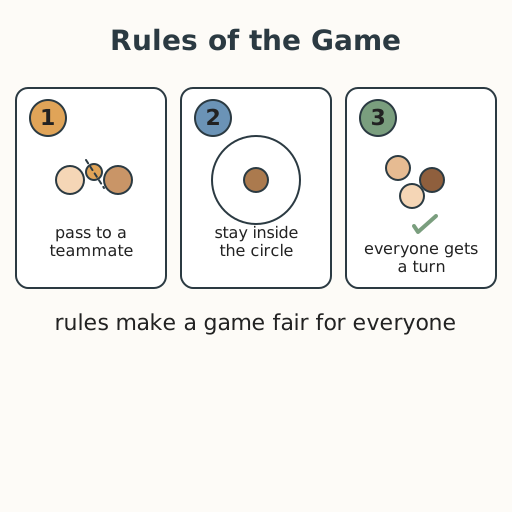
- Meet the game and its rules (10 min). Listen as the three rules are read aloud. Say them back in order. Watch them modeled. For a passing game they might be: (1) pass to a teammate, (2) stay inside the circle, (3) everyone gets a turn.
- Write the rules (10 min). On your paper, write or draw the three rules in order. This is your own copy of the agreement.
- Play the game (15 min). In your group, play the game and follow the three rules. Help each other remember them. The goal is shared — your team wins together by keeping the game going.
- Reflect (10 min). What happened when everyone followed the rules? What happened when someone forgot one? Which rule helped the most?
- Close (5 min). Say it together: “rules make a game fair, and we play together, not against each other.”
Differentiation
- Support: Use two rules instead of three, and have a partner point to each rule card as it is followed during play.
- Extension: Ask learners to write a fourth rule that would make the game even fairer or more welcoming, and try it.
Assessment
- Formative (observation/peer): Can the learner state the game’s rules and follow them during play, helping teammates do the same?
Resources
- SHAPE America — appropriate practices in movement and cooperative play: https://www.shapeamerica.org/
- World Health Organization — physical activity fact sheet: https://www.who.int/news-room/fact-sheets/detail/physical-activity
Home connection
Teach your three-rule game to someone at home. Explain each rule first, then play together — and ask them what rule they would add.