Lesson 07 — A Small Act of Care
Learners organize a small act of care — cleaning a shared space or helping a neighbor — by planning what, why, and how, then carrying it out and recording the difference it made.
Objectives
Objectives
- D02.S4.04.01 Organize a small act of care, such as cleaning a shared space or helping a neighbor.
Essential question
How do I organize a small act of care and actually do it?
Key vocabulary
Materials
Standard materials
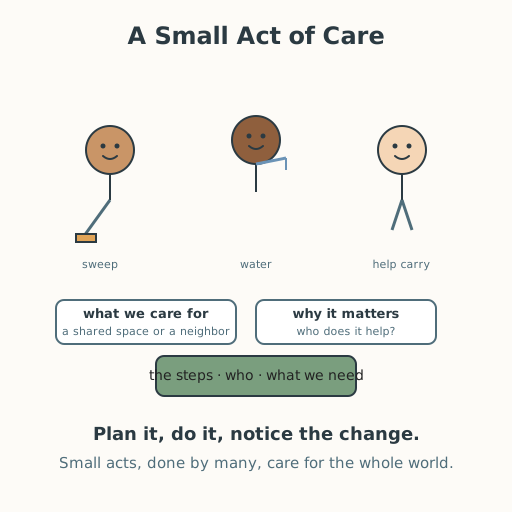
- Act-of-care planner · 1 per learner A page with — what we will care for, why it matters, the steps, who helps, what we need
- Cleaning or helping supplies · as available Cloths, a broom, a watering can, gloves — whatever the chosen act of care needs
Low-tech / no-cost
- Hands and voices Tidy with bare hands, carry with two arms, or lend a hand to a neighbor — no supplies needed
- A found tool A leaf for a duster, a hollow gourd or cup for watering — the act matters, not the tool
Enriched / lab & device
- A class "care calendar" · 1 A calendar where each small act of care is planned and checked off across the week
- A camera or tablet · 1 per group Photograph the act of care before and after to record the difference it made
Works in different contexts
- large-group Choose one shared space or neighbor as a whole class, divide the steps, and do the care together, then reflect as a group
- self-directed A learner fills the planner alone, does one small act of care, and records what changed
- outdoor-only Choose an outdoor shared space or a neighbor who works outside — sweep a path, water a plant, help carry — and do it in the open air
- multi-age Older learners lead the planning steps; younger learners carry a single step each, so every hand has a part
- level-grouped Group by comfort with organizing; every learner fills the same planner, and confident planners model the steps first
Lesson 7 — A Small Act of Care
Summary
Learners organize a small act of care — cleaning a shared space or helping a neighbor — by planning what they will care for, why it matters, and how (the steps), then carrying it out and recording the difference it made.
Objectives
- Organize a small act of care, such as cleaning a shared space or helping a neighbor. (D02.S4.04.01)
Connection
A swept floor, a watered plant, a bag carried up the stairs for an older neighbor — these are small acts, and together they are the quiet machinery that keeps a community livable. In a village, clearing a shared path after a storm helps everyone; in a city building, wiping the stair rail helps every hand that touches it. No act of care is too small to matter, and none requires being asked. Today you plan one, do it, and watch a shared space or a neighbor’s day get a little lighter.
Materials
- An act-of-care planner
- Cleaning or helping supplies (as available)
- A camera or tablet (optional)
Preparation
- Copy an act-of-care planner for each learner.
- Gather simple supplies for likely acts of care.
- Identify a shared space or a neighbor who could use help (with permission where needed).
Facilitator note
This is the unit’s action lesson, building on Lesson 5’s “my role.” Teach the planner as explicit instruction — what, why, steps, who, what we need — and model filling one out (Kirschner, Sweller & Clark, 2006). The value to protect: care is chosen and organized by the learners, not performed to be praised, and the point is the shared good, not an individual reward. This is egalitarianism and ethics in practice: everyone contributes, and the benefit flows to the whole — including the natural world when the “shared space” is outdoors. Keep the acts safe, doable, and within reach; a heavy or risky task is scaled down so every learner can contribute a real step. Honor every ability: a learner who cannot lift plans, counts, fetches, or holds the door — all are full acts of care. Record the act for the portfolio and reflect on the change, not the praise. Read the procedure aloud.
Procedure
- Gather (5 min). Remember Lesson 5: you found a role. Today you take the next step — you organize a small act of care, from start to finish, on your own.
- Plan the act (10 min). Fill your act-of-care planner. What will we care for — a messy shelf, a dry plant, a neighbor’s heavy bag, a littered path? Why does it matter — who does it help? Steps — what do we do, in order? Who helps? What do we need?
- Watch a worked example (5 min). Model: “We will tidy the book corner. Why: so every child can find a book. Steps: one, sort the books; two, wipe the shelf; three, put books back spine-out. Who: the three of us. Need: a cloth.” Notice the plan is small and doable.
- Carry it out (20 min). Do the act of care. Work together; check your steps as you go. Then look at the before and the after — what changed? Record it on your planner as a portfolio piece.
- Close (5 min). You just changed your community for the better with your own two hands. Small acts, done by many, are how the world is cared for. That power is yours.
Differentiation
- Support: Offer a two-step plan with pictures (“first sort, then wipe”) and a partner; a non-speaking learner points to the steps and does one part.
- Extension: Organize a recurring act of care (a weekly tidy) and invite others to join, so the care lasts beyond today.
Assessment
- Formative (observation): Did the learner plan an act of care (what, why, steps) and carry it out, and can they say what changed because of it?
- Artifact (portfolio): The completed act-of-care planner with the before/after record.
Home connection
Do one small act of care at home this week — a swept step, a cleared table, a carried bag — without being asked, and tell someone what changed because of it.
Resources
- CASEL SEL Framework (responsible decision-making competency): https://casel.org/fundamentals-of-sel/