Lesson 01 — Summarizing an Oral Presentation
Learners listen to a short oral presentation and summarize it: the main idea in one sentence plus the key details, in their own words, telling what matters most without repeating every word.
Objectives
Objectives
- D04.S1.04.01 Summarize the main idea and key details of an oral presentation or read-aloud.
Essential question
How do I summarize the main idea and key details of something I hear?
Key vocabulary
Materials
Standard materials
- A short oral presentation · 1 A live talk or recording, one to two minutes, clearly about one thing (how a seed grows, how to cross a road safely, how a game is played)
- A summary frame card · 1 A card with two lines — "The main idea is…" and "Key details: 1, 2, 3"
Low-tech / no-cost
- A remembered telling Use a story or explanation someone in the room tells aloud; no text or card needed — summarize on fingers or in the air
- Voice and memory Say the summary aloud and count key details on fingers
Enriched / lab & device
- A recorded presentation with pause control · 1 A device to replay and pause a short talk while noting the main idea and key details
- Printed summary frame cards · 1 per learner Reusable cards with "main idea" and three "key detail" lines
Works in different contexts
- large-group One learner gives the short talk to the whole group; the group works together to name the main idea, then individuals each recall three key details
- self-directed A learner listens to a recording or a remembered telling, then writes the main idea and three key details in their own words and checks them against the source
- multi-age Older learners model a one-sentence summary; younger learners echo the main idea and add one detail they caught
- level-grouped Each group hears a presentation at its own level and summarizes; groups then compare how the same skill looked at different levels
- outdoor-only A learner explains something outdoors — how to start a fire safely, how ants carry food — and the group summarizes the main idea and key details aloud
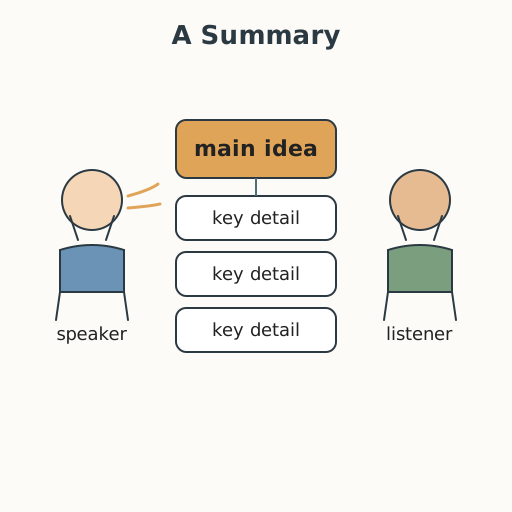
Lesson 1 — Summarizing an Oral Presentation
Summary
Learners listen to a short oral presentation and learn to summarize it: state the main idea in one sentence, then name the key details that matter. A summary is shorter than the original, in the listener’s own words, and keeps only what is most important.
Objectives
- Summarize the main idea and key details of an oral presentation or read-aloud. (D04.S1.04.01)
Connection
Think of someone explaining a new game, giving directions to a place, or telling you what happened at the market or in the field. You do not walk away holding every single word — you keep the big point and the few details that matter. That is summarizing. It is how you carry a speaker’s meaning with you, in your own words, long after they finish.
Materials
- A short oral presentation (live or recorded, one to two minutes)
- A summary frame card (“The main idea is…” / “Key details: 1, 2, 3”)
Preparation
- Choose or record a short, clear presentation about one thing.
- Prepare the summary frame card.
- Arrange a listening circle where everyone can hear the speaker.
Facilitator note
This lesson is written to the learner (“you”) so it works in a classroom and for a self-directed learner. Summarizing is a taught skill: model it first with a worked example (a short talk you give, then summarize aloud), then guide learners to try it (Kirschner, Sweller & Clark, 2006). Keep the parts clear — the main idea is the one big thing the talk is about; the key details are the few facts or steps that hold it up. Accept a summary in the learner’s own words and own language; there is no single “correct” wording. A learner who is Deaf or hard of hearing summarizes a signed presentation; a learner who is blind or has low vision summarizes what they hear. This is sense-making, not a memory test — honor a faithful summary even when it is worded differently. If a recording or translation tool is used, notice what it adds (many voices) and what it cannot carry (the living person); people remain the real source.
Procedure
- Gather (5 min). Remember the last time someone explained something to you. What did you keep from it? That is a summary already.
- Meet the summary (5 min). Learn what a summary is: the main idea in one sentence, plus the key details — the few things that matter most. It is shorter than the original, and it is in your own words.
- Watch a worked example (10 min). The facilitator gives a short talk, then thinks aloud: “Mostly, this talk was about…” (the main idea), “and the key details were…” (the important parts, not every word). Watch how one big idea is held up by a few details.
- Listen and summarize (15 min). Listen to a short presentation. Ask yourself: what was it mostly about? What few details really mattered? Say or write the main idea in one sentence, then list three key details.
- Check with a partner (5 min). Trade summaries. Did your partner catch the main idea? Did they keep the key details and leave out the small extras?
- Close (5 min). A summary is the gift of understanding: you keep the big idea and the details that matter, and you can pass them on in your own words.
Differentiation
- Support: Use a very short, single-topic talk and offer a choice of two possible main ideas; the learner picks the one the talk was mostly about.
- Support (non-speaking): Summarize by pointing to pictures, signing, or writing.
- Support (blind/low vision): Summarize from a talk heard aloud, stating the main idea and details orally or in braille or large print.
- Extension: Summarize a longer presentation in two sentences and note which details the speaker themselves emphasized most.
Assessment
- Formative (observation): Can the learner state the main idea of a heard presentation in one sentence and name the key details, in their own words and language?
Home connection
Tonight, ask someone at home to tell you how their day went or how to do a task, then say it back: “So mostly, it was about…, and the important parts were…” Ask if you got the summary right.
Resources
- Kirschner, P. A., Sweller, J., & Clark, R. E. (2006). Why minimal guidance during instruction does not work. Educational Psychologist, 41(2), 75–86. (Evidence for worked examples and explicit instruction when teaching a new skill.)
- National Reading Panel (2000). Report on comprehension — summarizing is a core comprehension strategy. (Widely used evidence base.)