Lesson 02 — Key Details of a Read-Aloud
Learners listen to a read-aloud and learn to separate key details from extra ones — choosing only the details that are needed to understand the whole — then retell the passage with the main idea and its key details.
Objectives
Objectives
- D04.S1.04.01 Summarize the main idea and key details of an oral presentation or read-aloud.
Essential question
How do I pick out the key details when someone reads aloud?
Key vocabulary
Materials
Standard materials
- A read-aloud passage · 1 A short grade-level passage in the home language, read aloud, with clear key details
- A "key details" note sheet · 1 Three or four lines for jotting or sketching the details that matter
Low-tech / no-cost
- A told story or report Use a remembered story or a spoken report; hold key details on fingers or in memory
- Drawings in sand or air Sketch each key detail as a simple mark to remember and retell it
Enriched / lab & device
- An audio recording of the passage · 1 Replay and pause to catch each key detail before noting it
- Individual note sheets · 1 per learner Printed sheets for writing or sketching key details as they listen
Works in different contexts
- large-group Read aloud once, then once more; the group names details together and decides which ones are key (needed) and which are extra
- self-directed A learner reads a passage aloud to themselves (or listens), notes the key details, then checks whether each detail is needed to understand the whole
- multi-age Older learners read aloud; younger learners hold up a finger for each key detail they hear, then the group agrees on the final set
- level-grouped Each group hears a passage at its own level and lists key details, then groups compare how many details were truly key
- outdoor-only Read or tell a short account of a real happening nearby and have learners pick the key details that explain what happened
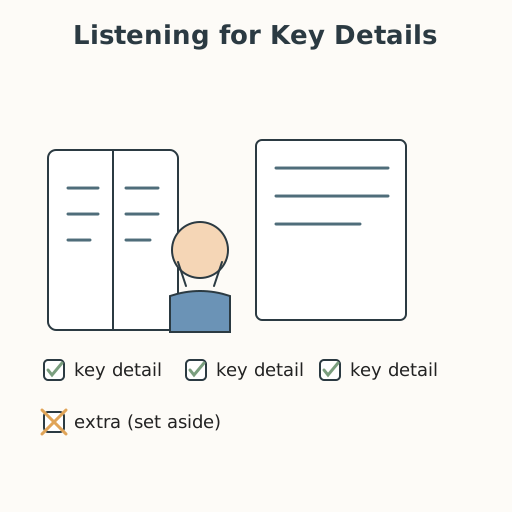
Lesson 2 — Key Details of a Read-Aloud
Summary
Learners listen to a read-aloud and practice choosing the key details — the few facts, steps, or events that are needed to understand the whole — while setting aside the extra details. They close by retelling the passage with the main idea and its key details.
Objectives
- Summarize the main idea and key details of an oral presentation or read-aloud. (D04.S1.04.01)
Connection
When someone reads a story or a report aloud, not every word is equally important. Some details are the load-bearing walls of the meaning; others are just decoration. If you tell a friend about a trip, you keep the storm that changed the plan — and leave out the color of every single shirt. Choosing key details is how listening becomes understanding.
Materials
- A read-aloud passage (short, grade-level, with clear key details)
- A “key details” note sheet
Preparation
- Choose a short passage with a few clear, important details.
- Prepare the note sheet.
- Plan to read the passage at a clear, unhurried pace.
Facilitator note
This lesson is written to the learner (“you”) so it works in a classroom and for a self-directed learner. Picking key details is a taught skill: model it with a worked example — read a short passage, then think aloud about which details are needed to understand it and which are extra (Kirschner, Sweller & Clark, 2006). The test question is always “if I took this detail away, would the meaning change?” — not “is this detail interesting?” Accept retells in the learner’s own words and language, and honor a faithful retell even when the wording differs. A learner who is Deaf or hard of hearing retells from a signed read-aloud or written text; a learner who is blind or has low vision retells from what they heard. Reading aloud well — with clear pace and volume — is itself a model of the speaking skills this unit builds.
Procedure
- Gather (5 min). Think of a story you love. If you had to tell it in one minute, which parts would you keep? Those are its key details.
- Meet the question (5 min). Learn the listener’s question for every read-aloud: which details are needed to understand the whole, and which are extra? Key details matter; extras can be set aside.
- Watch a worked example (10 min). The facilitator reads a short passage, then thinks aloud: “This detail — is it needed? Yes, because… That detail — is it needed? No, it is extra.” Watch how they keep the few and set aside the rest.
- Listen and choose (15 min). Listen to the read-aloud. Jot or sketch the details you hear, then decide which are key and which are extra. Keep the key ones.
- Retell (5 min). Retell the passage to a partner: the main idea plus the key details, in your own words. Did your partner leave out the extras?
- Close (5 min). A good listener is not a tape recorder. They choose what matters and carry that forward.
Differentiation
- Support: Use a very short passage and give a prepared list of details; the learner circles the key ones.
- Support (non-speaking): Point to pictures or sign the key details in order.
- Support (blind/low vision): Note key details by memory or braille as the passage is read, then retell orally.
- Extension: After retelling, explain why each kept detail was key and why one extra was set aside.
Assessment
- Formative (observation): Can the learner retell a read-aloud with the main idea and its key details, leaving out extras, in their own words and language?
Home connection
At home, have someone read you a short piece from a book or a message. Retell it with only the key details, and ask whether you kept what mattered.
Resources
- Kirschner, P. A., Sweller, J., & Clark, R. E. (2006). Why minimal guidance during instruction does not work. Educational Psychologist, 41(2), 75–86.
- National Reading Panel (2000). Report on comprehension (summarizing and identifying important information). (Widely used evidence base.)