Lesson 03 — Presenting with Clear Volume and Pace
Learners prepare and deliver a short talk, practicing two things that make speaking clear — appropriate volume (loud enough for the room, not shouting) and pace (not too fast, not too slow) — and give and receive simple listener feedback.
Objectives
Objectives
- D04.S1.04.02 Present a short talk to a group, speaking clearly with appropriate volume and pace.
Essential question
How do I speak so a group can hear and follow me?
Key vocabulary
Materials
Standard materials
- A short prepared talk · 1 Two to three sentences the learner already knows (a favorite animal, a game, a how-to)
- A "listener check" card · 1 Two prompts — "I could hear you" and "I could follow you" — with space for one suggestion
Low-tech / no-cost
- Voice and a partner Speak and receive feedback with no tools; use a raised hand as a "too quiet" signal
- A distance cue Practice speaking across the room or outdoor space so a partner at the far side can hear
Enriched / lab & device
- A microphone or voice recording app · 1 Hear your own volume and pace played back, and practice with amplification
- A metronome or timer · 1 Practice a steady pace, then deliberately slow or speed it up to feel the difference
Works in different contexts
- large-group One learner speaks to the whole group from the front; the group raises a quiet signal if they cannot hear, and the speaker adjusts volume or pace
- self-directed A learner records themselves, listens back, and checks two things: could someone hear it? could they follow the pace?
- multi-age Older learners demonstrate volume and pace; younger learners practice being the audience and giving the "I could hear / I could follow" check
- level-grouped Pairs within a group take turns speaking and checking; each pair reports one thing they improved
- outdoor-only Practice speaking so a listener at a distance, with wind and other sounds, can still hear and follow — the open air is a natural volume lesson
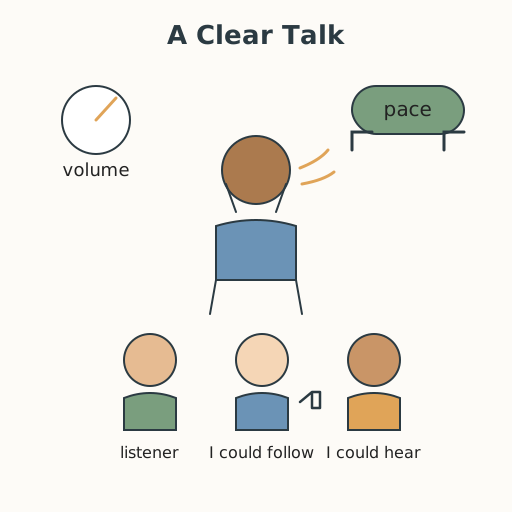
Lesson 3 — Presenting with Clear Volume and Pace
Summary
Learners prepare a short talk and practice the two things that make a speaker easy to hear and follow: volume (loud enough for the whole room, but not shouting) and pace (not too fast, not too slow, with small pauses). They give and receive simple listener feedback and adjust.
Objectives
- Present a short talk to a group, speaking clearly with appropriate volume and pace. (D04.S1.04.02)
Connection
Have you ever missed what someone said because they whispered, or lost the thread because they raced through it? Speaking is not only about words — it is about being heard and followed. Whether you are telling a story, explaining a rule, or asking for help, your voice can build a bridge to the listener or let the meaning fall into a gap. Volume and pace are two of the tools that build that bridge.
Materials
- A short prepared talk (two to three sentences)
- A “listener check” card (“I could hear you” / “I could follow you”)
Preparation
- Have each learner think of a short talk they can give (a favorite animal, a game, a how-to).
- Prepare the listener check card.
- Arrange the room so a speaker can be seen and heard from the back.
Facilitator note
This lesson is written to the learner (“you”) so it works in a classroom and for a self-directed learner. Presenting is a skill, so model it: give a short talk yourself at the right volume and pace, then once too quietly and too fast, and let learners name the difference (worked example before practice; Kirschner, Sweller & Clark, 2006). Frame feedback as help, not judgment — “I could hear you” and “I could follow you” are observations, not scores. Honor many ways of presenting: a learner who is Deaf or hard of hearing presents in sign or with a communication device, and clarity of signing pace and size is just as real as spoken volume; a learner who stutters or speaks with a speech difference presents at their own pace, and the room listens with patience. The measure of a clear talk is whether the audience understands, never whether a voice sounds “standard.” Keep the atmosphere safe and encouraging — speaking in front of a group is brave, and every attempt is a step.
Procedure
- Gather (5 min). Think of a time you could not hear or follow a speaker. What would have helped? That is what you will practice today.
- Meet the two tools (5 min). Learn the two checks for a clear talk: volume (loud enough for the farthest listener, not shouting) and pace (not too fast, not too slow, with small pauses between ideas).
- Watch a worked example (10 min). The facilitator gives a short talk three ways: too quiet, too fast, then just right. After each, ask: could you hear it? could you follow it? Notice what changed.
- Prepare your talk (5 min). Choose your two or three sentences and say them to yourself once, slowly.
- Present and check (15 min). Present your talk to a partner or group. Listeners use the card: “I could hear you” and “I could follow you,” plus one helpful suggestion. Try it once more, adjusting volume or pace.
- Close (5 min). A clear voice is a gift to your listeners. Volume and pace are tools you already own — use them so your meaning arrives.
Differentiation
- Support: Present one sentence at a time, pausing between; a partner gives one specific, kind suggestion at a time.
- Support (anxiety): Present to one trusted partner first, then a small group, before the whole group.
- Support (Deaf/hard of hearing or speech difference): Present in sign or with a device; clarity of pace and sign size is the “volume and pace” of that mode.
- Extension: Present a longer talk, varying pace on purpose — slow for an important idea, quick for an exciting one — and explain the choice.
Assessment
- Formative (observation/peer): Can the learner present a short talk that the audience reports hearing clearly and following at a comfortable pace?
Home connection
At home, tell someone one thing you learned today, checking your volume and pace, and ask: “Could you hear me and follow me?”
Resources
- Kirschner, P. A., Sweller, J., & Clark, R. E. (2006). Why minimal guidance during instruction does not work. Educational Psychologist, 41(2), 75–86.
- CASEL SEL Framework (self-awareness and relationship skills): https://casel.org/fundamentals-of-sel/