Lesson 05 — Finding Roots in Words
Learners discover that many words are built on a root that carries a core meaning, and use that root to figure out unfamiliar words. They build a word tree showing how one root grows into a whole family of related words.
Objectives
Objectives
- D04.S2.04.01 Use context clues and word parts, such as roots, prefixes, and suffixes, to figure out unfamiliar words.
Essential question
How does a word's root help me understand it?
Key vocabulary
Materials
Standard materials
- A word-root chart · 1 A chart showing one root and the words built from it (for example, "port" — carry — portable, transport, import, export)
- A set of root cards · 1 set Cards with a root on one side and words that share it on the other
Low-tech / no-cost
- A tree drawn in sand or chalk Draw a trunk labeled with the root, and branches for each word that shares it
- Voice and memory Say the root aloud, then list words that carry it, and explain how the root gives them their meaning
Enriched / lab & device
- A root-and-word matching game · 1 set Match roots to words that share them, then explain the shared meaning
- A digital word-part tool or dictionary · 1 Look up a word's root and see the family of words that grew from it
Works in different contexts
- large-group Build one root tree together on the board, each learner adding a word that shares the root and telling how the root lives inside it
- self-directed A learner chooses a root, lists words that share it, and explains how the root gives each word part of its meaning
- multi-age Older learners name the root; younger learners match words to it and echo the shared meaning
- level-grouped Each group explores a different root, then groups teach their root and word family to the class
- outdoor-only Use a real tree or plant as the image — trunk for the root, branches for the words — and say each word as you trace a branch
Lesson 5 — Finding Roots in Words
Summary
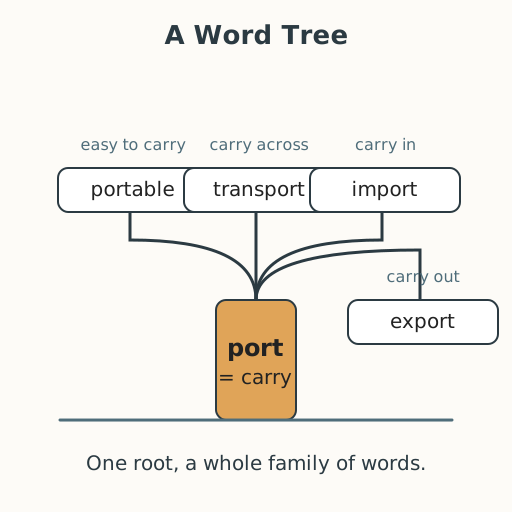
Learners learn that many words are built on a root — a small part that carries the word’s core meaning. They explore how one root grows into a whole family of related words (for example, the root port, meaning “carry,” grows into portable, transport, import, and export), and use the root to figure out unfamiliar words.
Objectives
- Use context clues and word parts, such as roots, prefixes, and suffixes, to figure out unfamiliar words. (D04.S2.04.01)
Connection
Think of a family: many people, one shared name, one shared story. Words have families too. A root is the shared part that carries the core meaning, and the words built on it are its children. If you know what the root means, you can often guess a whole word you have never met — like recognizing a family member by the family name. Roots turn a strange word into a familiar one.
Materials
- A word-root chart
- A set of root cards
Preparation
- Choose one root to model (for example, port = “carry”).
- Prepare the root chart and root cards.
Facilitator note
This lesson is written to the learner (“you”) so it works in a classroom and for a self-directed learner. Roots are a taught skill, so model the word tree with a worked example, thinking aloud about how the root’s meaning lives inside each word (Kirschner, Sweller & Clark, 2006). Use roots that clearly carry meaning, such as port (“carry”), struct (“build”), or spect (“look”). This is script- and language-agnostic: every language builds words from meaningful parts, though the parts differ; invite learners to share roots from their own languages too. The goal is meaning-making, not memorizing a list — a learner who can explain why a word means what it does has the skill. Honor guesses and explanations in the learner’s own language, and be generous: a reasonable connection between root and word is success, not a perfect etymology. Where a digital word-part tool is used, treat it as a helper to confirm, not a substitute for the thinking.
Procedure
- Gather (5 min). Think of a word you know that is long and built from smaller parts. What does each part do?
- Meet the root (5 min). Learn what a root is: the small part of a word that carries its core meaning. Many words share one root, and the root tells you what they all have in common.
- Watch a worked example (10 min). The facilitator draws a word tree: the trunk is the root port (“carry”); the branches are portable (easy to carry), transport (carry across), import (carry in), export (carry out). Watch how the root’s meaning lives in every branch.
- Grow your own word tree (15 min). Choose a root. List words that share it, and tell how the root gives each word its meaning. Draw or write your tree.
- Figure out a new word (5 min). Meet an unfamiliar word that shares your root. Use the root to guess what it means, then check by explaining it to a partner.
- Close (5 min). Know the root, and a whole family of words opens to you. Word parts are keys.
Differentiation
- Support: Use one root and match pre-made words to it; the learner explains how the root lives in each.
- Support (non-speaking): Point to the root and to the part of each word that carries it, or sign the shared meaning.
- Support (blind/low vision): Hear the root and words read aloud, or read them in braille or large print, and explain the shared meaning orally.
- Extension: Find the roots of three words in your own reading and explain each word’s meaning from its root, checking in a dictionary.
Assessment
- Formative (observation): Can the learner identify a root in unfamiliar words and use its meaning to figure out or explain the words?
Home connection
At home, pick one word you use often and try to find its root — ask someone, or look it up — then name another word that shares it.
Resources
- Kirschner, P. A., Sweller, J., & Clark, R. E. (2006). Why minimal guidance during instruction does not work. Educational Psychologist, 41(2), 75–86.
- National Reading Panel (2000). Report on vocabulary and morphology (word parts). (Widely used evidence base.)