Lesson 06 — Prefixes and Suffixes
Learners learn how prefixes (before the base) and suffixes (after the base) change a word's meaning, and practice building and taking apart words to figure out unfamiliar ones.
Objectives
Objectives
- D04.S2.04.01 Use context clues and word parts, such as roots, prefixes, and suffixes, to figure out unfamiliar words.
Essential question
How do prefixes and suffixes change a word's meaning?
Key vocabulary
Materials
Standard materials
- A word-building strip · 1 A strip with a base word in the middle and spaces for a prefix on the left and a suffix on the right (for example, un + help + ful)
- Prefix and suffix cards · 1 set Cards for common affixes (un-, re-, dis-, pre-, -ful, -less, -er, -ly)
Low-tech / no-cost
- Three boxes drawn in sand or chalk A box for the prefix, the base word, and the suffix; move words in and out to change meaning
- Voice and claps Say the base word, then add a prefix or suffix aloud and clap once per part
Enriched / lab & device
- A prefix/suffix sorting game · 1 set Sort affixes into "changes meaning this way" groups and build new words
- A digital word-building tool · 1 Combine affixes and bases to make and check new words
Works in different contexts
- large-group Build words together on the board, sliding prefixes and suffixes on and off a base word and naming how the meaning changes each time
- self-directed A learner builds words from affix and base cards, writes each, and explains how the affix changed the meaning
- multi-age Older learners model adding an affix; younger learners echo the new word and say whether the prefix came before or the suffix after
- level-grouped Each group builds words with a different set of affixes, then groups trade and read each other's words
- outdoor-only Draw the three boxes in the soil and step from prefix to base to suffix as you build each word aloud
Lesson 6 — Prefixes and Suffixes
Summary
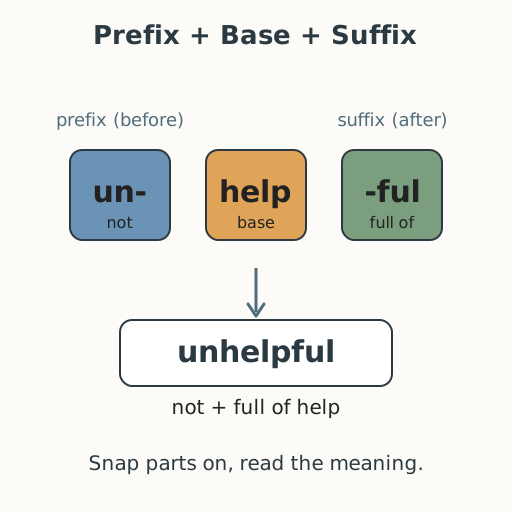
Learners learn how prefixes (parts added to the front of a base word) and suffixes (parts added to the end) change a word’s meaning. They build words like un + help + ful = unhelpful and take unfamiliar words apart to figure them out.
Objectives
- Use context clues and word parts, such as roots, prefixes, and suffixes, to figure out unfamiliar words. (D04.S2.04.01)
Connection
Think of a base word as a plain block, and of prefixes and suffixes as add-ons that snap onto it and change what it does — like adding a roof or a porch to a house. “Help” becomes “helpful” (full of help) or “unhelpful” (not helpful). Once you know a few affixes, you can take apart a long word and read it piece by piece, like a builder reading a plan.
Materials
- A word-building strip (base word + spaces for prefix and suffix)
- Prefix and suffix cards (un-, re-, dis-, pre-, -ful, -less, -er, -ly)
Preparation
- Prepare the word-building strip and affix cards.
- Choose a base word to model (for example, “help”).
Facilitator note
This lesson is written to the learner (“you”) so it works in a classroom and for a self-directed learner. Affixes are a taught skill: model building and taking apart words with a worked example, naming how the meaning changes each time (Kirschner, Sweller & Clark, 2006). Teach the pattern, not a memorized list — a prefix goes before and a suffix after, and each carries a meaning (un- = not, re- = again, -ful = full of, -less = without). This is script- and language-agnostic: languages affix meaning in different ways, and learners may share examples from their own languages. The goal is meaning-making — a learner who can explain “unhelpful = not + full of help” has the skill. Honor explanations in the learner’s own language, and treat a digital tool as a helper to check, not a substitute for thinking. Keep it playful: word-building is a game, and every new word is a small discovery.
Procedure
- Gather (5 min). Think of a long word you know. Break it into parts in your mind. What does each part add?
- Meet prefixes and suffixes (5 min). Learn the two kinds of add-ons: a prefix attaches before the base word, a suffix after. Each one changes the meaning in a small, predictable way.
- Watch a worked example (10 min). The facilitator builds a word on the strip: help → helpful (full of help) → unhelpful (not helpful). Then they take unhelpful apart, piece by piece, naming what each part means. Watch the meaning change with each snap.
- Build and take apart words (15 min). Use the cards to build new words from a base word. Write each one and explain what the prefix or suffix added. Then take an unfamiliar word apart and figure out its meaning from its parts.
- Share (5 min). Read a partner one word you built, and have them tell you what it means from its parts.
- Close (5 min). Affixes are snap-on meaning. Know a few, and long words stop being walls and become puzzles you can solve.
Differentiation
- Support: Build with one affix at a time on a single base word; the learner names how the meaning changed.
- Support (non-speaking): Point to the prefix or suffix and to a picture of the meaning, or sign the change.
- Support (blind/low vision): Hear the words built aloud, or read them in braille or large print, and explain each part’s meaning orally.
- Extension: Take apart three unfamiliar words from your reading, name each affix and its meaning, and explain the whole word.
Assessment
- Formative (observation): Can the learner take an unfamiliar word apart into prefix, base, and suffix, and use the parts to explain its meaning?
Home connection
At home, find one long word and break it into its parts — prefix, base, suffix — and tell someone what each part means.
Resources
- Kirschner, P. A., Sweller, J., & Clark, R. E. (2006). Why minimal guidance during instruction does not work. Educational Psychologist, 41(2), 75–86.
- National Reading Panel (2000). Report on vocabulary and morphology (affixes). (Widely used evidence base.)