Lesson 15 — Respecting a Peer's Language and Name
Learners show respect for a peer's language by learning and correctly pronouncing their name and a few words, asking "how do you say it?", practicing until it is right, and treating every name and language as worthy of care.
Objectives
Objectives
- D04.S4.04.02 Show respect for a peer's language by learning and correctly pronouncing their name and a few words.
Essential question
How do I show respect for a peer's language and name?
Key vocabulary
Materials
Standard materials
- A "my name" card · 1 A card where each learner writes their name and how to say it, in their own words or sounds
- A "words to learn" sheet · 1 Space for a greeting and a courtesy word (such as "thank you") in a peer's language
Low-tech / no-cost
- Voices and ears Ask a peer "how do you say your name?" and echo it carefully; learn two words the same way
- A spoken circle Sit in a circle and pass each name and word around, each person echoing it with care
Enriched / lab & device
- A recording app · 1 Record a peer saying their name and two words (with their permission) to practice the pronunciation
- A multilingual word wall · 1 Display each learner's name and a few words in their language, all equal in size, none above another
Works in different contexts
- large-group Go around the circle learning and echoing each name and two words; post them on the word wall as a shared record
- self-directed A learner chooses a peer (or a recording), asks how to say their name and two words, practices until correct, and checks by asking "did I say it right?"
- multi-age Younger learners ask and echo; older learners model patient repetition and gentle correction
- level-grouped In small groups, each person teaches their name and two words; the group practices together and checks one another kindly
- outdoor-only Pass names and words around an outdoor circle, speaking clearly in the open air and repeating until each is right
Lesson 15 — Respecting a Peer’s Language and Name
Summary
Learners show respect for a peer’s language by learning and correctly pronouncing their name and a few words. They ask “how do you say it?”, practice until it is right, and check kindly — treating every name and every language as worthy of care. This lesson closes the unit by bringing its whole journey together.
Objectives
- Show respect for a peer’s language by learning and correctly pronouncing their name and a few words. (D04.S4.04.02)
Connection
A person’s name is one of the first gifts they are given — it is tied to who they are, their family, and their story. Saying a name wrong, or not trying to say it right, can feel like saying “you are not worth the effort.” Saying it right, and learning even two words of a person’s language, says “I see you, and I honor where you come from.” Respect begins with a name.
Materials
- A “my name” card
- A “words to learn” sheet
Preparation
- Prepare the name cards and words-to-learn sheet.
- Think about how to model asking “how do you say your name?” with warmth and patience.
Facilitator note
This lesson is written to the learner (“you”) so it works in a classroom and for a self-directed learner. This is the unit’s capstone of respect: model asking “how do you say your name?” and echo it carefully, and let a learner correct you until you get it right — the facilitator is the first learner here. Names carry identity; mispronouncing a name repeatedly can feel like erasure, and the research on name pronunciation and belonging supports this (Kohli & Solórzano, 2012, on “racial microaggressions” including name mispronunciation). Hold this gently: no one should be forced to teach their language or be made into a display; a peer offers their name and words as a gift, and the gift can be declined. Practice is cooperative, not graded — “did I say it right?” is an invitation to be corrected, never a test with a score. Honor signed languages exactly as high as spoken ones — a signed name is a name. Treat accents as natural variation, never as error. A learner who is Deaf or hard of hearing learns names and words in sign or through written or visual forms. The measure is not perfection but care — a learner who keeps trying until it is right has shown the respect that matters.
Procedure
- Gather (5 min). Think about your own name. How do you feel when someone says it right? How do you feel when they do not try?
- Meet the question (5 min). Learn the respectful question: “How do you say your name?” — and the two-word gift: learn a peer’s greeting and a courtesy word (such as “thank you”) in their language.
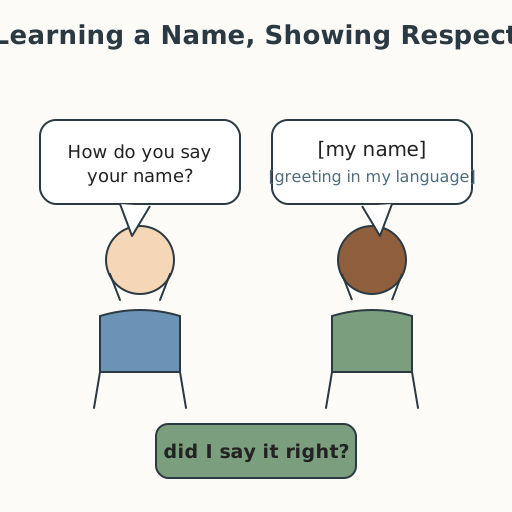
- Watch a worked example (10 min). The facilitator asks a volunteer “how do you say your name?”, listens, echoes it, and asks “did I say it right?” — repeating until correct. Watch how asking and echoing shows care.
- Learn a name and words (15 min). Pair up. Ask your partner how to say their name, and practice it until it is right, asking “did I say it right?” as you go. Then learn their greeting and a courtesy word. Switch roles.
- Share the circle (5 min). In the group, each person shares the name and one word they learned, saying it with care, and the person whose language it is confirms.
- Close (5 min). Every name and every language is a door into a person’s world. Learning them is respect in action. You have done that today.
Differentiation
- Support: Learn just the name first, then one word, checking “did I say it right?” after each.
- Support (non-speaking): Learn the name and words in sign or written/visual form, and confirm understanding with a nod, a sign, or a written note.
- Support (Deaf/hard of hearing or speech difference): Learn and produce names and words through the learner’s preferred mode — sign, written form, or a communication device — and practice at a comfortable pace.
- Extension: Learn a short phrase beyond a single word — “my name is…” or “please” — in a peer’s language, and use it correctly later in the week.
Assessment
- Formative (peer/observation): Can the learner correctly pronounce (or produce, in the preferred mode) a peer’s name and at least two words, checking and adjusting until the peer confirms it is right?
Home connection
At home, ask everyone to teach you how to say their name just as they like it, and learn one new word in a language spoken by someone you know.
Resources
- Kohli, R., & Solórzano, D. G. (2012). Teachers, please learn our names! Race, Ethnicity and Education, 15(4), 441–462. (On name mispronunciation and belonging.)
- CASEL SEL Framework (social awareness and relationship skills): https://casel.org/fundamentals-of-sel/