Lesson 14 — Language Families and Shared Roots
Learners discover that languages belong to families and that many languages share roots, using the word for "mother" across several related languages as a living example, and recognizing that shared roots are a record of shared human history.
Objectives
Objectives
- D04.S4.04.01 Explain that languages belong to families and that many languages share roots, giving an example.
Essential question
How are languages related to one another like families?
Key vocabulary
Materials
Standard materials
- A language-family chart · 1 A simple family tree showing how several languages share one older root
- A "shared root" word card set · 1 set Cards with one word — such as "mother" — in several related languages
Low-tech / no-cost
- Voices in the room Collect one word from the languages people in the room know and listen for shared sounds
- A chalk or sand family tree Draw a tree with one root and branches for each related language
Enriched / lab & device
- Recordings or a language tool · 1 Hear the same word in several related languages and compare the sounds
- A world language-family map · 1 See where the families of languages live across the world
Works in different contexts
- large-group Build one family tree together, each learner adding a word in their language and noticing which words share a family
- self-directed A learner compares one word in several related languages, notices the shared root, and explains what makes them a family
- multi-age Older learners read each word aloud; younger learners echo and say whether two words sound like cousins
- level-grouped Each group explores a different language family, then groups teach the class their family and its shared root
- outdoor-only Draw a language family as a real tree in the soil, roots and branches labeled, and walk from root to branch as you say each word
Lesson 14 — Language Families and Shared Roots
Summary
Learners discover that languages belong to families, and that many languages share roots. They use a living example — the word for “mother” in several related languages — to see how one older word grew into a family of cousin languages, and they recognize that shared roots are a record of shared human history.
Objectives
- Explain that languages belong to families and that many languages share roots, giving an example. (D04.S4.04.01)
Connection
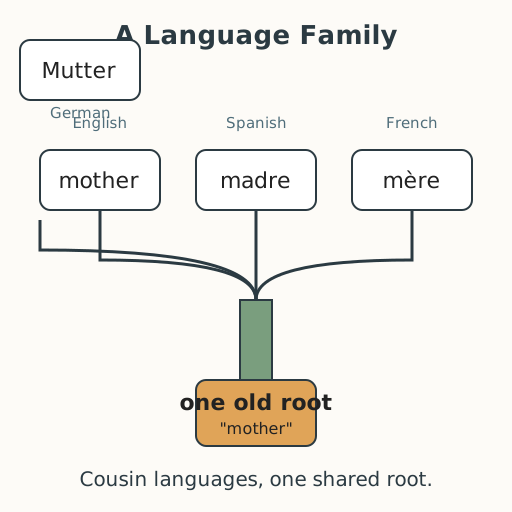
Think of a family reunion: cousins from far places, who have never met, still share a name and a grandparent. Languages are like that. The word for “mother” in English (mother), Spanish (madre), French (mère), German (Mutter), and Hindi (mātā) all descend from one very old word, spoken by people long ago. Languages that share a root are cousins, and their shared words are the family stories carried down the ages.
Materials
- A language-family chart
- A “shared root” word card set (for example, “mother” in several related languages)
Preparation
- Prepare the language-family chart and word cards.
- Gather the languages spoken or signed in the room, and any other sources available.
Facilitator note
This lesson is written to the learner (“you”) so it works in a classroom and for a self-directed learner. Teaching language families is an act of noticing, not ranking: guide learners to see and hear shared roots, and to understand that every language — related or not — is equal in worth (UNESCO holds that every language is a bearer of dignity). The example of “mother” is a real one: linguists reconstruct a common ancestor for English mother, Spanish madre, French mère, German Mutter, and Hindi mātā (the Proto-Indo-European root *méh₂tēr; see Fortson, Indo-European Language and Culture). Keep it honest about evidence: this ancient word is a reconstruction that linguists infer by comparing the descendant words — a scientific story, offered as such, not a revealed truth. Other families have their own shared roots (for example, in the Bantu family, the word for “person” is muntu in some languages and motho in others — a shared root across a wide family). Invite every learner’s home language into the circle, each entry equal. A language that has no “living relatives” is not less — it is simply its own branch, and it deserves the same honor. Treat translation tools as helpers that can show words, never as a replacement for the people who live the languages.
Procedure
- Gather (5 min). Think of your home language and the word you use for “mother.” Others in the world use words that sound surprisingly close. Why might that be?
- Meet the language family (5 min). Learn what a language family is: a group of languages that grew from one older language, like branches from one root. Cousin languages share words because they share that root.
- Watch a worked example (10 min). The facilitator shows the word for “mother” in several related languages — mother, madre, mère, Mutter, mātā — and points out the shared sounds. They explain: linguists compare these words to reconstruct one old root they all grew from. Watch how one root becomes a family.
- Find a family yourself (15 min). With the word cards or voices in the room, compare one word across several languages. Which ones sound like cousins? Say or sign each, and notice the shared root.
- Share (5 min). Tell a partner which languages you compared and what they shared. Did you find a family?
- Close (5 min). Languages are families, and their shared roots are the memory of our common past. No language is better than another — every branch is part of the great human tree.
Differentiation
- Support: Compare just two related words and name the one sound they share.
- Support (non-speaking): Compare signed or written forms of the word and point to the shared parts.
- Support (blind/low vision): Hear each word spoken and say which sound the same, or read the words in braille or large print.
- Extension: Find a second shared-root example (such as “night” — night, Nacht, nuit) and explain what makes it a family.
Assessment
- Formative (observation): Can the learner explain, with an example, that languages belong to families and share roots?
Home connection
At home, ask everyone for the word “mother” (or “water” or “three”) in every language they know, and look for the ones that sound like cousins.
Resources
- Fortson, B. W. (2010). Indo-European Language and Culture (2nd ed.). Wiley-Blackwell. (For the reconstruction of the Proto-Indo-European word for “mother.”)
- UNESCO, multilingual and mother-tongue-based education: https://www.unesco.org/en/days/mother-language