Lesson 01 — Place Value to One Million
Learners grow place value from hundreds to one million, reading and writing six-digit numbers in digits, words, and expanded form, and discovering that every big number is a bundle of millions, hundred-thousands, ten-thousands, thousands, hundreds, tens, and ones.
Objectives
Objectives
- D05.S1.04.01 Use place value to 1,000,000 to read, write, round, and compare multi-digit whole numbers.
Essential question
How does place value help me read and write any number up to one million?
Key vocabulary
Materials
Standard materials
- A place-value chart to one million · 1 per learner Columns labeled ones, tens, hundreds, thousands, ten-thousands, hundred-thousands, millions
- Paper or slate and a drawing tool · per learner To write numbers in digits, words, and expanded form
- Small counters or paper strips · a handful per pair To build small groups of ten, a hundred, and a thousand before going big
Low-tech / no-cost
- A scratched or chalk place-value chart on the ground Write the columns large in the dirt or sand and place stones or sticks in each column
- Voice and body Read numbers aloud in groups of three digits; stand in columns and hold up fingers for each place
Enriched / lab & device
- Base-ten blocks plus a thousands cube model · 1 set per pair Units, rods, flats, and a large cube to feel ten, a hundred, a thousand
- A number expander or place-value slider · 1 per learner A folding or sliding strip that shows a digit's value changing as it moves columns
Works in different contexts
- large-group Build one big number together on a wall or floor chart, reading each period in one voice before writing the digits
- self-directed A learner writes a six-digit number, names each digit's value, and checks by writing it in expanded form
- multi-age Older learners coach younger ones in naming the value of each digit; younger learners echo each place aloud
- level-grouped Learners who already read big numbers write numbers with zeros inside (like 405,070); others build and read numbers with no tricky zeros first
- outdoor-only Draw a six-column chart on the ground and place a stone in each column to build and read a big number
Lesson 1 — Place Value to One Million
Summary
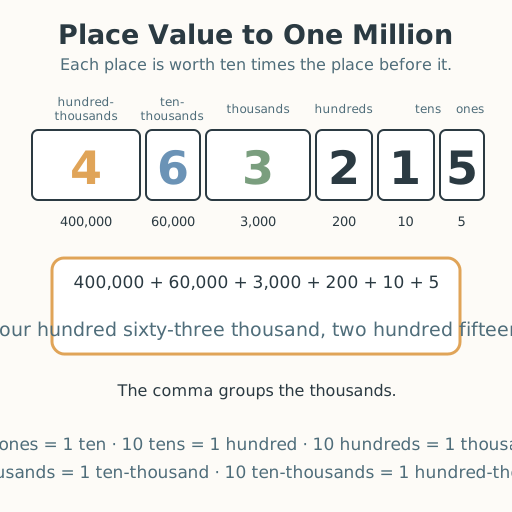
Learners grow place value from Grade 3’s hundreds to one million. They discover that a big number is a bundle of millions, hundred-thousands, ten-thousands, thousands, hundreds, tens, and ones, and they read and write six-digit numbers in three forms: digits, words, and expanded form (for example, 463,215 is “four hundred sixty-three thousand, two hundred fifteen” and 400,000 + 60,000 + 3,000 + 200 + 10 + 5). Place value becomes a thing you can see and say, not just a symbol.
Objectives
- Use place value to 1,000,000 to read, write, round, and compare multi-digit whole numbers. (D05.S1.04.01)
Connection
Every big number in your life is built from the same small idea. A city’s people, the rice in a harvest, the money a village saves for a well, the kilometers to a faraway place — people group these in thousands and millions so the number is easy to say. Last year you bundled ones into tens, tens into hundreds. This year the bundle grows: ten hundreds make a thousand, ten thousands make a ten-thousand, and a thousand thousands make a million. It is the same counting idea, just bigger.
Materials
- A place-value chart to one million (per learner)
- Paper or slate and a drawing tool
- A handful of small counters or paper strips (per pair)
Preparation
- Give each learner a place-value chart with the columns labeled.
- Prepare (or plan to draw) the number 463,215 as a worked example.
- Clear space to build small groups and count aloud.
Facilitator note
This lesson is written to the learner (“you”). It builds directly on Grade 3, where learners read and wrote numbers to 1,000; today the same unitizing move reaches one million — ten of any place makes one of the next place (Clements & Sarama, 2014). Teach the one new idea as a worked example (philosophy §13): show that ten tens is a hundred, ten hundreds is a thousand, ten thousands is a ten-thousand, and so on, then read 463,215 aloud in its periods. Keep it concrete: groups and charts first, symbols last. The speed at which a learner reads a big number is not a measure of their worth; a number is a fact about a collection, never about a person. The digits 0–9 we use today are one number system among many — they reached the wider world through Arabic-speaking scholars from India, while other peoples counted with tallies, knots, and many other ways (Ifrah, 2000; Zaslavsky, 1999). Count and read in the home language; number words differ across languages and all are correct. For learners who are Deaf or hard of hearing, sign each place or tap each column; for learners who are blind or have low vision, use a tactile chart and read by touch. Learners with limited movement direct a partner to place counters. Mastery arrives at its own pace.
Procedure
- Gather — remember the bundles (5 min). Last year you read numbers to 1,000: hundreds, tens, and ones. Make one group of ten right now. Ten ones make one ten; ten tens make one hundred; ten hundreds make one thousand. Say it together.
- Worked example — ten of one place makes the next (10 min). Watch and help build the places in order: ones, tens, hundreds, thousands, ten-thousands, hundred-thousands, millions. In each column, ten of that place make one of the next place. Now read 463,215 on the chart: four hundred-thousands, six ten-thousands, three thousands, two hundreds, one ten, five ones. Say it in words: four hundred sixty-three thousand, two hundred fifteen. Notice the comma that separates the thousands group from the rest.
- Guided practice — build and read (15 min). With counters, build a small number you know (like 432), then write it into the last three columns of your chart. Now make a bigger number by putting digits into the thousands, ten-thousands, and hundred-thousands columns. Read your number aloud, period by period. Write it three ways: in digits, in words, and in expanded form (400,000 + 60,000 + 3,000 + 200 + 10 + 5).
- Trade and check (8 min). Trade numbers with a partner. Read each other’s number aloud and check: do the digits, words, and expanded form all match? If not, fix them together, kindly.
- Tricky zeros (5 min). What if a place is empty? Write 405,070. The zeros are place-holders — the zero in the ten-thousands place says “no ten-thousands here,” the zero in the hundreds place says “no hundreds here,” and the zero in the ones place says “no extra ones here.” The 7 sits in the tens place: seven tens. Read it together: four hundred five thousand, seventy.
- Close (2 min). Remember: every place is worth ten times the place before it. A million is a thousand thousands. You can now read and write almost any number a person might use.
Differentiation
- Support: Read numbers up to 9,999 today; add ten-thousands and hundred-thousands another day, echoing each period.
- Support (motor): Use large, easy-to-grip counters or have a partner move them while the learner counts and directs.
- Extension: Write a number with zeros in two or three places (like 306,050) and explain what each zero is doing there.
Assessment
- Formative (observation): Can the learner name the value of each digit in a six-digit number and read the number aloud, period by period?
- Formative (written): Can the learner write a six-digit number in digits, words, and expanded form so all three match?
Home connection
At home, find a big number — the population of your town, the price of a large thing, the distance to a far city — and read it to a grown-up, saying the value of each digit. Then write it in words.
Resources
- Clements, D. H., & Sarama, J. (2014). Learning and Teaching Early Math: The Learning Trajectories Approach (2nd ed.). Routledge. (Unitizing — ten of one place making one of the next — as the foundation of place value.)
- Ifrah, G. (2000). The Universal History of Numbers. John Wiley & Sons. (The decimal positional system with zero originated in India and spread via Arabic-speaking scholars; it is one system among many.)
- Zaslavsky, C. (1999). Africa Counts: Number and Pattern in African Cultures (3rd ed.). Lawrence Hill Books. (Counting and tally systems across many traditions.)