Lesson 02 — Rounding & Comparing to One Million
Learners round multi-digit numbers to any place by finding the nearer landmark on a number line, and compare two big numbers by reading their digits left to right. Rounding becomes a choice between two neighbors, and comparing becomes a careful reading of place value.
Objectives
Objectives
- D05.S1.04.01 Use place value to 1,000,000 to read, write, round, and compare multi-digit whole numbers.
Essential question
How do I round a big number to any place and compare two big numbers?
Key vocabulary
Materials
Standard materials
- A number line strip to one million · 1 per pair A folded or drawn line to mark midpoints and round to any place
- Paper or slate and a drawing tool · per learner To record rounded and compared numbers
- A set of six-digit number cards · 1 set per pair To sort and compare
Low-tech / no-cost
- A rope or line scratched on the ground Mark a number line in the dirt, step to the midpoint, and round by walking to the nearer landmark
- Voice and body Round aloud by naming the two choices and picking the nearer one; compare by holding up the larger number of fingers
Enriched / lab & device
- A large wall number line to one million · 1 To round and compare together where all can see
- A calculator or number-line app · 1 per pair To check a rounded or compared answer
Works in different contexts
- large-group Round and compare on a wall number line, with the whole group voting on the nearer landmark
- self-directed A learner rounds a six-digit number to several places and checks each with a number line, then compares two numbers and explains how they know
- multi-age Older learners round to the hundred-thousand and explain the midpoint; younger learners round to the ten and echo
- level-grouped Learners who round easily work with numbers right at a midpoint; others round clearly nearer numbers first
- outdoor-only Use two landmarks as the rounding targets and walk a number line to round by choosing the nearer one
Lesson 2 — Rounding & Comparing to One Million
Summary
Learners round multi-digit numbers to the nearest ten, hundred, thousand, ten-thousand, or hundred-thousand by finding the nearer landmark on a number line, and compare two big numbers by reading their digits left to right. The key ideas: rounding is a choice between two neighbors (and the midpoint decides which way), and comparing starts at the largest place and moves right.
Objectives
- Use place value to 1,000,000 to read, write, round, and compare multi-digit whole numbers. (D05.S1.04.01)
Connection
Sometimes you do not need the exact number — you need a quick one that is close enough. A farmer says the harvest is “about forty thousand” sacks; a traveler says the next town is “about five hundred” kilometers away; a report says a city has “nearly half a million” people. Rounding turns a precise number into a neighbor you can hold in your head. Comparing is different: it asks which is bigger, and how do I know? — the same careful reading you use to see which pile of coins, which field, or which number is larger.
Materials
- A number line strip to one million (per pair)
- Paper or slate and a drawing tool
- A set of six-digit number cards (per pair)
Preparation
- Give each pair a number line strip and a set of number cards.
- Prepare (or plan to draw) a worked example of rounding 463,215 to the nearest hundred-thousand.
- Clear space to move and compare aloud.
Facilitator note
This lesson is written to the learner (“you”). Rounding is a place-value skill, not a memorized trick: teach it with a number line so learners see the two neighbors and the midpoint, then generalize to “look at the digit one place to the right” (Van de Walle, Karp & Bay-Williams, 2019). Model once as a worked example (philosophy §13), then guide practice before independent work. Comparing is the same left-to-right reading of digits they learned in Grade 3, grown to six digits. A number’s size is a fact about a collection, never a worth about a person; and rounding a number does not make a learner “careless” — it is a different, useful question. The decimal system we use is one number system among many (Ifrah, 2000); where a home language reads numbers in a different order, honor that reading. For learners who are Deaf or hard of hearing, sign the comparison symbols and midpoint; for learners who are blind or have low vision, use a tactile number line and read places by touch. Learners with limited movement direct a partner to mark the line. Mastery arrives at its own pace.
Procedure
- Gather — quick numbers (5 min). When someone asks “how far?” or “how many?”, you often give a round, close number. Name a time you said “about…” instead of the exact count. That is rounding.
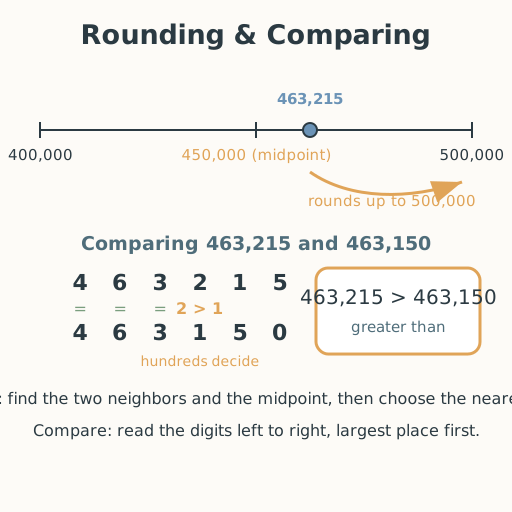
- Worked example — rounding to the hundred-thousand (10 min). On the number line, find 463,215. Its two hundred-thousand neighbors are 400,000 and 500,000. Where is the midpoint? 450,000. Is 463,215 closer to 400,000 or 500,000? It is past the midpoint, so it rounds up to 500,000. Say it: “463,215 is about 500,000.”
- Guided practice — round to any place (15 min). Round 463,215 to the nearest ten-thousand, then thousand, then hundred, then ten. Each time, find the two neighbors, find the midpoint, and choose the nearer one. Record each rounded number.
- Compare two numbers (8 min). Take two number cards, like 463,215 and 463,150. Read left to right: hundred-thousands equal (4 = 4), ten-thousands equal (6 = 6), thousands equal (3 = 3). Now the hundreds: 2 is greater than 1, so we already know 463,215 is the greater number — no need to look further. Write it with the symbol: 463,215 > 463,150.
- Check with a partner (5 min). Trade cards. Round each other’s number and compare two numbers. Do you agree on the nearer landmark and which number is larger? Fix it together, kindly.
- Close (2 min). Remember: rounding picks the nearer neighbor; the midpoint decides the tie. Comparing reads the digits left to right, largest place first.
Differentiation
- Support: Round to the nearest ten and hundred first; add bigger places another day.
- Support (blind/low-vision): Use a tactile number line and movable markers to feel the nearer neighbor.
- Extension: Round a number to two different places and explain which rounded number is more precise and why.
Assessment
- Formative (observation): Can the learner round a six-digit number to a given place and explain the two neighbors and midpoint?
- Self: Can the learner compare two six-digit numbers, write the correct symbol, and tell how they know?
Home connection
At home, round a real big number — a price, a distance, a crowd size — to two different places and tell a grown-up which rounding is closer to the exact number and why.
Resources
- Van de Walle, J. A., Karp, K. S., & Bay-Williams, J. M. (2019). Elementary and Middle School Mathematics: Teaching Developmentally (10th ed.). Pearson. (Rounding as finding the nearer landmark on a number line; comparing by reading digits left to right.)
- Ifrah, G. (2000). The Universal History of Numbers. John Wiley & Sons. (The decimal system as one number system among many.)