Lesson 03 — Adding & Subtracting Multi-Digit Numbers
Learners add and subtract multi-digit whole numbers by working one place at a time and trading ten of one place for one of the next (regrouping). They connect the written algorithm to concrete groups of ten, a hundred, and a thousand.
Objectives
Objectives
- D05.S1.04.02 Add, subtract, multiply, and divide multi-digit whole numbers, and use estimation to check that answers are reasonable.
Essential question
How do I add and subtract multi-digit whole numbers accurately?
Key vocabulary
Materials
Standard materials
- A place-value chart to one million · 1 per learner To add and subtract one column at a time
- Paper or slate and a drawing tool · per learner To record problems and answers
- Small counters · a handful per pair To show regrouping with real groups of ten
Low-tech / no-cost
- A scratched place-value chart and stones or sticks Build each number in the dirt and move counters to regroup ten of one place into one of the next
- Voice and body Count the tens aloud as you trade; show ten ones as ten fingers becoming one closed fist
Enriched / lab & device
- Base-ten blocks · 1 set per pair Units, rods, flats, and a thousands cube to trade ten of a place for one of the next
- A calculator · 1 per pair To check a sum or difference after computing by hand
Works in different contexts
- large-group Add and subtract together on a wall chart, chanting the trades in one voice
- self-directed A learner solves a set of problems with counters, records each, and checks with a second method
- multi-age Older learners model a trade (ten tens to one hundred) while younger learners watch and echo the count
- level-grouped Learners who are ready add and subtract with regrouping across several places; others work within one place first
- outdoor-only Build numbers from sticks and stones in a ground chart and physically trade ten of one place for one of the next
Lesson 3 — Adding & Subtracting Multi-Digit Numbers
Summary
Learners add and subtract multi-digit whole numbers by working one place at a time and regrouping — trading ten of one place for one of the next. They connect the written method to concrete groups of ten, a hundred, and a thousand, so the algorithm is not a magic rule but a record of real trading.
Objectives
- Add, subtract, multiply, and divide multi-digit whole numbers, and use estimation to check that answers are reasonable. (D05.S1.04.02)
Connection
Every day people combine and take away large quantities: a market seller adds the day’s takings, a family subtracts what it spends from what it saved, a builder adds the lengths of wall pieces, a cook subtracts the flour already used from the bag. The numbers are large, but the action is small and familiar — join, or take away — done one place at a time. When a column fills up to ten, you trade it for one in the next column, exactly as you did with piles of beans.
Materials
- A place-value chart to one million (per learner)
- Paper or slate and a drawing tool
- A handful of small counters (per pair)
Preparation
- Give each learner a place-value chart.
- Prepare (or plan to draw) the worked example: 47,268 + 38,519.
- Clear space to build and trade counters.
Facilitator note
This lesson is written to the learner (“you”). It builds on Grade 3’s addition and subtraction within 1,000; the new stretch is multi-digit regrouping across more places. Teach the trade as a worked example (philosophy §13): model ten ones becoming one ten and ten tens becoming one hundred with real counters, then record the same trade in the written algorithm (Carpenter, Fennema, Franke, Levi & Empson, 2015; Van de Walle, Karp & Bay-Williams, 2019). Let learners explain their own strategies — there is more than one correct path, and explaining is the learning. The number of steps a learner needs is not a measure of their worth; a sum is a fact about quantities, never about a person. Regrouping is a feature of our base-ten system, one system among many (Ifrah, 2000); count in the home language. For learners who are Deaf or hard of hearing, sign each trade; for learners who are blind or have low vision, use a tactile chart and trade real counters by feel. Learners with limited movement direct a partner to move the counters. Mastery arrives at its own pace.
Procedure
- Gather — join and take away (5 min). Recall a time you combined two groups or took some away. Adding joins; subtracting takes away. Big numbers use the same ideas, one place at a time.
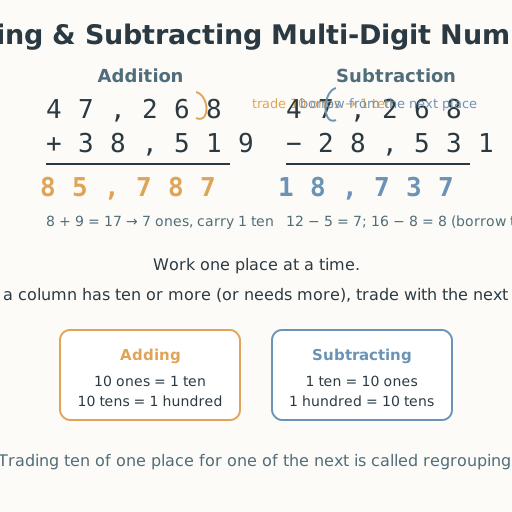
- Worked example — adding with a trade (10 min). Build 47,268 and 38,519 with counters on the chart. Add the ones: 8 + 9 = 17. That is 7 ones and one extra ten — trade ten ones for one ten, and carry it to the tens column. Keep adding, column by column, trading whenever a column reaches ten or more. The sum is 85,787. Record each trade in writing as you go.
- Guided practice — subtract with a trade (15 min). Now subtract 47,268 − 28,531. Start in the ones: 8 − 1 = 7. Move left. Where a column does not have enough, trade one from the next place — one ten becomes ten ones — and record the borrow. Finish and check: does the difference make sense?
- Try your own (10 min). Write two of your own multi-digit addition and subtraction problems. Solve them with counters first, then with the written method. Do the two ways agree?
- Check with a partner (3 min). Trade problems. Do you both get the same answer? If not, redo the trade together, kindly.
- Close (2 min). Remember: work one place at a time, and when a column has ten or more (or needs more), trade with the next place. That is the whole secret.
Differentiation
- Support: Add and subtract within 1,000 first; add larger places another day.
- Support (motor): Use large, easy-to-grip counters or have a partner trade while the learner counts and directs.
- Extension: Add three multi-digit numbers at once, or find a missing addend in a multi-digit sum.
Assessment
- Formative (observation): Can the learner add and subtract multi-digit numbers, trading correctly and explaining the trade with counters?
- Self: Can the learner check their own answer by a second method (counters then written, or estimation)?
Home connection
At home, add two real quantities (prices of two things, distances of two trips) and subtract one from the other. Tell a grown-up where you traded and why.
Resources
- Carpenter, T. P., Fennema, E., Franke, M. L., Levi, L., & Empson, S. B. (2015). Children’s Mathematics: Cognitively Guided Instruction (2nd ed.). Heinemann. (Children’s own joining/separating strategies as the base for addition and subtraction.)
- Van de Walle, J. A., Karp, K. S., & Bay-Williams, J. M. (2019). Elementary and Middle School Mathematics: Teaching Developmentally (10th ed.). Pearson. (Connecting concrete trading to the standard algorithm.)
- Ifrah, G. (2000). The Universal History of Numbers. John Wiley & Sons. (Base-ten as one number system among many.)