Lesson 05 — Dividing Multi-Digit Numbers
Learners divide multi-digit whole numbers by sharing into equal groups or by grouping, record the quotient, and make sense of the remainder — the leftover that will not fit evenly. They check their answer by multiplying back and adding the leftover.
Objectives
Objectives
- D05.S1.04.02 Add, subtract, multiply, and divide multi-digit whole numbers, and use estimation to check that answers are reasonable.
Essential question
How do I divide multi-digit whole numbers and make sense of remainders?
Key vocabulary
Materials
Standard materials
- Small counters · about 60 per pair To share and group concretely
- Paper or slate and a drawing tool · per learner To record the quotient and remainder
- A place-value chart · 1 per learner To divide one place at a time
Low-tech / no-cost
- Stones, seeds, or sticks shared on the ground Share a pile into equal groups and see what is left over
- Voice and body Count out the groups aloud; show the leftover with open fingers
Enriched / lab & device
- Base-ten blocks · 1 set per pair To divide by trading tens for ones
- A calculator · 1 per pair To check a quotient after computing by hand
Works in different contexts
- large-group Divide one large collection together, counting out equal groups in one voice
- self-directed A learner shares a collection into equal groups, records the quotient and remainder, and checks by multiplying
- multi-age Older learners divide with a remainder and explain what it means; younger learners share small groups and count
- level-grouped Learners who are ready divide a multi-digit number by a one-digit divisor; others divide within 100 first
- outdoor-only Share a gathered pile of objects into equal groups on the ground and name the leftover
Lesson 5 — Dividing Multi-Digit Numbers
Summary
Learners divide multi-digit whole numbers by sharing a collection into equal groups (or grouping it into equal piles), record the quotient, and make sense of the remainder — the leftover that will not divide evenly. They check by multiplying back and adding the leftover: divisor × quotient + remainder = dividend.
Objectives
- Add, subtract, multiply, and divide multi-digit whole numbers, and use estimation to check that answers are reasonable. (D05.S1.04.02)
Connection
Fair sharing is one of the oldest and most important human acts: dividing food among a family, seats among a bus, seeds among a field, money among a group. Often it is not exact — there is a leftover, and you must decide what it means. A remainder is not a mistake; it is real information: the last row is not full, the last coin will not split, the last piece goes to one more person. Division is sharing, and the leftover is part of the story.
Materials
- About 60 small counters (per pair)
- Paper or slate and a drawing tool
- A place-value chart (per learner)
Preparation
- Give each pair about 60 counters.
- Prepare (or plan to draw) the worked example: 125 ÷ 4.
- Clear space to share and count aloud.
Facilitator note
This lesson is written to the learner (“you”). Division is the inverse of multiplication, and it is best learned as sharing and grouping with real objects before the written algorithm (Carpenter, Fennema, Franke, Levi & Empson, 2015; Van de Walle, Karp & Bay-Williams, 2019). Teach the remainder as a worked example (philosophy §13): share 125 into 4 groups, see 31 in each with 1 left, and write 125 ÷ 4 = 31 R 1; then check 31 × 4 + 1 = 125. The check is the feedback loop that turns a guess into a proof. The number of steps a learner needs is not a measure of their worth, and a quotient is a fact about quantities, never about a person. Fair sharing is a human and cross-cultural value; how a remainder is handled (left over, divided further, saved) differs by context, and none is “wrong.” Count in the home language. For learners who are Deaf or hard of hearing, sign each group and the leftover; for learners who are blind or have low vision, share tactile objects into cups by feel. Learners with limited movement direct a partner to share. Mastery arrives at its own pace.
Procedure
- Gather — fair shares (5 min). Recall a time you shared something equally. Did it come out even, or was there a leftover? Sharing is dividing.
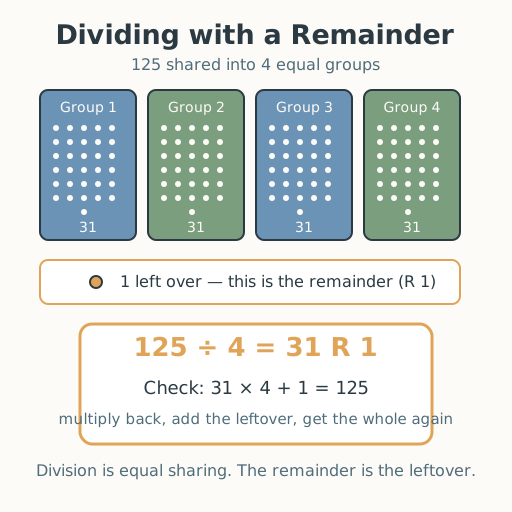
- Worked example — 125 ÷ 4 (10 min). Take 125 counters. Share them into 4 groups, one at a time, so each group is equal. Each group gets 31, and 1 counter is left. Write: 125 ÷ 4 = 31 R 1. The leftover is the remainder. Check: 31 × 4 = 124, plus the 1 left = 125. It works.
- Guided practice — share and record (15 min). Share your own pile into 3 groups, then into 6 groups. For each, write the division sentence with its remainder, then check by multiplying back and adding the leftover. Did the check bring you back to the whole pile?
- Make sense of the leftover (8 min). Tell the story of a remainder: if 25 people ride in cars that hold 4, how many full cars? 6, with 1 person left — so you need 7 cars. The remainder changes the answer, and the story tells you how.
- Check with a partner (5 min). Trade a division problem. Do you agree on the quotient and remainder? Check together by multiplying, kindly.
- Close (2 min). Remember: division is equal sharing, the remainder is the leftover, and multiplying back plus the leftover is your proof.
Differentiation
- Support: Divide within 100 first; add a multi-digit dividend another day.
- Support (motor): Use large counters or have a partner share while the learner counts and directs.
- Extension: Divide a multi-digit number and write the answer as a mixed number (for example, 25 ÷ 4 = 6 1/4), explaining what the fraction means.
Assessment
- Formative (observation): Can the learner share a collection into equal groups, record the quotient and remainder, and check by multiplying back plus the leftover?
- Self: Can the learner explain what a remainder means in a real story?
Home connection
At home, share a real collection (a bag of nuts, a deck of cards, a pile of spoons) into equal groups and name the quotient and remainder. Tell a grown-up what the leftover means.
Resources
- Carpenter, T. P., Fennema, E., Franke, M. L., Levi, L., & Empson, S. B. (2015). Children’s Mathematics: Cognitively Guided Instruction (2nd ed.). Heinemann. (Sharing and grouping as the base of division.)
- Van de Walle, J. A., Karp, K. S., & Bay-Williams, J. M. (2019). Elementary and Middle School Mathematics: Teaching Developmentally (10th ed.). Pearson. (Connecting sharing to the division algorithm and interpreting remainders.)