Lesson 06 — Estimation: Does My Answer Make Sense?
Learners round the numbers in a problem to friendly neighbors, estimate the answer, and then judge whether a calculated answer is reasonable by seeing how close it is. Estimation becomes a habit of checking — "does this make sense?" — that catches errors and builds number sense.
Objectives
Objectives
- D05.S1.04.02 Add, subtract, multiply, and divide multi-digit whole numbers, and use estimation to check that answers are reasonable.
Essential question
How do I estimate to check that a calculated answer is reasonable?
Key vocabulary
Materials
Standard materials
- A set of computation cards with answers (some wrong) · 1 set per pair To judge whether each answer is reasonable
- Paper or slate and a drawing tool · per learner To record estimates and checks
Low-tech / no-cost
- Voice and memory Estimate aloud by rounding and comparing; decide "too big, too small, or about right"
- Real objects to count Estimate a jar of beans, then count to check how close the estimate was
Enriched / lab & device
- A calculator · 1 per pair To compute an exact answer and then judge whether it is reasonable against an estimate
- A "reasonable or not?" sorting game on cards or a device · 1 set per pair Sort answers into reasonable and not reasonable, and explain each choice
Works in different contexts
- large-group Show an answer on the board and have the group hold up "reasonable" or "not reasonable" cards, then explain
- self-directed A learner estimates each answer first, computes, and compares, flagging any answer far from the estimate
- multi-age Older learners explain the rounding that makes a good estimate; younger learners echo "about right" or "not reasonable"
- level-grouped Learners who estimate easily judge tricky answers near the boundary; others judge clearly wrong answers first
- outdoor-only Estimate a natural collection (a heap of stones), round to a friendly number, then count to check
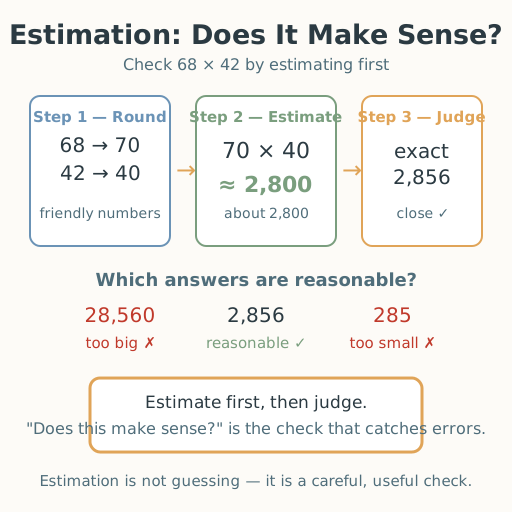
Lesson 6 — Estimation: Does My Answer Make Sense?
Summary
Learners estimate by rounding the numbers in a problem to friendly neighbors, then use the estimate to judge whether a calculated answer is reasonable. The habit is the lesson’s heart: before you trust an answer, ask “does this make sense?” and check it against a quick, rough number.
Objectives
- Add, subtract, multiply, and divide multi-digit whole numbers, and use estimation to check that answers are reasonable. (D05.S1.04.02)
Connection
Every day people check numbers with a quick rough one. At the market you glance at a basket and think “about how much will this cost?” before paying. A cook doubles a recipe and senses whether the amount “feels right.” A builder looks at a wall and knows a measurement is off before measuring twice. Estimation is the body’s early warning: if your exact answer is nowhere near your rough one, something is wrong, and you look again. It is not guessing — it is a careful, useful check.
Materials
- A set of computation cards with answers, some wrong (per pair)
- Paper or slate and a drawing tool
Preparation
- Prepare the computation cards, each with a problem and an answer (some correct, some clearly wrong).
- Prepare (or plan to draw) the worked example: 68 × 42.
- Clear space to estimate and compare aloud.
Facilitator note
This lesson is written to the learner (“you”). Estimation is a number-sense skill: teach it with rounding to friendly numbers, then comparing (Van de Walle, Karp & Bay-Williams, 2019). Model once as a worked example (philosophy §13): 68 × 42 → about 70 × 40 = 2,800, so an answer near 2,800 is reasonable and 28,560 or 285 are not. This is the feedback loop of the unit — estimation is how a learner checks their own work without an adult. An estimate that is “off” is not a moral failing; it is information about the method, and everyone’s first estimate can be improved. A wrong answer is never a verdict on the learner. Estimation and rounding are used the world over, in every marketplace and field; the numbers may be pesos, rupees, shekels, or shillings, but the “does this make sense?” question is universal. Count in the home language. For learners who are Deaf or hard of hearing, sign the comparison; for learners who are blind or have low vision, estimate with tactile objects and compare counts by feel. Learners with limited movement direct a partner to sort the cards. Mastery arrives at its own pace.
Procedure
- Gather — the early warning (5 min). Think of a time a number felt wrong before you even checked. How did you know? That feeling is estimation.
- Worked example — 68 × 42 (10 min). Round 68 to 70 and 42 to 40. Multiply the friendly numbers: 70 × 40 = 2,800. So 68 × 42 should be about 2,800. The exact answer is 2,856 — close! Reasonable. If someone said 28,560, would that be reasonable? No — it is ten times too big. If someone said 285? Too small. Say the rule: estimate first, then judge.
- Guided practice — estimate then compute (15 min). For several problems, write your estimate first (round to friendly numbers), then compute the exact answer, then decide: is the exact answer close to the estimate? Flag any that are far off and find the error.
- Sort the cards (8 min). With your cards, sort answers into “reasonable” and “not reasonable” without computing exactly — use estimation alone. Then check a few by computing and see if your sort was right.
- Check with a partner (5 min). Trade a card and explain why you called it reasonable or not. Do you agree? Fix it together, kindly.
- Close (2 min). Remember: estimate first, then judge. “Does this make sense?” is the question that catches the mistake before it matters.
Differentiation
- Support: Estimate sums and differences first; multiply and divide another day.
- Support (blind/low-vision): Estimate with real objects and compare by touch and count.
- Extension: For a given exact answer, find two different estimates — one that overestimates and one that underestimates — and explain which is closer.
Assessment
- Formative (observation): Can the learner round to friendly numbers, state a reasonable estimate, and judge whether a given answer is close to it?
- Self: Can the learner catch a wrong answer by estimating first, and explain what tipped them off?
Home connection
At home, before anyone computes a real total — the cost of a shopping list, the time of a journey — estimate it first, then check the exact answer against your estimate. Tell a grown-up whether it was reasonable.
Resources
- Van de Walle, J. A., Karp, K. S., & Bay-Williams, J. M. (2019). Elementary and Middle School Mathematics: Teaching Developmentally (10th ed.). Pearson. (Estimation by rounding and judging reasonableness as core number sense.)