Lesson 12 — Area of Rectangles
Learners find the area of a rectangle by covering it with square units and counting, then discover the shortcut — area = length × width — and apply the formula to real problems like tiling a floor or measuring a field. Area becomes "how many squares cover it."
Objectives
Objectives
- D05.S3.04.02 Apply formulas for the area and perimeter of rectangles to solve real-world and mathematical problems.
Essential question
How do I find the area of a rectangle with a formula and use it to solve real problems?
Key vocabulary
Materials
Standard materials
- Square tiles or grid paper · a set per learner To cover rectangles and count square units
- Paper or slate and a drawing tool · per learner To record dimensions and area
Low-tech / no-cost
- A rectangle marked on the ground with stones or leaves as square units Cover the rectangle and count the units, then multiply rows by columns
- Voice and body Step out the length and width, then skip count the rows to find the area
Enriched / lab & device
- Centimeter grid or area tiles · 1 set per pair To build and measure rectangles with standard units
- A measuring tape and a calculator · 1 per pair To measure real surfaces and compute their area
Works in different contexts
- large-group Cover a large floor rectangle together, counting the rows and columns in one voice
- self-directed A learner tiles rectangles, counts the square units, then checks length × width against the count
- multi-age Older learners use the formula for real surfaces; younger learners count the square units inside
- level-grouped Learners who are ready find a missing side length from the area; others count and multiply first
- outdoor-only Mark a garden plot, cover it with square steps, and multiply its length by its width to find its area
Lesson 12 — Area of Rectangles
Summary
Learners find the area of a rectangle by covering it with square units and counting, then discover the shortcut — area = length × width — and apply the formula to real problems like tiling a floor or measuring a field. Area becomes “how many squares cover it.”
Objectives
- Apply formulas for the area and perimeter of rectangles to solve real-world and mathematical problems. (D05.S3.04.02)
Connection
How many tiles to cover a floor? How much cloth to make a rug? How much land is this field? Each question asks the same thing: how many squares cover a surface? That is area. If you count the squares once, you notice a shortcut — the number of rows times the number in each row, which is length times width. Area is how people plan a garden, a floor, a piece of cloth, or a roof, anywhere in the world.
Materials
- Square tiles or grid paper (per learner)
- Paper or slate and a drawing tool
Preparation
- Give each learner square tiles or grid paper.
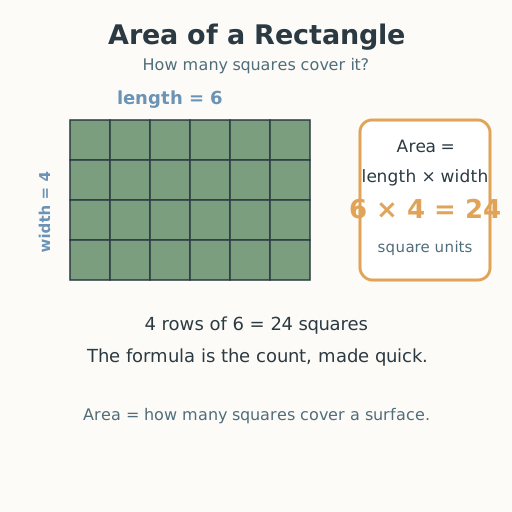
- Prepare (or plan to draw) the worked example: a 6-by-4 rectangle.
- Clear space to cover and count.
Facilitator note
This lesson is written to the learner (“you”). Area begins as covering with square units and counting, then generalizes to length × width — the formula is a shortcut for the count, not a new idea (Van de Walle, Karp & Bay-Williams, 2019). Teach the shortcut as a worked example (philosophy §13): tile a 6-by-4 rectangle, count 24, then see that 6 × 4 = 24. Build on Grade 3’s area work. The number of tiles a learner needs to count before seeing the pattern is not a measure of their worth; an area is a fact about a surface, never about a person. Measuring land by its covering squares is a human and cross-cultural practice, from ancient field surveying to modern tile and cloth work. Count in the home language. For learners who are Deaf or hard of hearing, sign the count; for learners who are blind or have low vision, feel the tiles and count rows and columns by touch. Learners with limited movement direct a partner to place tiles. Mastery arrives at its own pace.
Procedure
- Gather — cover it with squares (5 min). How many squares would cover the top of your hand? That is area: how many squares cover a surface.
- Worked example — a 6-by-4 rectangle (10 min). Cover a rectangle that is 6 units long and 4 units wide with square tiles. Count: 4 rows of 6 — that is 6 + 6 + 6 + 6 = 24 square units. Now notice the shortcut: length × width = 6 × 4 = 24. The formula is just the count, made quick.
- Guided practice — count, then multiply (15 min). Cover several rectangles, count the square units, then check with length × width. Do the count and the multiplication always agree? (They should.)
- Real problems (10 min). Solve: a floor is 8 tiles long and 5 tiles wide — how many tiles? A garden is 9 meters by 4 meters — how many square meters of soil? For each, say the formula and the answer.
- Check with a partner (3 min). Trade a problem. Do you agree on the area? Count it together, kindly.
- Close (2 min). Remember: area is how many squares cover a surface, and length × width finds it in one step.
Differentiation
- Support: Count square units only today; add the formula another day.
- Support (blind/low-vision): Use tactile tiles and count rows and columns by touch.
- Extension: Given an area (like 24) and one side (like 6), find the other side and explain how you know.
Assessment
- Formative (observation): Can the learner find the area of a rectangle by counting square units and by length × width, and state the answer in square units?
- Self: Can the learner solve a real area problem and check their answer by counting?
Home connection
At home, measure a real rectangle — a rug, a table, a door — and find its area in your own hand-spans or steps, then tell a grown-up the area.
Resources
- Van de Walle, J. A., Karp, K. S., & Bay-Williams, J. M. (2019). Elementary and Middle School Mathematics: Teaching Developmentally (10th ed.). Pearson. (Area as covering with square units, generalizing to length × width.)