Lesson 11 — Classifying Shapes by Lines & Angles
Learners classify triangles and quadrilaterals by their lines and angles — how many pairs of parallel sides, how many right angles, how many equal sides — and discover the family relationships among shapes (every square is a rectangle and a rhombus). Classification becomes a careful reading of a shape's features.
Objectives
Objectives
- D05.S3.04.01 Draw and identify points, lines, line segments, rays, and angles, and classify shapes by their lines and angles.
Essential question
How do I classify shapes by their lines and angles?
Key vocabulary
Materials
Standard materials
- A set of shape cards (triangles and quadrilaterals) · 1 set per pair Shapes to sort by sides and angles
- Paper or slate and a drawing tool · per learner To draw and label shapes
- A square corner (a folded paper corner) · 1 per learner To test for right angles
Low-tech / no-cost
- Sticks and stones on the ground Build triangles and quadrilaterals with sticks and sort them by their corners and sides
- Voice and body Make shapes with arms and count the parallel pairs and right angles aloud
Enriched / lab & device
- Geoboards and rubber bands · 1 per pair To build shapes and check parallel lines and angles
- A dynamic geometry app · 1 per pair To drag shapes and watch how their angles and sides change
Works in different contexts
- large-group Sort a big set of shapes together on the board, naming the features that decide each group
- self-directed A learner sorts shapes by parallel lines and right angles, then writes a rule for each group
- multi-age Older learners name precise categories (parallelogram, rhombus); younger learners sort by "right angle or not" and "parallel or not"
- level-grouped Learners who classify easily explain the family relationships among quadrilaterals; others sort into broad groups first
- outdoor-only Find and sort shapes in nature and buildings — windows, leaves, tiles, walls — by their lines and angles
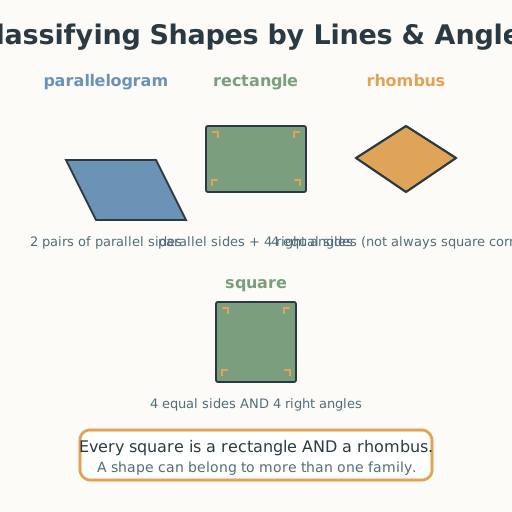
Lesson 11 — Classifying Shapes by Lines & Angles
Summary
Learners classify triangles and quadrilaterals by their lines and angles: how many pairs of parallel sides, how many right angles, and how many equal sides. They discover the family relationships among shapes — a square is both a rectangle and a rhombus — and write a rule for each group. Classification becomes a careful reading of a shape’s features.
Objectives
- Draw and identify points, lines, line segments, rays, and angles, and classify shapes by their lines and angles. (D05.S3.04.01)
Connection
Sorting by features is something you already do: you know a thing is a chair by its legs and seat, a bird by its beak and wings. Shapes are sorted the same way — by their lines and angles. A window with four square corners is a rectangle; a roof slope that comes to a point is a triangle. Builders, weavers, and tile-makers across the world have sorted shapes by these features for thousands of years to make walls stand, cloth fit, and patterns repeat. Classifying is how you read a shape’s family.
Materials
- A set of shape cards (triangles and quadrilaterals) (per pair)
- Paper or slate and a drawing tool
- A square corner (folded paper) (per learner)
Preparation
- Prepare the shape cards: triangles (by sides and angles) and quadrilaterals (square, rectangle, rhombus, parallelogram, trapezoid).
- Prepare (or plan to draw) the quadrilateral family as a worked example.
- Clear space to sort and compare aloud.
Facilitator note
This lesson is written to the learner (“you”). Classification is the analysis of attributes: teach it by asking “how many pairs of parallel sides? how many right angles? how many equal sides?” (Van de Walle, Karp & Bay-Williams, 2019). Model the quadrilateral family as a worked example (philosophy §13): a parallelogram has two pairs of parallel sides; a rectangle is a parallelogram with four right angles; a square is a rectangle with four equal sides and a rhombus with four right angles. The key insight is hierarchical classification — one shape can belong to more than one group. How quickly a learner names a category is not a measure of their worth; a shape’s features are facts, never a judgment about a person. Shape-sorting is a human and cross-cultural practice, from quilts and mosaics to roofs and maps (Zaslavsky, 1999). Use the home language’s shape words; all are correct. For learners who are Deaf or hard of hearing, sign each feature; for learners who are blind or have low vision, feel shapes’ sides and corners and sort by touch. Learners with limited movement direct a partner to sort. Mastery arrives at its own pace.
Procedure
- Gather — sort by features (5 min). How do you know a thing is a chair? You notice its parts. Shapes are sorted the same way — by lines and angles.
- Meet the features (8 min). Learn to read a shape: parallel sides never meet; right angles make a square corner (test with your folded corner); equal sides are the same length. Count each feature on a few shapes.
- Worked example — the quadrilateral family (10 min). Look at a square, a rectangle, a rhombus, and a parallelogram. Each has two pairs of parallel sides. The rectangle adds four right angles; the square adds four equal sides; the rhombus has four equal sides but not always right angles. Say it: every square is a rectangle and a rhombus.
- Sort the cards (15 min). Sort the triangles by their sides (equal sides?) and angles (right? acute? obtuse?). Sort the quadrilaterals by parallel sides and right angles. Write a one-line rule for each group you make.
- Check with a partner (5 min). Trade your sorted groups. Can your partner name the feature that decides each group? Do you agree? Fix it together, kindly.
- Close (2 min). Remember: classify by features — parallel lines, right angles, equal sides. One shape can belong to more than one family.
Differentiation
- Support: Sort shapes into “has a right angle” and “no right angle” today; add parallel sides another day.
- Support (blind/low-vision): Feel shapes and sort by corners and sides.
- Extension: Explain why every square is a rectangle, but not every rectangle is a square, using the features.
Assessment
- Formative (observation): Can the learner sort shapes by parallel sides, right angles, and equal sides, and state the rule for each group?
- Self: Can the learner explain why a square belongs to more than one category?
Home connection
At home, find shapes in a floor, a wall, or a piece of cloth, and sort them by their lines and angles. Tell a grown-up the feature that decides each group.
Resources
- Van de Walle, J. A., Karp, K. S., & Bay-Williams, J. M. (2019). Elementary and Middle School Mathematics: Teaching Developmentally (10th ed.). Pearson. (Classifying shapes by attributes, including hierarchical relationships among quadrilaterals.)
- Zaslavsky, C. (1999). Africa Counts: Number and Pattern in African Cultures (3rd ed.). Lawrence Hill Books. (Shape and pattern in cultural designs.)