Lesson 07 — Energy Moves: Heat, Sound, Light
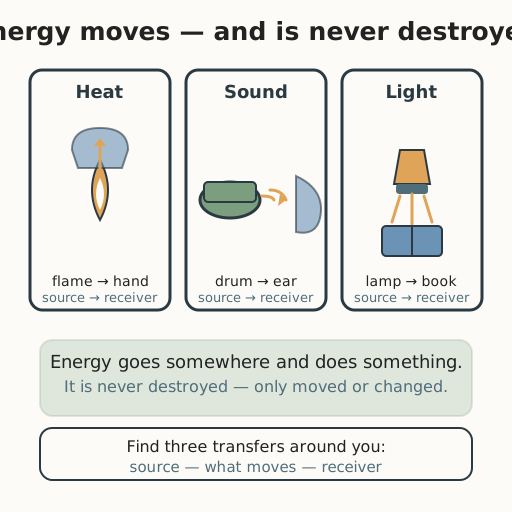
Learners trace energy as it moves from a source to a receiver, never vanishing. They feel heat move from a warm stone to a cool one, hear sound move from a drum to an ear, and see light move from a lamp to a surface. Each time the energy changes place or form but is not destroyed — it goes somewhere, doing something. Learners record source, what moves, and receiver for three transfers.
Objectives
Objectives
- D06.S3.04.01 Describe how energy moves from one place or object to another (such as heat, sound, and light) and is never destroyed.
Essential question
How does energy move from one place or object to another, and why is it never destroyed?
Key vocabulary
Materials
Standard materials
- A small drum or tin and a drumstick · 1 set To see and feel sound energy move
- A flashlight or a lamp · 1 To show light energy moving from a source to a surface
- A warm object and a cool object (a warmed stone and a cool one) · 1 pair To feel heat energy move from warm to cool
- Paper and pencils · per learner
Low-tech / no-cost
- A clap, a voice, and a hand Feel sound with a hand on your throat, feel heat from a hand rubbed warm, and feel sunlight on skin
- A sunny patch and a shady patch Compare warmth in sun and shade to feel light turning into heat
Enriched / lab & device
- A small solar-powered toy or a thermometer · 1 per group To see light energy become motion or heat
- An energy-transfer recording sheet · per learner Columns for Source, What moves, and Receiver for three energy transfers
Works in different contexts
- large-group Demonstrate each transfer at the front — drum, flashlight, warm stone — and record the source and receiver together
- self-directed A learner finds three energy transfers around them (a lamp, a voice, warm hands) and writes source, what moves, and receiver for each
- outdoor-only Find energy moving outdoors — sunlight warming stone, wind moving leaves, a bird's call reaching your ear — and trace each from source to receiver
- multi-age Older learners name source and receiver and write the transfer; younger learners feel and point to where the energy goes
- level-grouped Learners still learning name one transfer; learners who can reason explain three and tell why energy is never destroyed
Lesson 7 — Energy Moves: Heat, Sound, Light
Summary
Energy is the ability to make things happen, and it never simply disappears. Learners trace three kinds of energy — heat, sound, and light — as each moves from a source to a receiver. A warm stone passes heat to a cool one; a drum sends sound to an ear; a lamp sends light to a page. In every case the energy goes somewhere and does something: it is never destroyed, only moved or changed. Learners record the source, what moves, and the receiver for three transfers they find themselves.
Objectives
- Describe how energy moves from one place or object to another (such as heat, sound, and light) and is never destroyed. (D06.S3.04.01)
Connection
Touch a cup that has been sitting in the sun. Warm, isn’t it? That warmth is energy that traveled as light from the Sun, landed on the cup, and became heat. Clap your hands and hear the sound travel through the air to your ear. Shine a light on a wall and watch the light leave the lamp and land on the wall. Energy is always moving from one place to another — from the fire to the pot, from the drum to your ear, from the Sun to the Earth — and it is never destroyed. It only changes place or form, which is why a sunny window, a ringing bell, and a warm fire are all the same story: energy on the move.
Materials
- A small drum or tin and a drumstick
- A flashlight or a lamp
- A warm object and a cool object (a warmed stone and a cool one)
- Paper and pencils
Preparation
- Warm one stone in the sun or in warm (not hot) water, and keep a second stone cool.
- Set out the drum, flashlight, and stones where learners can safely touch and use them.
- Prepare a record space: Source | What moves | Receiver.
Facilitator note
This lesson is written to the learner (“you”). Teach the transfer idea with a worked example — model one transfer (“the lamp is the source, light moves, the wall is the receiver”) — then let learners find their own transfers (guided practice) before recording independently. The key science to protect: energy is never destroyed; when it seems to “disappear” (the sound fades, the stone cools), it has only spread out into the surroundings (the conservation-of-energy idea, held simply and honestly — evidence, not dogma). Keep the technology and environment lenses alive: every light, machine, and fire we use is energy on the move, and that is why we care where our energy comes from and where it goes. Keep hands safe — warm, never scalding. Invite wonder alongside fact: energy’s endless journey is something scientists describe from centuries of careful measurement, and it is also a thing to marvel at.
Procedure
- Gather and remember (5 min). Last year you met solids, liquids, and gases, and how heating and cooling change them. Today: what is that warmth, and where does it go?
- Meet energy (10 min). Energy is what makes things happen — it warms, it makes sound, it lights. It moves from a source (where it starts) to a receiver (where it lands). Say the three kinds: heat, sound, light.
- Trace three transfers (20 min). First, hold the warm stone near the cool one — feel the heat move from warm to cool. Next, tap the drum — hear the sound travel to your ear. Last, shine the flashlight — see the light land on the wall. Each time, say the source, what moves, and the receiver.
- Record your own (15 min). Find three energy transfers around you — a lamp, a voice, warm hands, the Sun through a window. For each, write the source, what moves, and the receiver.
- Close (5 min). Energy is never destroyed. When it seems to vanish, it has only spread out. Tomorrow you will build a path for one kind of energy — electricity — to move along.
Differentiation
- Support: Trace one transfer (light from lamp to wall) with a partner and say the source and receiver.
- Support (non-speaking): Point to the source and the receiver of a transfer; a partner names what moves.
- Support (blind/low-vision): Feel heat move from a warm stone to a cool one and hear sound travel; describe each transfer aloud.
- Extension: Explain in one sentence where the energy “goes” when a sound fades or a stone cools, and why it is not destroyed.
Assessment
- Formative (observation): Can the learner name a source and a receiver for one energy transfer and say what moves?
- Self: The learner checks their record: “Did I name a source, what moves, and a receiver for each?”
Home connection
At home, trace one energy transfer with a grown-up — a kettle heating water, a phone lighting a page, a voice reaching across a room — and say the source and the receiver.
Resources
- BBC Bitesize (KS2 Science), “What is light?” — light travels from a source and carries energy. https://www.bbc.co.uk/bitesize/topics/z3nnb9q/articles/zpnvf82
- BBC Bitesize (KS2 Science), “How are sounds made?” — sound is made by vibrations and travels as energy. https://www.bbc.co.uk/bitesize/topics/zgffr82/articles/zh9bydm