Lesson 03 — Reading Rhythm Notation
Learners read basic rhythm notation — quarter notes, paired eighth notes, and a quarter rest — and play rhythms from written symbols by clapping, tapping, or using sticks. They write a rhythm of their own and perform it for a partner.
Objectives
Objectives
- D07.S2.04.01 Read and play or sing a simple melody or rhythm from basic notation.
Essential question
How do I read and play a rhythm from written symbols?
Key vocabulary
Materials
Standard materials
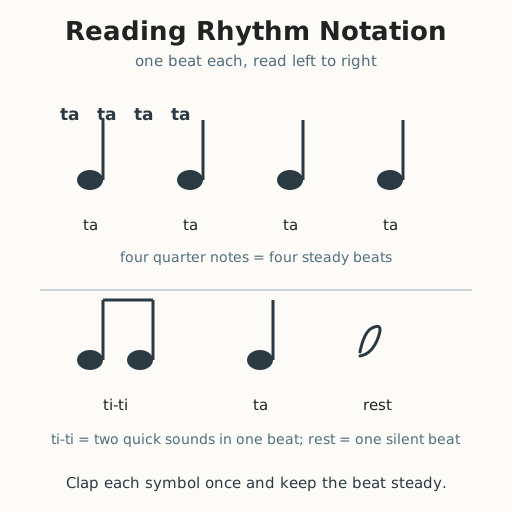
- Rhythm notation guide graphic · 1 Shows quarter notes (ta), eighth notes (ti-ti), and a quarter rest
- Blank rhythm cards or paper · per learner To write and share their own rhythm
Low-tech / no-cost
- Voice and body Clap, tap, or stomp the rhythm; no cards or instruments needed
- Sticks or stones · per learner Tap two sticks or stones together to play the rhythm
Enriched / lab & device
- A metronome app or steady drum beat · 1 To keep the beat steady while learners clap their rhythms
- Classroom percussion · 1 set Simple drums, shakers, or rhythm sticks for performing notation
Works in different contexts
- large-group Project the notation and clap each bar together first; then learners write and perform their own in small groups
- multi-age Younger learners echo-clap a rhythm after an older peer; older learners read and write their own bars
- self-directed A learner reads the symbols, claps the example bars, writes one of their own, and checks it matches a steady beat
- outdoor-only Clap the rhythm or tap it with sticks on a log or the ground; draw the symbols in the dirt with a stick
Lesson 3 — Reading Rhythm Notation
Summary
Learners meet the written symbols of rhythm: a quarter note (one beat, spoken “ta”), two eighth notes (one beat split in two, spoken “ti-ti”), and a quarter rest (one silent beat). They read symbols left to right, play rhythms by clapping or tapping, and write a short rhythm of their own to perform.
Objectives
- Read and play a simple rhythm from basic notation. (D07.S2.04.01)
Connection
Music is a language people can write down so others can play it — the way a recipe lets someone cook a dish they have never tasted. On paper, a steady beat becomes symbols: a filled note for “clap,” a joined pair for “quick-quick,” a squiggle for “rest — be silent.” A drummer in one town can write a rhythm and a drummer far away can read it and play the very same thing. Today you learn to read that language.
Materials
- Rhythm notation guide graphic
- Blank rhythm cards or paper
- Voice and body (clapping, tapping) or sticks/stones
Preparation
- Print or display the rhythm notation guide.
- Have blank rhythm cards or paper ready for learners to write their own rhythm.
Facilitator note
This lesson is written to the learner (“you”). Reading notation is a skill, so teach it with a worked example and guided practice before independent work (Kirschner, Sweller & Clark, 2006): model “ta ta ta ta,” then “ti-ti ta rest,” clapping each bar while pointing to the symbols, and have the group echo. Keep the beat steady by tapping a foot or using a drum. A learner who is deaf or hard of hearing can feel the beat through a drum on the floor or a partner’s tap on their hand, and can show a rest as “no movement.” A learner with limited hand use can nod, blink, or tap a finger. The goal is that the symbols match the sounds — correctness, not speed.
Procedure
- Gather (5 min). You already keep a steady beat. Today you learn to write a beat so anyone can read it. That writing is called notation.
- Meet the symbols (10 min). Look at the guide graphic.
- A quarter note is a filled oval with a stem. It is one beat — say “ta.”
- Two eighth notes are joined by a beam. Together they are one beat split in two — say “ti-ti.”
- A quarter rest is a squiggly mark. It is one silent beat — say nothing, or whisper “rest.”
- Read together (10 min). Point to each symbol and say or clap it. Start with the worked example: four quarter notes — “ta, ta, ta, ta.” Then try “ti-ti, ta, rest.” Keep the beat steady the whole way.
- Write your own (15 min). On your card, write a rhythm four beats long using quarter notes, eighth notes, and a rest. Practice it, then perform it for a partner. Can your partner read it back exactly as you played it?
- Close (5 min). You just read and wrote music. Symbols carry sound — one drummer writes it, another plays it.
Differentiation
- Support: Begin with only quarter notes and rests; add eighth notes when ready.
- Extension: Write two measures, or add a “ti-ka-ti-ka” (four sixteenth notes) to the mix and teach it to a partner.
- Support (deaf/hard-of-hearing): Feel the beat through a drum or a partner’s tap, and show a rest as no movement.
- Support (blind/low-vision): Read and write rhythm by touch instead of sight — use raised note cards or small objects (a round stone for a quarter note, two small linked stones for a pair of eighths, an empty space for a rest) and read back the pattern by feeling each shape while a partner says “ta,” “ti-ti,” or “rest” aloud; a learner can also echo a rhythm back by clapping it after hearing it.
Assessment
- Formative (observation): Does the learner read a written rhythm and play it steadily, matching the symbols?
- Performance (peer): A partner reads back the learner’s written rhythm; the learner checks it matches what they intended.
Home connection
At home, clap a four-beat rhythm and write it down in symbols, then teach it to someone and see if they can read it back to you.
Resources
- No external resources required; the claims in this lesson are about reading and writing simple rhythm symbols, which learners do directly and check by playing back.