Lesson 05 — Music of Another Culture
Learners listen to and describe the music of more than one culture, noticing how each tradition uses its own instruments, scales, and rhythms. They name one respectful question about a tradition they heard, honoring the living musicians who keep it.
Objectives
Objectives
- D07.S2.04.02 Describe how the music of another culture uses its own instruments, scales, or rhythms, and name one respectful question about it.
Essential question
How does another culture's music use its own instruments, scales, and rhythms?
Key vocabulary
Materials
Standard materials
- Audio or video of music from more than one culture · 1 set Respectful recordings made or shared by the communities — e.g., West African drumming, Indian classical music, Indonesian gamelan
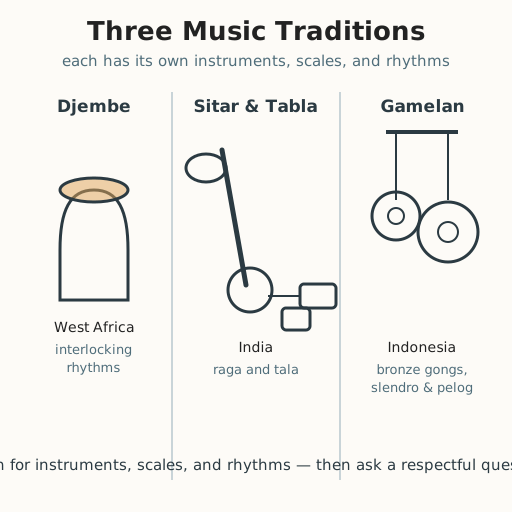
- Instrument guide graphic · 1 Shows a djembe, sitar and tabla, and gamelan gongs with labels
Low-tech / no-cost
- Descriptions and the guide graphic If no audio is available, describe the sounds and read the labels together
- Voices and bodies Imitate a steady drum pattern with claps and stomps to feel a rhythm cycle
Enriched / lab & device
- Community-made recordings with headphones · 1 set Listen closely and describe what you hear in instruments, scale, and rhythm
- A visiting musician or community member (invited respectfully) · 1 The best way to learn a tradition is from its living musicians
Works in different contexts
- large-group Play one short recording at a time and describe it together, filling a listening chart on the board
- multi-age Older learners name instruments and scales; younger learners clap the steady beat they hear
- self-directed A learner listens to one recording, describes its instruments, scale, and rhythm, and writes one respectful question
- outdoor-only Listen or describe, then clap a rhythm cycle together; no devices needed
Lesson 5 — Music of Another Culture
Summary
Learners meet music from more than one part of the world and learn that every tradition has its own instruments, scales, and rhythms. They listen (or read descriptions) of West African drumming, Indian classical music, and Indonesian gamelan, describe what they hear, and name one respectful question — treating the music as a living tradition, not a museum piece.
Objectives
- Describe how the music of another culture uses its own instruments, scales, or rhythms, and name one respectful question about it. (D07.S2.04.02)
Connection
Every music has its own voice. A goblet-shaped drum from West Africa speaks with interlocking rhythms; a sitar and tabla from India ride a melody-framework called a raga over a rhythm-cycle called a tala; bronze gongs of an Indonesian gamelan ring together in its own five- and seven-note scales. None of these is “better” — each is a whole world of sound built by living musicians who learned it from the people before them. When you hear music you have never heard before, the kindest thing you can do is listen closely and ask, “How does this music work, and what does it mean to the people who make it?”
Materials
- Audio or video of music from more than one culture
- Instrument guide graphic (djembe, sitar and tabla, gamelan gongs)
Preparation
- Choose short, respectful recordings made or shared by the communities themselves — for example, West African djembe drumming, Indian classical music (sitar, tabla, tambura), and Indonesian gamelan. If audio is not available, the descriptions and guide graphic are enough.
- Prepare a simple listening chart: instruments | scale or melody | rhythm | one respectful question.
Facilitator note
This lesson is written to the learner (“you”). The stance is the same as Lesson 2: these are living traditions, and the goal is accurate, respectful description plus curiosity. Model the skill: after one recording, name the instruments you hear, say something about the melody’s shape or the rhythm’s pattern, and pose one respectful question. Be honest that a short recording can only hint at a tradition, and the deepest learning comes from the musicians themselves — if you can invite a local musician, do. Guard against “exotic” language (“weird,” “strange,” “primitive”); use neutral description (“fast,” “steady,” “ringing,” “many parts at once”). Some music is sacred or for specific occasions only — honoring that boundary is part of respect.
Procedure
- Gather (5 min). You know how to read rhythm and melody. Today you listen to how other cultures build music with their own instruments, scales, and rhythms.
- Meet three traditions (15 min). Look at the guide graphic and listen to (or
read about) each one:
- West African drumming: a djembe and low drums play interlocking rhythms — different patterns that fit together into one groove.
- Indian classical music: a sitar plays a raga (a melodic framework) while a tabla keeps a tala (a rhythm cycle), with a drone underneath.
- Indonesian gamelan: bronze gongs and metal keys ring together in slendro (five-note) and pelog (seven-note) scales, often for ceremonies and shadow-puppet plays. For each, describe what you notice: its instruments, its scale or melody, its rhythm.
- Listen closely (10 min). Listen again to one tradition. Fill your chart: what instruments do you hear? Does the melody step or leap? Is the rhythm steady, quick, or layered? Use calm, neutral words.
- Ask a respectful question (10 min). Write one question you would ask a living musician of that tradition — something you truly want to understand, like “When is this music played, and what does it mean for the occasion?” Share it with a partner.
- Close (5 min). Every music is a living world. Listen closely, describe honestly, and ask with respect.
Differentiation
- Support: Offer a word bank (instruments, fast/slow, steady, ringing, layered) and sentence starters (“I hear…”, “I wonder…”).
- Extension: Compare two traditions on the same chart and name one thing they share and one thing that makes each its own.
- Support (deaf/hard-of-hearing): Describe rhythm through felt vibration (a drum on the floor) and read the visual labels to learn the instruments and scales.
Assessment
- Formative (observation): Does the learner describe a tradition’s instruments, scale or melody, and rhythm, and offer a respectful question?
- Artifact (portfolio): The completed listening chart with the learner’s respectful question.
Home connection
At home, listen to music from a culture different from yours with a grown-up and describe together what instruments, scale, and rhythm you hear, then write one respectful question about it.
Resources
- UNESCO Intangible Cultural Heritage — music traditions of the world: https://ich.unesco.org/en/lists
- The Metropolitan Museum of Art, Heilbrunn Timeline of Art History — musical instruments: https://www.metmuseum.org/toah/