Lesson 06 — A Dance from Another Culture
Learners learn a simple, openly-shared dance step from another culture — the Philippines' tinikling, stepping between two poles — and practice it over marked lines. They describe its meaning and occasion, honoring the community that dances it and understanding that the best learning comes from living dancers.
Objectives
Objectives
- D07.S3.04.01 Learn and perform a simple dance or movement form from another culture and describe its meaning or occasion.
Essential question
How do I learn and honor a dance from another culture?
Key vocabulary
Materials
Standard materials
- Video or images of a simple dance form · 1 set Community-made or community-approved examples — e.g., tinikling (Philippines), Mexican folklórico footwork, an Irish céilí dance
- Floor marks or tape (or sticks as "poles") · per pair To mark the stepping path between imaginary bamboo poles
Low-tech / no-cost
- Tape, chalk, or lines drawn in dirt Mark two parallel lines on the floor or ground to step between
- Voice and body Clap the beat and step the pattern; no poles or music needed
Enriched / lab & device
- Two bamboo poles or dowels and two pole clappers · per group For a real tinikling set-up, with careful supervision and slow pole clapping
- A recording of the dance's music · 1 To step in time with the real rhythm
Works in different contexts
- large-group Demonstrate the foot pattern for the whole group first, then practice in small groups with tape lines
- multi-age Older learners clap the poles or beat while younger learners step the pattern; rotate roles
- self-directed A learner watches or reads the steps, practices the foot pattern alone over marked lines, and describes the dance's meaning
- outdoor-only Draw two lines in the dirt and step the pattern; clap the beat with hands
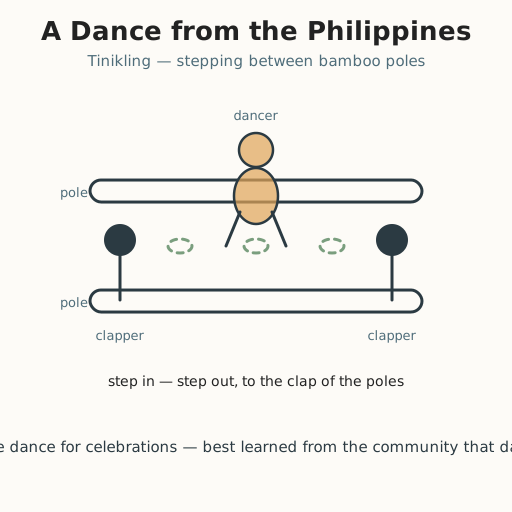
Lesson 6 — A Dance from Another Culture
Summary
Learners learn a simple, openly-taught dance from another culture — tinikling, the national folk dance of the Philippines, in which dancers step in and out between two tapping bamboo poles, imitating the tikling bird stepping between grass stems. They practice the foot pattern over marked lines, perform it in time, and describe its meaning and occasion — honoring it as a living tradition, not a costume.
Objectives
- Learn and perform a simple dance or movement form from another culture and describe its meaning or occasion. (D07.S3.04.01)
Connection
Dance is a way a people tells who they are. In the Philippines, dancers step lightly between two long bamboo poles that clap together in rhythm, the way the quick-footed tikling bird steps between grass stems and rice-plant traps. People dance tinikling at fiestas, school days, and celebrations — it is joyful, shared, and very much alive. When you learn another people’s dance, you are borrowing a story, so you treat it with care: learn the real steps, know what it is for, and remember the deepest lesson comes from the people who dance it every day.
Materials
- Video or images of a simple dance form (tinikling, or another openly-shared dance)
- Floor marks, tape, or chalk (or two sticks as “poles”)
Preparation
- Choose a short, community-made or community-approved video or image of tinikling, or prepare an accurate description. (Alternates: Mexican folklórico zapateado footwork or an Irish céilí dance — choose what you can teach accurately and respectfully.)
- Mark two parallel lines on the floor about a shoulder-width apart, or place two sticks as “poles.”
Facilitator note
This lesson is written to the learner (“you”). Teaching another culture’s dance is a responsibility: teach what is accurate, give credit, and be clear that the ideal teacher is a living dancer from that community — invite one if you can. Use a worked example for the foot pattern (Kirschner, Sweller & Clark, 2006): demonstrate “in, in, out” slowly while counting, then let learners mirror. If using real poles, clap them very slowly and flat to the ground, and never on anyone’s feet — lines of tape are the safest first step. Do not turn the dance into a costume or a caricature; the meaning (a festive bird-like stepping dance for celebration) matters more than perfect steps. A learner who uses a wheelchair or has limited mobility can perform the upper-body rhythm and arm pattern, or clap the pole rhythm — every body joins the dance. If a learner cannot step, the rhythm role is a full role, not a lesser one.
Procedure
- Gather (5 min). You have made depth, read rhythm and melody, and listened to other cultures’ music. Today you move — you learn a dance from another culture.
- Meet tinikling (10 min). Watch or read about tinikling. Dancers step in and out between two bamboo poles that two clappers tap together in a steady three-beat rhythm. The dance imitates the tikling bird stepping lightly between grass stems. Its occasion is celebration — fiestas, gatherings, school days.
- Learn the feet (15 min). Stand beside your two marked lines. Count the beat slowly and practice the step: in, in, out — step between the lines, step between the lines, step outside. Watch a partner or the group first, then try it yourself. Keep your feet light and quick, like a bird.
- Perform it (10 min). With a partner or small group, perform the pattern in time — one or two people clap the three-beat rhythm while you step. Take turns: dancer, clapper, dancer, clapper.
- Close (5 min). Describe it back: what dance did you learn, and what is its meaning and occasion? Remember — it belongs to a living people, and learning it is a way of saying “I honor your story.”
Differentiation
- Support: Practice the step at half speed with a strong verbal count; step over a single line first, then two.
- Support (mobility): Perform the upper-body rhythm or the pole-clapping rhythm — a full role in the dance.
- Extension: Add a second movement (an arm wave or a clap on the “out” step) and teach the whole pattern to a partner.
Assessment
- Formative (observation): Does the learner perform a simple movement form in time and describe its meaning or occasion?
- Performance (peer): A partner checks the step pattern against the beat and names the dance’s occasion.
Home connection
At home, show someone the tinikling foot pattern over two lines and tell them what the dance imitates and when it is danced. Ask if they know a dance from their own culture and what it means.
Resources
- National Commission for Culture and the Arts (Philippines) — Philippine folk dance: https://ncca.gov.ph/
- UNESCO Intangible Cultural Heritage — performing arts: https://ich.unesco.org/en/lists