Lesson 10 — The Living Arts Celebration
Learners celebrate and review the whole unit in a living-arts sharing: they display their depth artwork, perform their notation rhythms and melodies, share their dance and character, and show their design prototype. They reflect on the unit's big ideas — craft deepens expression, and other cultures' arts are living traditions to honor with a respectful question.
Objectives
Objectives
- D07.S1.04.01 Create an artwork that shows depth or space by overlapping, size, or placement.
- D07.S1.04.02 Identify the subject, materials, and likely purpose of an artwork from another culture and name one respectful question about it.
- D07.S2.04.01 Read and play or sing a simple melody or rhythm from basic notation.
- D07.S2.04.02 Describe how the music of another culture uses its own instruments, scales, or rhythms, and name one respectful question about it.
- D07.S3.04.01 Learn and perform a simple dance or movement form from another culture and describe its meaning or occasion.
- D07.S3.04.02 Create a character using voice, body, and a simple prop or costume, and explain what they chose to communicate.
- D07.S4.04.01 Design and make something for a specific user and need, and gather feedback to improve it.
- D07.S4.04.02 Explain how an object from another culture reflects that culture's materials, needs, and ideas.
Essential question
What did I make, and what did I learn about honoring the living arts?
Key vocabulary
Materials
Standard materials
- Learners' work from the unit · per learner Depth artworks, rhythm and melody cards, dance steps, characters, and prototypes
- Display space and labels · 1 set A table, wall, or floor space with simple labels for each station
Low-tech / no-cost
- Works shared by showing and telling Hold up, perform, or describe each work; no display boards needed
- A circle for sharing Gather in a circle to perform and reflect together
Enriched / lab & device
- A simple audio or video recording · 1 per group Record performances and reflections to keep in the portfolio
- A community-invited sharing time · 1 Invite families or community members to see and hear the work
Works in different contexts
- large-group Run four stations (see, hear, move, make) and rotate small groups through, then gather for reflection
- multi-age Older learners host each station and guide younger learners to try a small part of each art
- self-directed A learner arranges their own mini-gallery, performs one piece, and writes a reflection on what they learned
- outdoor-only Set up stations outdoors and perform in an open circle, using the sky and ground as the gallery
Lesson 10 — The Living Arts Celebration
Summary
Learners bring the whole unit together in a living-arts celebration. In four stations — see, hear, move, make — they share their depth artwork, their read-and- played rhythms and melodies, their dance and character, and their design prototype. They finish by reflecting on the unit’s two big ideas: craft deepens expression, and the arts of other cultures are living traditions to honor with a respectful question.
Objectives
- Create an artwork that shows depth or space by overlapping, size, or placement. (D07.S1.04.01)
- Identify the subject, materials, and likely purpose of an artwork from another culture and name one respectful question about it. (D07.S1.04.02)
- Read and play or sing a simple melody or rhythm from basic notation. (D07.S2.04.01)
- Describe how the music of another culture uses its own instruments, scales, or rhythms, and name one respectful question about it. (D07.S2.04.02)
- Learn and perform a simple dance or movement form from another culture and describe its meaning or occasion. (D07.S3.04.01)
- Create a character using voice, body, and a simple prop or costume, and explain what they chose to communicate. (D07.S3.04.02)
- Design and make something for a specific user and need, and gather feedback to improve it. (D07.S4.04.01)
- Explain how an object from another culture reflects that culture’s materials, needs, and ideas. (D07.S4.04.02)
Connection
All around the world, people end their work with a celebration — a harvest feast, a festival, a market day where everyone shows what they made and taught each other. A celebration is not the opposite of work; it is the part where work is shared, and sharing is how knowledge travels. Today is that day for you: you show what you made, you see what others made, and you remember what you learned about honoring the living arts of every people.
Materials
- Learners’ work from the unit (depth artworks, rhythm and melody cards, dance steps, characters, prototypes)
- Display space and labels
Preparation
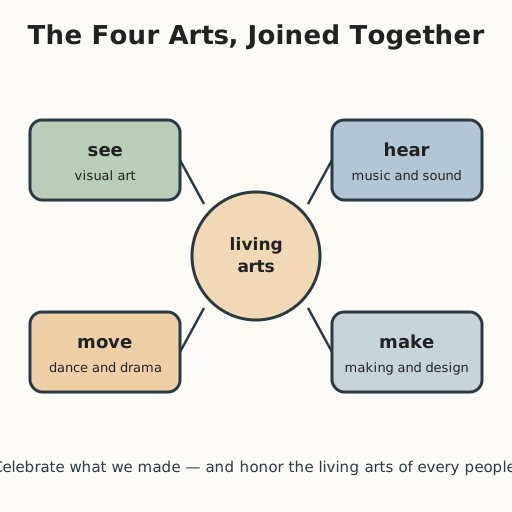
- Set up four stations — see (visual art), hear (music and sound), move (dance and drama), and make (making and design) — with learners’ work and simple labels.
- Prepare a short reflection prompt: “One thing I made, one thing I learned about another culture’s art, and one respectful question I still have.”
Facilitator note
This lesson is written to the learner (“you”). It is both a celebration and a
summative review, so use it to retrieve the unit’s key ideas (retrieval practice):
ask learners to name the three depth tricks, read a rhythm aloud, describe one
culture’s music or dance, and recall the design cycle. Keep the tone celebratory and
non-competitive — this is a gallery and a sharing, never a contest or ranking
(docs/philosophy.md §8). Each learner shares at least one thing; a learner who is
shy may share through a partner or by placing their work with a written label. Honor
the unit’s cross-cultural thread explicitly: invite learners to restate one respectful
question they asked, and to say why learning from a living community matters more
than borrowing about it. Capture the work in the portfolio — photos, recordings, or
written reflections — so the unit’s artifacts endure.
Procedure
- Gather and remember (10 min). In a circle, look at the celebration graphic — four arts around one center. Quickly remember together: What were the three ways to show depth? What did “ta” and “ti-ti” mean? What dance did you learn, and what did it imitate? What are the five design steps?
- Visit the four stations (25 min). Move through the stations in small groups:
- See: show your depth artwork and point to where you used overlap, size, and placement.
- Hear: clap or sing one rhythm or melody you read from notation.
- Move: perform your dance step or your character, and tell its meaning.
- Make: show your prototype and say what your user’s feedback changed. At each station, share and look at others’ work with curiosity and kindness.
- Honor the living arts (10 min). Gather again. Say one thing you learned about another culture’s art, music, dance, or object — and one respectful question you still have. Why is it better to learn from a living community than to just borrow about it?
- Reflect and close (15 min). Write or say your reflection: one thing you made, one thing you learned about another culture’s art, and one respectful question you still have. Place your work in your portfolio. Remember: you are a maker now — and a guest who honors the makers of the world.
Differentiation
- Support: Provide a reflection sentence frame (“I made…, I learned…, I wonder…”) and let the learner share at one station rather than all four.
- Extension: Write a short “artist’s note” for one work explaining the choices you made, and present it aloud to the group.
- Support (non-speaking): Share work by pointing, performing, or placing it with a drawn or written label; a partner reads the label aloud.
Assessment
- Summative (portfolio): The unit’s artifacts — depth artwork, notation card, dance or character performance, design prototype, and reflective note — gathered in the portfolio.
- Self (reflection): The learner’s written or spoken reflection naming one thing made, one thing learned about another culture’s art, and one respectful question.
Home connection
At home, hold a small family gallery: show your favorite work from the unit, perform one piece, and tell your family one respectful question you learned to ask about another culture’s art.
Resources
- UNESCO Intangible Cultural Heritage — the living heritage people practice and pass on: https://ich.unesco.org/en/lists