Lesson 09 — An Object's Story
Learners read an object the way they read a story. They study objects from more than one culture — a woven flax basket, a gourd calabash, an Andean cloth — and explain how each reflects its culture's materials, needs, and ideas, honoring the people and places that shaped it.
Objectives
Objectives
- D07.S4.04.02 Explain how an object from another culture reflects that culture's materials, needs, and ideas.
Essential question
How does an object reflect the materials, needs, and ideas of its culture?
Key vocabulary
Materials
Standard materials
- Images or real examples of objects from more than one culture · 1 set E.g., a Māori kete (woven flax basket), a gourd calabash, an Andean woven cloth, a Japanese paper lantern
- Object-story frame · per learner Boxes for materials, needs, and ideas
Low-tech / no-cost
- A local handmade object A basket, pot, tool, or cloth from your own community to study the same way
- Drawings and talk Draw the object and tell its story with a partner; no images needed
Enriched / lab & device
- A museum or online collection (used respectfully) · 1 Community-approved images with the makers' own words where possible
- A visiting maker or elder (invited respectfully) · 1 Learn an object's story straight from its people
Works in different contexts
- large-group Study one object together and fill the frame on the board, then pairs study a second object
- multi-age Older learners write the three-part story; younger learners point to the material and say what the object is for
- self-directed A learner studies one object, fills the materials-needs-ideas frame, and explains its story to someone
- outdoor-only Study a local handmade object or one you can draw in the dirt, and tell its three-part story aloud
Lesson 9 — An Object’s Story
Summary
Learners discover that every designed object tells a story about its place. Using a three-part frame — materials (what it is made of), needs (what it is for), and ideas (what it means) — they study objects from more than one culture, such as a Māori woven flax basket, a gourd calabash, and an Andean woven cloth, and explain how each reflects the culture that made it.
Objectives
- Explain how an object from another culture reflects that culture’s materials, needs, and ideas. (D07.S4.04.02)
Connection
An object is never just a thing — it is an answer to a place. A woven basket is made of what grows nearby and is shaped for what people must carry. A dried gourd becomes a bowl, a cup, or a rattle because it is light, hollow, and everywhere in a hot, dry place. A thick woolen cloth tells you the maker’s home is cold and that they herd animals, and its patterns carry the weaver’s community and beliefs. Read an object carefully and you can hear the land, the weather, and the people who made it.
Materials
- Images or real examples of objects from more than one culture
- Object-story frame (materials, needs, ideas)
Preparation
- Choose a few objects to study — for example, a Māori kete (a basket woven from harakeke, New Zealand flax), a gourd calabash (used as bowl, cup, or rattle across many regions), and an Andean woven cloth (llama or alpaca wool with natural dyes). Prefer images and accounts from the communities or cultural institutions.
- Copy an object-story frame for each learner.
Facilitator note
This lesson is written to the learner (“you”). Like Lessons 2 and 5, it carries the “living heritage” stance: objects are read with respect, not labeled “primitive” or “clever-for-them.” Model the skill with a worked example — take one object and name its materials (flax leaves), its needs (carrying and storing food), and its ideas (weaving patterns and protocols that carry care for the plant and the community). Then have learners do the same. Use neutral, accurate language and give credit to the specific culture by name. Remind learners that an object’s “ideas” can include beliefs, stories, or values we must ask about rather than assume. If a local elder or maker can share an object’s true story, invite them — that is the most faithful source. The goal is that a learner can say, in three clear parts, why this object looks the way it does.
Procedure
- Gather (5 min). You designed something for a user last time. Today you read objects other people have designed — and each one tells a story.
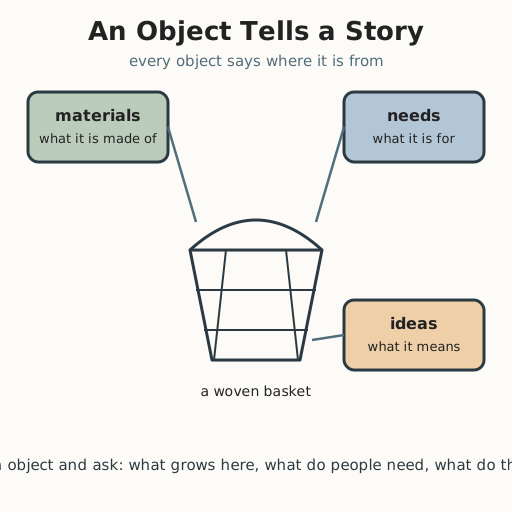
- Meet the three-part frame (10 min). Look at the graphic. Every object can be
read in three parts:
- Materials: what is it made of? (What grows or is found nearby?)
- Needs: what is it for? (What problem did it solve?)
- Ideas: what does it mean? (What beliefs, stories, or values does it carry?)
- Read a worked example (10 min). A Māori kete basket is woven from harakeke (New Zealand flax), a plant that grows there — that is its material. It is used for carrying and storing food — that is its need. Its weaving patterns and the respectful way the plant is cut carry the community’s care and knowledge — that is its idea. See how the object reflects its place?
- Read another object (15 min). Choose a gourd calabash or an Andean cloth. Fill your frame: What is it made of, and why is that material available? What need does it serve? What ideas — beliefs, stories, values — does it carry? Write one sentence for each part.
- Close (5 min). Share your three-part story. An object is a message from its place: what grows there, what people need, and what they value.
Differentiation
- Support: Offer a word bank (plant, wool, gourd, carry, store, keep warm, care, community) and sentence starters for each part.
- Extension: Study a fourth object and compare how two different cultures solve the same need (e.g., carrying water) with different materials.
- Support (non-speaking): Point to the material, act out the need, and point to a symbol for the idea.
Assessment
- Formative (observation): Does the learner explain an object’s materials, needs, and ideas, connecting each to the culture that made it?
- Artifact (portfolio): The completed object-story frame.
Home connection
At home, choose one everyday object and tell its three-part story with a grown-up: what is it made of, what is it for, and what idea or value does it show? Then wonder how another culture might meet the same need with different materials.
Resources
- Te Papa Tongarewa (Museum of New Zealand) — Māori taonga and weaving: https://www.tepapa.govt.nz/
- The Metropolitan Museum of Art, Heilbrunn Timeline of Art History: https://www.metmuseum.org/toah/