Lesson 01 — Reading a Food Label
Learners open the unit by reading a simplified nutrition label: they name its parts — serving size, energy, sugar, salt, and fiber — and say what each one tells them about the food. The label is taught as a tool for information, never for judging a body or a way of eating.
Objectives
Objectives
- D03.S3.04.01 Read simple nutrition information on food packages and use it to make a healthier choice.
Essential question
What information is on a food package, and what does each part tell me?
Key vocabulary
Materials
Standard materials
- A sample nutrition label chart · 1 A large, simplified nutrition label with serving size, energy, sugar, salt, and fiber circled in different shapes (shape, not only color)
- Empty or real food packages · a few Cleaned, real packages (or printed pictures) from many kinds of food — grains, fruits, legumes, dairy — to point at and practice reading
- Paper and pencils · per learner To copy the parts of a label and draw one food package label
Low-tech / no-cost
- A hand-drawn label Draw a big nutrition label in the dirt, on a board, or on paper, with the five parts labeled by hand
- Voice and memory Name the five parts aloud and recall a food package from home; no printed labels needed
Enriched / lab & device
- Real food packages for a class label hunt · 1 set A small collection of clean packages from many world cuisines to read and compare side by side
- A magnifying glass or tablet camera · 1 per pair To zoom in on small print on real labels, or photograph a label to enlarge it
Works in different contexts
- large-group Show one big label chart and read each part together, then send pairs to hunt for the same parts on their own package
- self-directed A learner reads the label chart, copies the five parts into a notebook, then finds the same parts on one real or remembered package
- outdoor-only Draw the label chart large on the ground with chalk or sticks and step to each part as it is named; recall packages from home or the market
- multi-age Older learners read the small print on real packages aloud while younger learners point to the matching part on the big chart
- level-grouped Learners who already know the parts teach them back and read real packages; others match each part name to its place on the chart with a helper
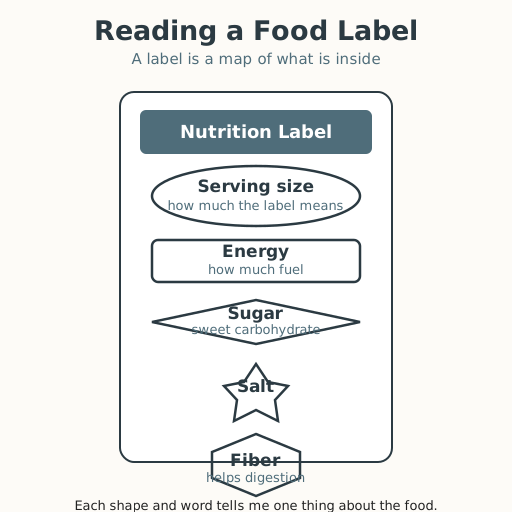
Lesson 1 — Reading a Food Label
Summary
Learners open the unit by reading a simplified nutrition label. They name its parts — serving size, energy, sugar, salt, and fiber — and say what each one tells them about a food. The label is taught as a tool for information, never for judging a body or a way of eating.
Objectives
- Read simple nutrition information on food packages, naming the parts of a label and what each tells us. (D03.S3.04.01)
Connection
Most packaged foods have a small box of writing on the back or side — a nutrition label. You have probably seen one on a bag, a box, or a tin at home or in a market, even if you never stopped to read it. That little box is a map: it tells you what is inside the food, so you can make your own choices. Today you will learn to read that map.
Materials
- A large sample nutrition label chart (serving size, energy, sugar, salt, fiber)
- A few cleaned, real food packages (or printed pictures) from many kinds of food
- Paper and pencils
Preparation
- Draw or print a large, simplified nutrition label with five parts circled: serving size, energy, sugar, salt, and fiber. Use a different shape (circle, square, diamond, star, triangle) around each part, not only color, so it reads clearly in grayscale.
- Gather a few clean food packages from different cuisines.
- Set the tone: a label gives information, never shame. No food and no body is “bad.”
Facilitator note
This lesson is written to the learner (“you”). The label is a tool for information, never for judging. Teach the five parts plainly: serving size (how much the label is talking about), energy (calories/kcal — how much fuel), sugar (a kind of carbohydrate, often sweet), salt (sodium), and fiber (part of plant food that helps digestion). Do not rank foods as “good” or “bad,” and do not connect any number on the label to a body’s size or worth. Different bodies and different lives need different amounts, and a food is not a person. Honor that not every learner has packaged food at home, and that fresh, home-cooked, and market food often has no label at all — that is normal and fine. A learner who is blind or has low vision reads the label by having the parts described in order and by feeling raised shapes on the chart; a learner who does not use a speaking voice points to each part; a learner who is deaf or hard of hearing follows the chart and demonstrations from the front, since every part is shown, not only told. The nutrition facts reflect widely used labeling (energy, sugar, salt, fiber, and serving size), as described in World Health Organization guidance on food labels. This lesson opens the unit’s D03.S3.04.01 label-reading path and leads into choosing a healthier option.
Procedure
- Gather (5 min). Think of a packaged food you have seen — a bag of rice, a box of cereal, a tin of beans, a packet of biscuits. Did you ever notice the small box of writing on it? That is a nutrition label, and it is a map of what is inside.
- Meet the five parts (15 min). Look at the big label. A label usually tells you five things. The serving size says how much of the food the label is talking about. Energy (calories) says how much fuel the food gives your body. Sugar is a kind of carbohydrate that tastes sweet. Salt (sodium) is the mineral that makes food salty. Fiber is the part of plant foods that helps your digestion work well. Point to each part as we name it.
- Say what each part tells you (10 min). Match the part to its job: serving size tells you how much; energy tells you how much fuel; sugar and salt are things to notice; fiber is something many bodies need more of. Tell a partner one part and what it tells you.
- Label hunt (10 min). Take a real package (or a remembered one). Can you find the serving size? The energy? The sugar, salt, and fiber? Point to each one. If your food has no label — fresh fruit, home-cooked food — say so: that is normal, and you can still know it is a healthy part of your day.
- Close (5 min). Say it together: “A nutrition label is a map. I can read serving size, energy, sugar, salt, and fiber — and use them to make my own choices.”
Differentiation
- Support: Introduce one or two parts at a time (serving size and energy first); accept spoken, pointed, or drawn answers.
- Support (non-speaking): Point to each part on the chart and match part cards to their places.
- Support (blind/low-vision): Hear each part named in order and feel raised shapes on the chart; repeat the names and jobs aloud.
- Extension: Read the label on a real package from home and name all five parts, plus one more thing the label lists (such as protein or fat).
Assessment
- Formative (observation): Can the learner point to and name the parts of a simplified label and say, in their own way, what one part tells them?
- Self: The learner names the part they can now read and one food whose label they want to check next.
Home connection
With a grown-up, find one packaged food at home and read the label together. Point to the serving size, energy, sugar, salt, and fiber, and name what each one tells you.
Resources
- World Health Organization, “Nutrition labelling” and “Healthy diet” (what labels show and why they help people choose): https://www.who.int/news-room/fact-sheets/detail/healthy-diet
- Food and Agriculture Organization of the United Nations, “Food labelling” (information on food packages): https://www.fao.org/food-labelling/en