Lesson 02 — Choosing a Healthier Option
Learners use the label-reading skill from Lesson 1 to compare two similar foods and make a healthier choice. They practice a simple rule — more fiber, and less added sugar and salt — through worked examples and guided practice, always as information for themselves, never as a judgment of a food or a body.
Objectives
Objectives
- D03.S3.04.01 Read simple nutrition information on food packages and use it to make a healthier choice.
Essential question
How do I use a food label to make a healthier choice between two foods?
Key vocabulary
Materials
Standard materials
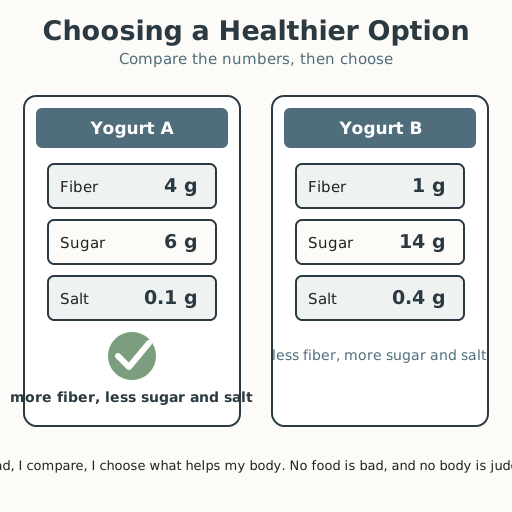
- Two side-by-side sample labels · 1 Two simplified labels for a similar food (e.g., two yogurts or two snacks) that differ in sugar, salt, and fiber, drawn large
- A "choose" worksheet · per learner Two labels plus a sentence frame — "I would choose ___ because it has ___."
- Paper and pencils · per learner
Low-tech / no-cost
- Two remembered foods Name two foods your family eats and compare them aloud — more fiber, less salt — with no worksheet
- A hand-drawn comparison Draw two simple labels in the dirt or on paper and circle the differences
Enriched / lab & device
- Real pairs of food packages · 1 set Pairs of similar foods (two yogurts, two breads, two juices) from many cuisines, to read and compare in small groups
- A class "healthier choice" chart · 1 A reusable chart to record each pair and the class's reasons for choosing
Works in different contexts
- large-group Compare one pair together at the front, then send pairs to compare a second pair and share their reason
- self-directed A learner reads two labels, fills the sentence frame, and checks their choice against the "more fiber, less added sugar and salt" rule
- outdoor-only Draw two labels on the ground and stand beside the one you would choose, then say why; no paper needed
- multi-age Older learners scribe the reasons while younger learners point to the number that is higher or lower
- level-grouped Learners who can compare on their own do a third pair; others compare with a partner and the sentence frame
Lesson 2 — Choosing a Healthier Option
Summary
Learners use the label-reading skill from Lesson 1 to compare two similar foods and make a healthier choice. They practice a simple rule — more fiber, and less added sugar and salt — through worked examples and guided practice. The choice is always information for themselves, never a judgment of a food, a family, or a body.
Objectives
- Read simple nutrition information on food packages and use it to make a healthier choice between two foods. (D03.S3.04.01)
Connection
Last time you learned to read a label like a map. Now you get to use the map. When two foods look alike on the shelf — two yogurts, two breads, two juices — the label helps you notice what is different inside them, so you can choose the one that serves your body better. Choosing is not about being “good” or “bad”; it is about picking what helps you.
Materials
- Two side-by-side sample labels (a similar pair of foods that differ in sugar, salt, and fiber)
- A “choose” worksheet with the sentence frame “I would choose ___ because it has ___.”
- Paper and pencils
Preparation
- Prepare two large, simplified labels for a similar pair of foods (for example, two yogurts: one higher in fiber and lower in sugar and salt, one the reverse). Keep the numbers simple and round.
- Prepare the sentence frame and, for enrichment, pairs of real packages.
- Reaffirm the no-shame tone: a “healthier choice” is information for one’s own body, never a verdict on anyone.
Facilitator note
This lesson is written to the learner (“you”). Model the comparison step-by-step before independent work (a worked example for a new skill): read the serving size of both, compare fiber, compare sugar, compare salt, then decide. The rule is gentle and honest: for many bodies, more fiber and less added sugar and salt is a helpful direction — but no single food is “bad,” a treat now and then is a normal part of life, and different bodies, budgets, and lives make different choices, all worthy of respect. Never let the lesson slide into ranking a learner, a family, or a body by what they eat; the choice is about the food’s label, not the person. Honor food scarcity: a family that eats what is available and affordable is not making a “wrong” choice — access is not the same as preference, and every fed child is a win. A learner who is blind or has low vision compares by hearing the numbers read in the same order each time; a learner who does not use a speaking voice points to the label or fills the frame on a card; a learner who is deaf or hard of hearing follows the side-by-side labels and the demonstration, since every step is shown. This lesson practices D03.S3.04.01 toward mastery and leads into the cultural-foodways lessons that follow.
Procedure
- Gather (5 min). Remember the five parts of a label: serving size, energy, sugar, salt, and fiber. Today you will use them to compare two foods and choose.
- Watch a worked example (10 min). Look at the two labels. First read the serving size of both — are they the same amount? Next compare fiber: which has more? Then compare sugar and salt: which has less? A helpful choice for most bodies is the one with more fiber and less added sugar and salt. Watch and follow as we do the first pair together.
- Guided practice (15 min). With a partner, do a second pair the same way: read the serving size, compare fiber, compare sugar, compare salt. Decide together and say why using the frame: “I would choose ___ because it has ___.”
- Your own choice (10 min). Do one more pair on your own. Fill in the frame and check yourself: did you compare all three — fiber, sugar, salt — before deciding?
- Close (5 min). Say it together: “I read the label, I compare, and I choose what helps my body. No food is bad, and no body is judged.”
Differentiation
- Support: Compare only one thing at a time (fiber first); model the sentence frame and accept spoken, pointed, or drawn answers.
- Support (non-speaking): Point to the label that has more fiber or less sugar, and build the sentence from word cards.
- Support (blind/low-vision): Hear the numbers read in the same order and repeat the comparison aloud.
- Extension: Compare a third pair and explain how serving size matters — why you must check that both labels are talking about the same amount before comparing.
Assessment
- Formative (observation): Can the learner compare two labels and name a healthier choice with a reason (more fiber, less added sugar or salt)?
- Self: The learner names the rule (“more fiber, less added sugar and salt”) and one choice they made today.
Home connection
At home, compare two similar foods your family has (or remembers) — two breads, two juices, two snacks. Which has more fiber? Which has less added sugar or salt? Tell a grown-up your choice and why.
Resources
- World Health Organization, “Healthy diet” (the direction of more fiber and less added sugar and salt): https://www.who.int/news-room/fact-sheets/detail/healthy-diet