Lesson 03 — Many Healthy Tables
Learners discover that there is no single "right" healthy meal: families and cultures around the world eat many different healthy foods. They meet several world cuisines, add their own family's foods to a class chart, and learn to describe and honor many ways of eating well.
Objectives
Objectives
- D03.S3.04.02 Describe how different families and cultures eat different healthy foods, and treat every way of eating with respect.
Essential question
How do different families and cultures eat different healthy foods?
Key vocabulary
Materials
Standard materials
- "Many healthy tables" picture cards · 1 set Pictures of varied healthy meals from around the world — a rice-and-vegetable bowl, an injera platter with lentils, tortillas with beans, a fish-and-vegetable stew, noodles with greens — each labeled
- A large "our healthy tables" chart · 1 Columns to record the foods each family in the class eats that keep them well
- Paper and crayons · per learner To draw one healthy meal from the learner's own family or culture
Low-tech / no-cost
- Voice and memory Each learner names a healthy food their family eats; no cards needed
- A drawn "world table" Draw one long table in the dirt or on paper and add each family's food to it by drawing or naming
Enriched / lab & device
- A "foods of the world" picture book · 1 A book showing healthy meals and ways of eating across many countries and communities
- A class "world of food" wall map · 1 A map to place each food near the place it is eaten, honoring many regions
Works in different contexts
- large-group Show each picture card and record foods on the class chart, then let pairs share one food from their own home
- self-directed A learner studies the cards, draws one meal from their own family, and writes or tells why it is healthy
- outdoor-only Build a "world table" on the ground — each learner adds a remembered food by drawing with a stick or placing a leaf, and names why it is healthy
- multi-age Older learners scribe the class chart while younger learners point to and name foods on the cards
- level-grouped Learners who can explain why a meal is healthy teach it back; others match each food to its picture
Lesson 3 — Many Healthy Tables
Summary
Learners discover that there is no single “right” healthy meal: families and cultures around the world eat many different healthy foods. They meet several world cuisines, add their own family’s foods to a class chart, and learn to describe and honor many ways of eating well.
Objectives
- Describe how different families and cultures eat different healthy foods, and treat every way of eating with respect. (D03.S3.04.02)
Connection
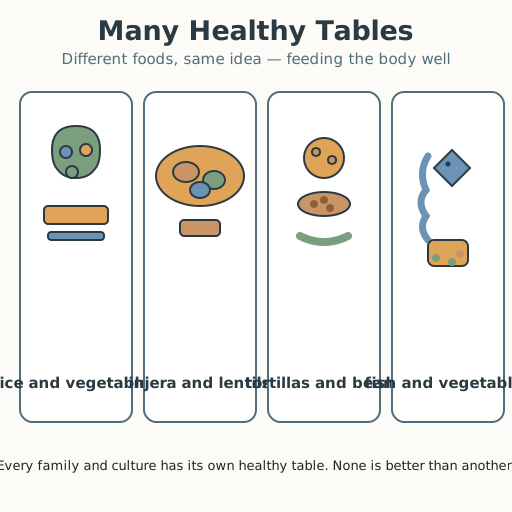
Picture a healthy meal. Maybe you pictured rice and beans, or noodles and greens, or bread and lentil stew, or fish and vegetables. There is no one right answer — and that is the wonderful thing. Every family and culture has its own healthy table, built from the foods of its land, its history, and its traditions. Today you will see many of them.
Materials
- “Many healthy tables” picture cards (varied healthy meals from around the world)
- A large “our healthy tables” chart
- Paper and crayons
Preparation
- Prepare the picture cards showing varied healthy meals (a rice-and-vegetable bowl, an injera platter with lentils, tortillas with beans, a fish-and-vegetable stew, noodles with greens) — all different, all healthy, none ranked above another.
- Prepare the class chart and set a warm, respectful tone for sharing family foods.
Facilitator note
This lesson is written to the learner (“you”). There is no single correct healthy meal, and no culture’s food is better than another’s. Teach that what makes a meal healthy is that it feeds the body well — a mix of grains or roots, vegetables or fruits, and protein — and that every cuisine has its own beautiful way of doing this. Honor that some families grow, gather, fish, or herd their food, and some buy it; all are worthy. Be careful never to let “healthy” become a weapon: do not shame any food a learner’s family eats, and remember that scarcity is real — a family may not always have a full “balanced” plate, and that is a question of access, never of worth. A learner who is blind or has low vision learns the meals by having each one described and named; a learner who does not use a speaking voice points to a card or draws their family’s food; a learner who is deaf or hard of hearing follows the cards and the chart from the front, since every food is shown, not only told. The framing that healthy diets appear in many food cultures reflects FAO and WHO accounts that all regions have healthy traditional dietary patterns. This lesson opens D03.S3.04.02 and leads into treating every way of eating with respect.
Procedure
- Gather (5 min). Think of one healthy meal your family makes. There are millions of different answers, and every one of them can be right.
- Meet the world’s tables (15 min). Look at each picture card and name what you see: a rice and vegetable bowl, an injera platter with lentils, tortillas with beans, a fish and vegetable stew, noodles with greens. These come from different lands and different cultures — the shared foods, stories, and ways of a people. Each one gives the body grains or roots, vegetables or fruit, and protein. All are healthy; none is better than the others.
- Why are they all healthy? (10 min). A healthy meal feeds the body well. Point to the grain or root in each picture, the vegetable or fruit, and the protein. Say what you notice: different foods, same idea — feeding the body well. Tell a partner one meal and what makes it healthy.
- Add your own table (10 min). Draw one healthy meal your own family or culture eats. Then add it to the class chart — our room now holds many healthy tables from many homes.
- Close (5 min). Say it together: “There are many healthy tables in the world. Every family’s way of eating deserves respect.”
Differentiation
- Support: Look at two or three cards first and name one food in each; accept spoken, drawn, or pointed answers.
- Support (non-speaking): Point to a food on a card and to your drawing of your own family’s meal.
- Support (blind/low-vision): Hear each meal described in words and name the grain, vegetable, and protein in each.
- Extension: Name the country or community a card’s meal comes from, and describe one more healthy dish from that same culture.
Assessment
- Formative (observation): Can the learner describe two different healthy meals from different cultures and say, in their own way, why both are healthy?
- Portfolio: The learner’s drawing of their family’s healthy meal, kept in the unit portfolio.
- Self: The learner names one new food they saw today and one healthy meal from their own home.
Home connection
At your next meal, name what is on your family’s table and tell a grown-up how it feeds your body — the grain or root, the vegetable or fruit, and the protein. Then ask a grown-up about a meal from their own childhood.
Resources
- Food and Agriculture Organization of the United Nations, “Healthy diets” (healthy traditional dietary patterns exist in every region): https://www.fao.org/nutrition/education/food-dietary-guidelines/en/
- World Health Organization, “Healthy diet” (what a healthy diet includes): https://www.who.int/news-room/fact-sheets/detail/healthy-diet